
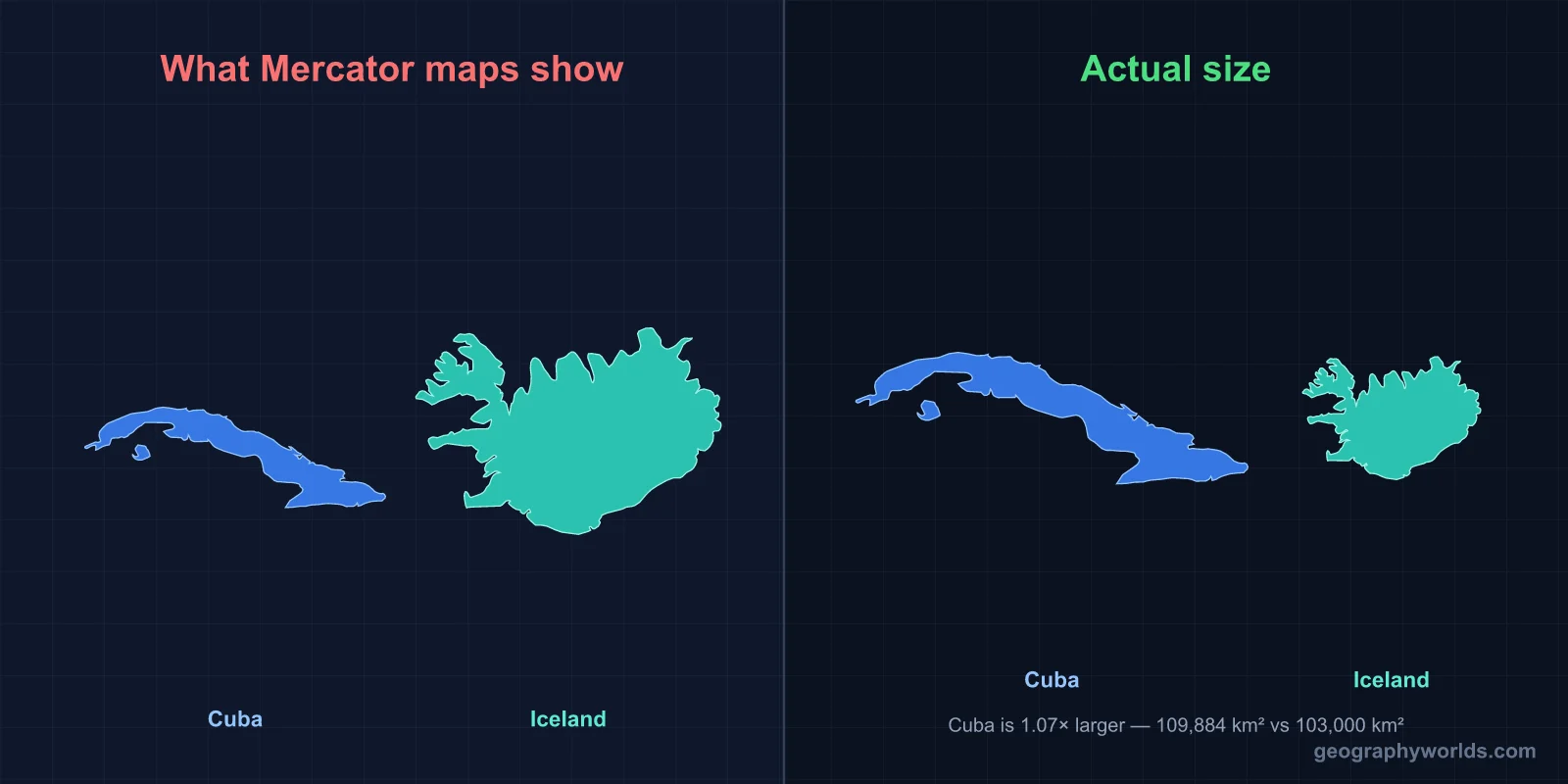
Yes. Cuba is slightly larger than Iceland. Cuba covers 109,884 km², while Iceland covers 103,000 km². Cuba is about 1.07 times the size of Iceland — larger by 6,884 km², about the size of Luxembourg or Brunei. But Cuba has more than 28 times more people than Iceland (11 million vs 390,000).
The Short Answer
Cuba and Iceland are two of the world's most famous island nations, but they're in completely different climate zones and cultural worlds. Cuba is the largest island in the Caribbean and a tropical nation just 145 km from Florida. Iceland is a subarctic island in the North Atlantic, sitting on the Mid-Atlantic Ridge between Europe and Greenland.
Both are sovereign island nations and globally recognized — Cuba for its complex relationship with the United States, Spanish-language culture, and music; Iceland for its dramatic landscapes, geothermal activity, and quality of life. Despite similar physical sizes, they're profoundly different countries.

The Real Numbers
- Cuba total area: 109,884 km² (42,426 sq mi)
- Iceland total area: 103,000 km² (39,769 sq mi)
- Difference: 6,884 km² — about the size of Luxembourg or Brunei
- Ratio: Cuba is about 1.07× the size of Iceland
Population
Cuba has dramatically more people:
- Cuba population: ~11,000,000
- Iceland population: ~390,000
- Cuba density: ~100 people per km²
- Iceland density: ~3.8 people per km²
Cuba has 28× more people than Iceland. Cuban density is about 26× higher. Iceland is one of the most sparsely populated countries in the world — comparable to Mongolia or Greenland.
Geography
Cuba is a tropical island in the Caribbean. Major features:
- Coastline: 3,735 km of Caribbean coast
- Sierra Maestra mountains: Eastern Cuba, including Pico Turquino (1,974 m) — Cuba's highest peak
- Tropical plains: Most of Cuba is relatively flat
- Beaches: Famous beaches at Varadero, Holguín, and along the eastern coast
- Underground caves: Including the Bellamar Caves
Iceland is a subarctic island shaped by volcanic and glacial activity:
- Volcanoes: About 30 active volcanic systems
- Glaciers: Cover about 11% of the country
- Hot springs and geysers: Including the original Geysir
- Coast: Heavily indented with fjords and dramatic coastline
- Highest peak: Hvannadalshnúkur (2,110 m)
Climate
Cuba has tropical climate. Temperatures stay between 22-32°C year-round. Hurricane season runs from June to November. Cuba is exposed to major Caribbean hurricanes that occasionally cause significant damage.
Iceland has subarctic to maritime polar climate. Coastal temperatures are moderated by the Gulf Stream — Reykjavík averages 0°C in winter and 11°C in summer. Snow is common in winter. Iceland's climate is much milder than its latitude would suggest, due to ocean currents.
Economy
Iceland is richer per capita:
- Cuba GDP: ~$100 billion (estimated)
- Iceland GDP: ~$30 billion
- Cuba per capita GDP: ~$9,500
- Iceland per capita GDP: ~$77,000
Iceland's economy is much smaller in absolute terms but per-capita GDP is 8× higher than Cuba's. Iceland's economy is based on fishing, aluminum smelting (using cheap renewable energy), tourism, and a strong service sector. Cuba's economy is centrally planned, with major sectors in tourism, nickel mining, sugar/agriculture, and pharmaceutical and biotech.
Political Systems
Cuba is a one-party communist state. The Cuban Communist Party has held power since 1959 when Fidel Castro's revolution overthrew the Batista government. Cuba's economy and politics have been heavily shaped by US sanctions and the loss of Soviet support after 1991. Recent leaders include Raúl Castro and Miguel Díaz-Canel.
Iceland is one of the world's oldest continuous parliamentary democracies. The Althing (parliament) was founded in 930 AD. Iceland is a republic with a strong tradition of social democracy. The country consistently ranks high on global quality-of-life, gender equality, and democracy indices.
Culture
Cuba has a vibrant culture blending Spanish, African, and indigenous Taíno influences. Famous Cuban exports include music (salsa, son cubano, rumba, bolero), cigars, rum, baseball, and a unique culinary tradition. Cuban-American culture has spread throughout the Americas.
Iceland has a distinctive Nordic culture rooted in Viking heritage. Iceland produced some of the world's great medieval literature (the Sagas). Modern Icelandic culture includes globally recognized musicians (Björk, Sigur Rós), films, and the Icelandic language which has remained remarkably close to Old Norse.
Tourism
Both attract significant tourism. Cuba receives about 3-4 million international tourists annually, with major draws being Havana, Varadero beaches, Trinidad, and Viñales. Tourism has been disrupted by political tensions and economic difficulties.
Iceland receives about 2 million tourists annually — about 5× the country's population. Major attractions include the Blue Lagoon, Northern Lights, geysers, glaciers, waterfalls, and the South Coast Ring Road.
Key Facts
- Cuba is about 1.07× the size of Iceland.
- Cuba has 28× more people than Iceland.
- Iceland is 8× richer per capita than Cuba.
- Cuba is the largest Caribbean island; Iceland is the world's 18th-largest island.
- Cuba is a one-party communist state; Iceland is a parliamentary democracy.
Fun Facts
- Cuba has about 4,000 islands and cays in addition to the main island.
- Iceland has more sheep than people — about 800,000 sheep vs 390,000 people.
- Cuba is home to the world's smallest bird, the bee hummingbird.
- Iceland has more hot springs and geothermal areas per square kilometer than nearly any other country.
- Cuba's 1962 missile crisis brought the world to the brink of nuclear war.
Historical Significance
Both islands have outsized historical significance for their sizes. Cuba was at the center of the Spanish empire in the Americas — Havana was a key port for ships carrying gold and silver from the Americas to Spain. Cuba's 1898 independence (with US intervention against Spain) helped shape modern Latin America. Cuba's 1959 revolution and subsequent Cold War alignment with the Soviet Union made it a focal point of 20th-century geopolitics, especially the 1962 Cuban Missile Crisis.
Iceland's historical significance includes its Viking-era founding (874 AD), one of the world's oldest continuous parliaments (the Althing, 930 AD), the production of the medieval Sagas, and its strategic Cold War position between North America and the Soviet Union. The 1986 Reykjavík Summit between Reagan and Gorbachev was a pivotal moment in ending the Cold War.
Education and Healthcare
Both countries have notable systems despite vastly different political setups. Iceland has free public education through university level and a universal healthcare system. Educational outcomes are excellent. Iceland's public spending and welfare state are among the most generous in the world relative to its small population.
Cuba famously has free education at all levels and free universal healthcare — achievements much praised internationally. Cuba has more doctors per capita than nearly any country in the world and exports medical professionals to developing countries. Cuba's educational outcomes are notable, with very high literacy rates and university enrollment.
The Bottom Line
Cuba is barely larger than Iceland by area (7%), but Cuba has 28× more people and a tropical climate. Iceland is far richer per capita and has a colder, more volcanic geography. Both are remarkable island nations with strong national identities, distinctive cultures, and significant global influence relative to their physical size. Their similar sizes coexist with completely different climatic, political, economic, and cultural contexts — making the comparison illuminating for understanding how geography alone doesn't determine destiny. Politics, economic systems, climate, and history all shape what countries become — even when the physical canvas is similar in size. Both Cuba and Iceland punch far above their geographic weight in global recognition and influence. The two countries also share an interesting characteristic: both are political identities deeply shaped by their geographic isolation as island nations. This isolation has allowed both to develop distinct cultures, languages (Icelandic preserves Old Norse remarkably well; Cuban Spanish has distinctive characteristics), and political systems. Their relative similarity in physical size makes the dramatic differences in everything else even more interesting to compare. Both also demonstrate how small island nations can develop globally recognized identities through cultural exports, distinctive political systems, and engagement with global affairs. Their stories continue to be told and retold around the world, far beyond what their modest sizes would suggest. From Cuban music influencing global pop to Icelandic creative arts gaining international acclaim, both islands contribute disproportionately to world culture. Both also face their own demographic and economic challenges that will shape their futures — Iceland's tourism-dependent economy and Cuba's transitioning post-revolutionary economy each navigate complex global dynamics. Both islands continue to surprise the world with their cultural output and resilience, proving that small countries can have outsized global impact through creative excellence and distinctive national character. Their stories are reminders that geography sets the stage but does not determine the script — humans write the histories that make places memorable.