
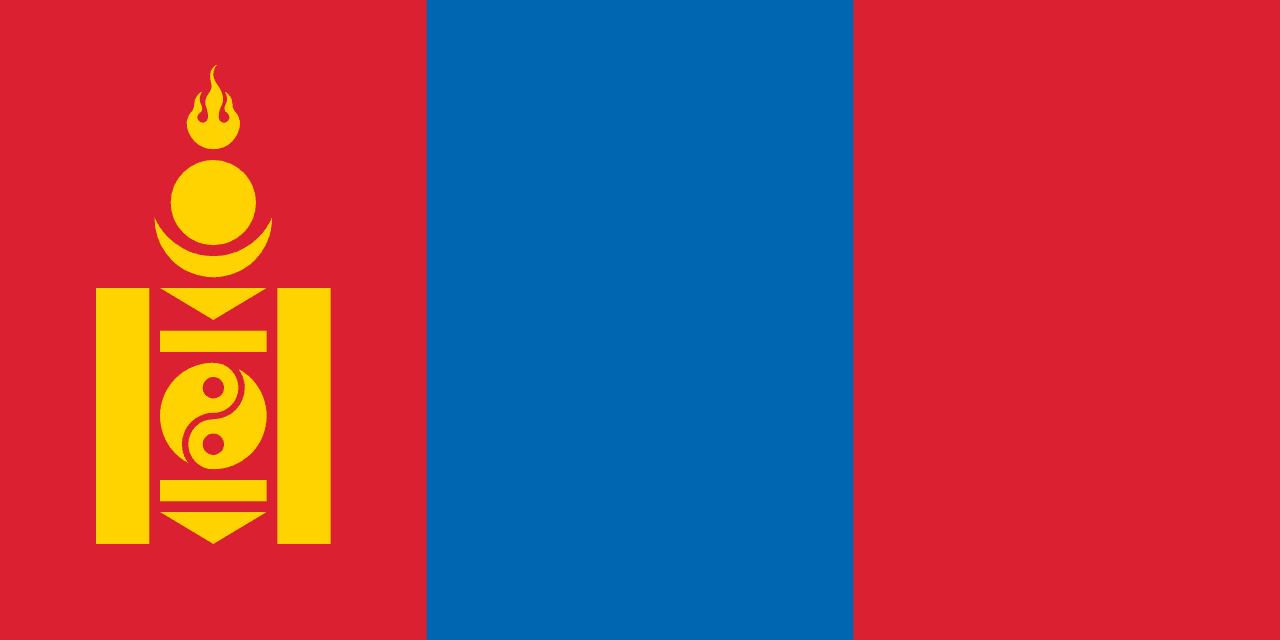
Few national flags pack as much meaning into a single strip of fabric as the flag of Mongolia. At first glance it reads as a simple red-blue-red triband, the kind of vertical arrangement you find on banners around the world. But tucked into the hoist-side red band is the Soyombo, a stacked column of geometric shapes that functions almost like a written sentence about the Mongolian nation. It is a flag that rewards a second look, because once you learn what those little marks mean, you can never see it as just three colored stripes again.
Adopted in its current form in 1992, the flag belongs to a country wedged between two giants, Russia to the north and China to the south, on the high steppe of East and Central Asia. Its design carries the weight of a long nomadic history, a Buddhist-influenced symbolic tradition, and a more recent political rebirth. This article walks through the colors, the layout, the history, the symbolism, and the way the banner lives in Mongolia today.
A Triband Built Around a Symbol
The Mongolian flag is a vertical triband: three equal bands of color running top to bottom. The two outer bands are red, and the central band is blue. Centered on the red band nearest the flagpole sits the golden Soyombo emblem, which gives the flag its unmistakable identity and keeps it from being confused with any other tricolor.
This is worth pausing on. Plenty of flags use red and blue, and a red-blue-red sequence on its own would be fairly anonymous. The decision to anchor the Soyombo in the hoist band is what makes the design distinctly Mongolian. The emblem is rendered in yellow, and its placement on red rather than blue ensures it stands out boldly even when the flag is seen from a distance or fluttering in the famously strong steppe winds.
What the Colors Mean
The palette is deliberate and rooted in how Mongolians have long understood their land and aspirations. The red bands represent progress and prosperity, a forward-looking optimism for the nation. In the harsh climate of the steppe, where winters are brutal and survival has always demanded resilience, the warmth and energy associated with red carry real cultural resonance.
The blue central band stands for the eternal sky. This is no throwaway poetic flourish. The reverence for the open blue sky, sometimes called Tengri, runs deep in Mongolian tradition and predates any modern state. To place the sky at the heart of the flag is to put one of the oldest objects of Mongolian devotion right in the center of national identity. The yellow of the Soyombo, meanwhile, ties the emblem to the country's Buddhist heritage and lends the sacred symbol a luminous, gold-like presence.
Reading the Soyombo
The Soyombo is the most fascinating part of the flag and the hardest to describe in a sentence, because it is really a vertical stack of distinct symbols, each with its own meaning. Read from the top down, the emblem contains representations of fire, the sun, the moon, earth, water, and the yin-yang figure. Together they form a compact statement of Mongolian cosmology and values.
The flame at the top traditionally signals growth, revival, and the continuation of the family and nation, with its tongues sometimes read as past, present, and future. Below it, the sun and moon evoke the heavens and the enduring life of the Mongolian people. There are also triangular shapes pointing downward, long understood as the defeat of enemies, and horizontal bars representing honesty, justice, and steadfastness. The two vertical bars flanking the column are read as walls, expressing the idea that friendship is stronger than any stone fortress. The paired yin-yang fish at the center symbolize balance and the complementary forces of the world; in Mongolian readings the ever-watchful fish, which never close their eyes, also stand for vigilance.
From Empire to Republic: A Short History
Mongolia's flag did not appear out of nowhere. The Soyombo character itself is centuries old, attributed to the tradition of a Mongolian spiritual and scholarly figure, and it became a powerful emblem of Mongolian sovereignty and Buddhist culture long before it was placed on a modern flag. When Mongolia moved through the turbulent 20th century, the Soyombo endured as a marker of national identity.
During the communist era of the 20th century, the flag carried the Soyombo together with a socialist star above it, reflecting the country's political alignment of the time. The decisive change came with the fall of communism. The current flag was restored and adopted in 1992, when the socialist star was removed, leaving the Soyombo to stand on its own atop the red-blue-red field. That single edit, dropping the star, was loaded with significance: it marked Mongolia's transition to a new democratic era while reaffirming continuity with its older national symbolism. If you want more context on the country behind the banner, our mongolia country guide goes deeper into its landscape, culture, and history.
How It Compares to Similar Flags
Red-and-blue vertical tribands are not unique to Mongolia, which makes the Soyombo all the more important as a distinguishing feature. A casual observer might momentarily confuse the basic color blocking with other tricolors, but no other national flag carries the Soyombo emblem, so recognition is essentially instant once you spot it.
It is also instructive to compare the Mongolian flag with the banners of nearby and historically connected regions. Mongolian peoples and territories beyond the modern state's borders have used the Soyombo in their own flags and emblems, reflecting shared heritage. And while the blue field on Mongolia's flag echoes the sky symbolism found in some Central Asian banners, the combination of the sky-blue center, the prosperity-red flanks, and the layered golden Soyombo produces a composition that is genuinely one of a kind. Where many flags rely on a single central charge such as a star or coat of arms, Mongolia's emblem is a miniature ideographic essay, which sets it apart from look-alike tricolors.
The Flag in Modern Mongolian Life
Today the flag is woven into civic and everyday life. It flies over government buildings in the capital, Ulaanbaatar, and appears at state ceremonies, on official documents, and across the country during national celebrations. The most prominent of these is Naadam, the great summer festival of wrestling, horse racing, and archery, where the national colors and the Soyombo are everywhere among the crowds and competitors.
The flag also travels the world with Mongolian athletes. When Mongolian wrestlers and judoka step onto international mats, the red-blue-red banner with its golden emblem becomes a compact ambassador for the country. For a nation with a relatively small population spread across an enormous land area, the flag does heavy lifting as a symbol of unity, reminding citizens at home and the diaspora abroad of a shared identity rooted in the eternal sky and the Soyombo's promise of endurance.
Quick Facts Worth Knowing
- The current flag was adopted in 1992 after the communist era ended, when the socialist star was removed from above the Soyombo.
- Its three colors are red, blue, and yellow: red for progress, blue for the eternal sky, and yellow for the sacred Soyombo emblem.
- The Soyombo packs in symbols of fire, sun, moon, earth, water, and yin-yang, a remarkable amount of meaning for one small emblem.
- Mongolia sits in Asia, landlocked between Russia and China on the high steppe.
- The two vertical bars in the Soyombo are read as fortress walls, expressing the idea that friendship is stronger than stone.
- The emblem appears on the hoist-side red band, never on the central blue band, so it always reads clearly against a warm background.
Frequently Asked Questions
When was the flag of Mongolia adopted?
The current flag was adopted in 1992. While the Soyombo emblem and the red-blue-red layout have older roots, the modern version was restored after the communist era ended, with the socialist star that had previously sat above the Soyombo removed to mark the country's democratic transition.
What do the colors of the Mongolian flag mean?
Red represents progress and prosperity, blue represents the eternal sky that holds deep significance in Mongolian tradition, and the yellow of the Soyombo connects the emblem to the nation's Buddhist heritage. The colors together express resilience, reverence for the heavens, and national aspiration.
What is the symbol on the Mongolian flag?
It is the Soyombo, a stacked column of geometric figures that serves as Mongolia's national symbol. It contains representations of fire, the sun, the moon, earth, water, and the yin-yang, along with elements read as triumph over enemies, honesty, and the strength of friendship. It is the single feature that most clearly distinguishes Mongolia's flag from other red-and-blue tricolors.
What continent is Mongolia on?
Mongolia is in Asia. It is a landlocked country on the Central and East Asian steppe, bordered by Russia to the north and China to the south, with a culture shaped by nomadic traditions and the vast open sky celebrated on its flag.
