
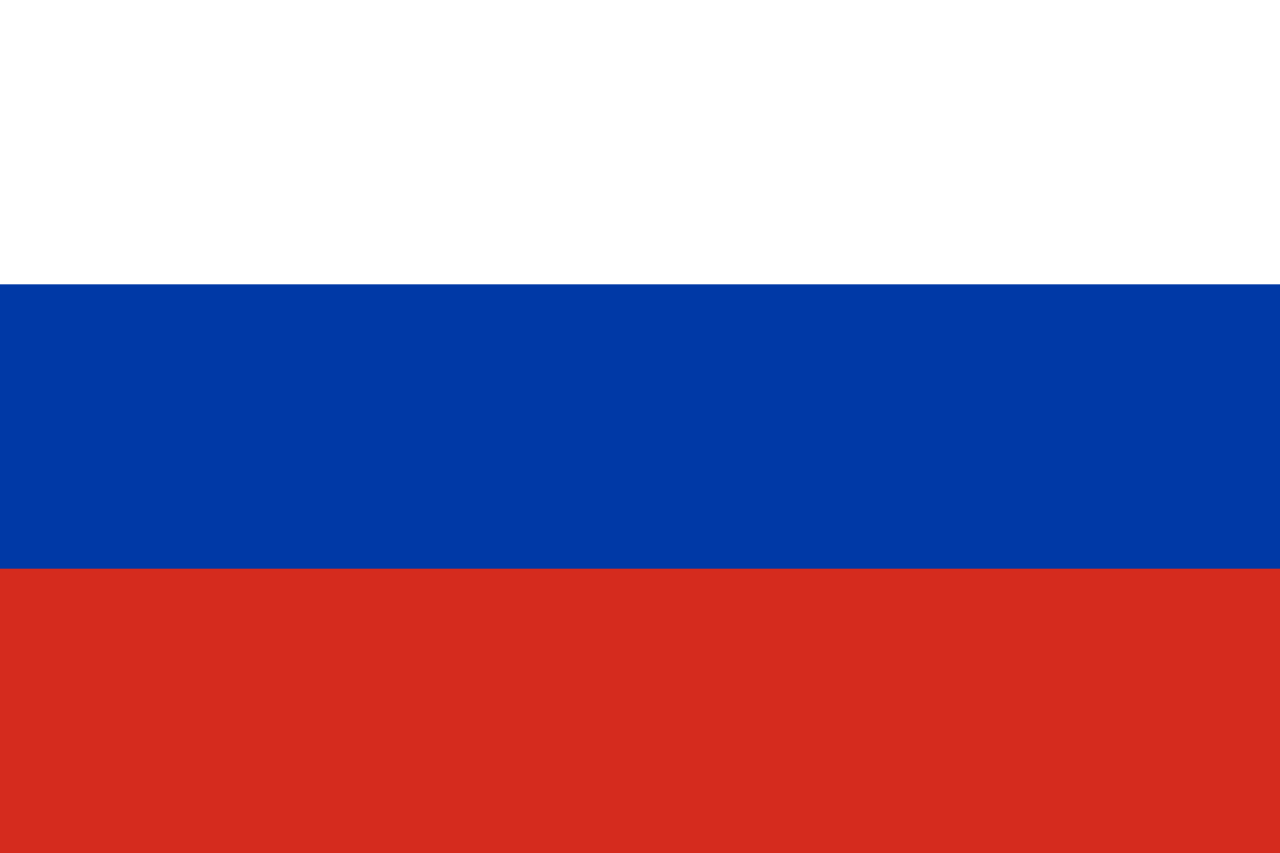
Three plain horizontal bands stacked from top to bottom — white, blue, and red — make up one of the most recognizable national emblems in Europe. The Russian tricolor looks deceptively simple, yet it carries more than three centuries of layered history: imperial ambition, maritime trade, revolution, suppression, and revival. The version flying over Moscow today was formally restored in 1991, but its roots reach back to the reign of Peter the Great, and its influence radiates across a whole family of Slavic flags. To understand the Russian flag is to trace a story that swings between erasure and rebirth.
A Tricolor Built From Three Equal Bands
The design itself is an exercise in restraint. The flag is divided into three horizontal stripes of identical height — white on top, blue in the middle, red at the bottom — set against a standard ratio of 2:3. There is no crest, no eagle, no inscription on the national civil flag; the power of the banner comes entirely from the arrangement and order of its colors.
That ordering matters. Plenty of nations use white, blue, and red, but the precise sequence and orientation are what make a flag uniquely Russian. The horizontal layout distinguishes it immediately from vertical tricolors like France's, while the top-to-bottom color order separates it from look-alikes that share the same palette. The shades have shifted across the centuries — older renditions leaned toward deeper, navy-leaning blues — but modern usage has settled the tones into a standardized form so the flag reads consistently whether it is stitched onto a uniform or printed on a billboard.
What White, Blue, and Red Are Meant to Say
Russians have never agreed on a single official reading of the colors, and that ambiguity is part of the flag's charm. The most widely cited interpretation assigns a virtue to each band: white for nobility and frankness, blue for faithfulness, honesty, and wisdom, and red for courage, generosity, and love. These are aspirational qualities, a kind of moral self-portrait rendered in cloth.
A second, more geographic reading ties the three stripes to the historical conception of the Russian world: Great Russia, Little Russia (the lands often identified with Ukraine), and White Russia (Belarus). In this view the flag becomes a map of identity rather than a list of virtues. Because no single meaning was ever carved into law, both interpretations coexist, and Russians tend to choose whichever resonates with them. The flag, in other words, invites its own citizens to fill in the symbolism.
From Peter the Great's Ships to the Russian Empire
The tricolor's origin is a tale of borrowed inspiration. In 1696, Peter the Great introduced the white-blue-red banner, reportedly drawing on the Dutch flag he admired during his travels and his obsession with shipbuilding. It first served a practical purpose as the ensign of Russian merchant vessels, marking Russian trade ships on foreign seas before it ever became a symbol of the nation as a whole.
Over the following two centuries the tricolor gradually rose in status, eventually functioning as the national flag of the Russian Empire. That trajectory was abruptly severed by the events of 1917. After the revolution, the empire fell, and the new Soviet state adopted the red banner with its hammer and sickle. The familiar white-blue-red was set aside — and for a long stretch of the twentieth century, it disappeared from official Russian life entirely.
Banned, Then Reborn in 1991
For 74 years the tricolor was effectively absent. From 1922 until 1991 the Soviet red flag completely replaced it, and the older imperial colors were associated with a vanished, pre-revolutionary order. The hammer and sickle, not the three stripes, became the image the world associated with the country.
That changed in the dramatic final months of the Soviet Union. On August 22, 1991, amid the upheaval surrounding the USSR's dissolution, the historic tricolor was restored as Russia's flag. The date now carries enormous symbolic weight: it is commemorated annually as Russian Flag Day. The choice to revive the pre-Soviet banner was itself a political statement — a deliberate reach back past the Communist era toward an older national continuity. For Russians who had only known the red flag, the white-blue-red represented both a break with the recent past and a reconnection with a much deeper one. If you want broader context on the country itself, the russia country guide covers its geography and culture in detail.
A Flag With Many Cousins
Few flags have spawned such a recognizable lineage. The Russian tricolor is widely regarded as the template behind the so-called pan-Slavic colors, and its design directly influenced banners adopted by other Slavic nations. Serbia, Slovakia, and Slovenia all fly horizontal white-blue-red tricolors that echo the Russian arrangement, a visual family resemblance born of shared cultural identity and nineteenth-century Slavic solidarity.
The catch is that this family is easy to confuse. Slovakia and Slovenia, for instance, typically add a national coat of arms to distinguish themselves, and Serbia's modern flag carries its own emblem. The plain, unadorned Russian civil flag is the purest expression of the palette. And then there is the original muse: the Netherlands, whose red-white-blue ensign inspired Peter the Great in the first place. The Dutch and Russian flags share three colors but differ in order and orientation of meaning — a reminder that the Russian tricolor is both an heir and an ancestor in the broader story of European vexillology.
The Tricolor in Modern Russian Life
Today the flag is woven through public life. It flies over government buildings, anchors national celebrations, and turns up on everything from sports jerseys to commercial branding, where the white-blue-red combination signals national identity. Two dates put it front and center: Flag Day on August 22, marking the 1991 restoration, and Russia Day on June 12, the country's broader national holiday.
The tricolor is also a fixture of spectacle. It is hoisted during Victory Day commemorations, waved by crowds at the Olympic Games, and brandished enthusiastically at international ice hockey tournaments, where Russian fans are famous for their devotion. In these settings the flag operates less as a piece of state protocol and more as a rallying point — a shorthand for patriotism that needs no explanation.
Quick Facts Worth Knowing
- August 22 is celebrated as Russian Flag Day, honoring the 1991 restoration of the tricolor.
- The flag was banned during the Soviet era, absent from official use from 1922 to 1991.
- Peter the Great was reportedly inspired by the Dutch flag during his travels abroad.
- The design influenced the flags of many Slavic nations, including Serbia, Slovakia, and Slovenia.
- The Soviet hammer-and-sickle banner completely replaced the tricolor for 74 years.
- Russia sits in Europe, and its flag uses a standard 2:3 proportion with three equal bands.
Frequently Asked Questions
When was the Russian flag adopted?
The current Russian flag was restored on August 22, 1991, during the dissolution of the Soviet Union. While the design itself dates back to Peter the Great in 1696, the 74-year Soviet period interrupted its use. The 1991 restoration is now commemorated each year as Russian Flag Day.
What do the colors of the Russian flag mean?
Interpretations vary because no single meaning was ever made official. One common reading holds that white stands for nobility and frankness, blue for faithfulness, honesty, and wisdom, and red for courage, generosity, and love. Another associates the three bands with Great Russia, Little Russia (Ukraine), and White Russia (Belarus).
Who designed the Russian flag?
The tricolor is traditionally credited to Peter the Great, who introduced it in 1696 reportedly after being inspired by the Dutch flag during his travels. It began as a merchant ship ensign before evolving into the national flag of the Russian Empire and, eventually, the flag of the modern Russian Federation.
What continent is Russia on, and how does its flag compare to similar ones?
Russia is located in Europe. Its white-blue-red tricolor is the inspiration behind the pan-Slavic palette, and it closely resembles the flags of Serbia, Slovakia, and Slovenia. Those nations usually add a coat of arms to set themselves apart, while the plain Russian civil flag shares only its colors — in a different order — with the Dutch banner that originally inspired it.