

Singapore has the fastest internet in the world. In Ookla’s Speedtest Global Index for March 2026, the countries with the fastest internet are Singapore, with a median fixed broadband download speed of 425.46 Mbit/s, the United Arab Emirates at 384.51 Mbit/s and Hong Kong, a special administrative region of China, at 352.40 Mbit/s. France is effectively level with Hong Kong at 352.35 Mbit/s, and Iceland, Chile, Macau, the United States, Switzerland and Denmark complete the top 10. On mobile networks the order changes completely: the UAE leads at 644.66 Mbit/s, ahead of Qatar and Kuwait. The figures below are medians, the speed that half of all tests beat and half fall short of, which reflects what a typical household gets better than an average that a few gigabit lines can drag upwards.
The Speedtest Global Index top 10 for March 2026
Ookla, a network-testing company founded in 2006 and based in Seattle, publishes its index monthly from the tests people run on Speedtest.net. The fixed broadband table covered 153 countries and territories in March 2026. The ten fastest were:
| Rank | Country or territory | Median fixed download (Mbit/s) |
|---|---|---|
| 1 | Singapore | 425.46 |
| 2 | United Arab Emirates | 384.51 |
| 3 | Hong Kong | 352.40 |
| 4 | France | 352.35 |
| 5 | Iceland | 347.30 |
| 6 | Chile | 334.99 |
| 7 | Macau | 318.05 |
| 8 | United States | 309.80 |
| 9 | Switzerland | 292.56 |
| 10 | Denmark | 291.60 |
The United States is by far the most populous country in the top 10: with more than 300 million people it still reaches 309.80 Mbit/s, ahead of compact European states such as Switzerland and Denmark. Two of the top seven, Hong Kong and Macau, are not sovereign countries but Chinese special administrative regions that Ookla ranks separately. Remove them and the country list runs Singapore, UAE, France, Iceland, Chile, United States, Switzerland, Denmark, Romania and Vietnam.
Singapore, the UAE and Hong Kong: the leaders you would expect
The top three are the kind of places that ought to win a broadband race: small, wealthy, dense and run by governments that treat connectivity as infrastructure. Singapore has been planning for it for three decades. The Singapore ONE project, a government-led plan to wire the island with fibre, DSL and cable, was announced in June 1996 and launched commercially in June 1998, and by December 1998 it was available nationwide with the completion of the national fibre-optic network. Later programmes such as Intelligent Nation 2015 and the Smart Nation initiative kept the pressure on, and connectivity is above 99%. Even before the web, Singapore launched Teleview, an interactive information service that began trials in 1987, and in December 2006 the Infocomm Development Authority started Wireless@SG, which offers free wireless access in busy public areas. Singapore is not new to first place either: Ookla measured it as the fastest in the world in August 2018, at 181.47 Mbit/s, so its median has more than doubled since.
The United Arab Emirates took a different route to the same place. Etisalat was the sole telecommunications provider from 1976 until February 2006, when a second operator, du, arrived. Outside mobile, the two have effectively divided the country between them: because their fixed-line service areas are split geographically, they rarely compete for the same customers, and in practice each runs its territory as a monopoly. The UAE’s speed record sits alongside heavy restrictions on content: Freedom House describes its internet as significantly restricted, a reminder that a fast connection and an open one are different measurements. Hong Kong is one of the most densely populated places on Earth, and a city of high-rise blocks is a comparatively cheap place to run fibre to a great many homes.
Chile, France and Iceland: three surprises in the top six
The unexpected names start at number four. France spent the early internet years on its own path: the Minitel videotex service, launched in 1982, was the most successful online service in the world before the web, and ADSL was the mainstream connection through the 2000s. Intense competition among providers has since pushed fibre plans of up to 1 Gbit/s into the mainstream from about €26 a month, with no data caps on fixed lines, and in March 2026 France finished just 0.05 Mbit/s behind Hong Kong.
Iceland, with roughly 395,000 residents on a volcanic island in the North Atlantic, is fifth. Chile, sixth at 334.99 Mbit/s, is the fastest country in the Americas, two places above the United States, and the only Latin American nation in the top 10. Its connections are provided entirely by private companies, and about 90.2% of Chileans had internet access in 2023. International traffic lands through five submarine cables at Arica and Valparaíso, including Google’s Curie cable at Valparaíso and Telxius’s Cable Mistral, which serve a long, narrow country with no land neighbours to the west.
Romania, Vietnam and Thailand just outside the top 10
Positions 11 to 14 hold three countries that rarely appear in lists of rich, high-tech economies: Romania (283.06 Mbit/s), Vietnam (281.72) and, after Israel, Thailand (279.65). Romania is the long-running outlier. After 1999, small neighbourhood providers known locally as “rețea de bloc” (block networks) wired up apartment blocks with Ethernet cable, serving between 50 and 3,000 customers each and skipping copper telephone lines and dial-up altogether. In June 2017 the regulator ANCOM counted 871 active providers, and 94% of broadband connections were fibre-based (FTTx). In mid-2013 the western city of Timișoara recorded the highest download speed of any city in the world in the Net Index ranking, 89.91 Mbit/s, and 1 Gbit/s plans have been sold for around 8 euros a month.

Spain (277.98), Canada (277.70) and Taiwan (270.85) follow, and Peru, at 18th with 258.37 Mbit/s, is a second South American surprise.
South Korea, Japan and Germany: well-known tech nations that miss out
The biggest near-miss is South Korea. It was one of the first countries anywhere to adopt broadband universally, has ranked first in the UN’s ICT Development Index since the index began, and 97.6% of its people own a smartphone. Ookla placed it second in 2019. By late 2022 it had slipped to 34th, and in March 2026 it sat 19th at 257.76 Mbit/s, still fast but overtaken by countries that built fibre later and to higher specifications. Japan, the other East Asian pioneer, is 20th at 255.27 Mbit/s.
Several large European economies fall much further. The Netherlands is 23rd, Sweden 32nd, Finland 40th, Norway 41st and the United Kingdom 42nd at 172.24 Mbit/s. Italy is 58th at 117.11 Mbit/s. Germany, the largest economy in Europe, is 65th at 103.72 Mbit/s, below Mexico and El Salvador. The reason is the copper it already had: DSL, introduced by Deutsche Telekom in 1999, is still the dominant technology with more than 30 million subscribers, and since 2013 new Deutsche Telekom VDSL2 cabinets have supported vectoring, which from August 2014 squeezed up to 100 Mbit/s out of existing telephone wires. Cable is currently the most widely available gigabit option for German homes, while fibre coverage is still expanding. Among the world’s most populous countries, India is 101st at 60.85 Mbit/s and Indonesia 115th at 45.91 Mbit/s.
Mobile speeds: why Qatar and Kuwait lead a different race
Ookla’s mobile table rewards a different set of conditions, and the Gulf dominates it. The UAE is first at 644.66 Mbit/s, followed by Qatar at 576.06, Kuwait at 372.76 and Bahrain at 274.94, all small, wealthy states whose people are concentrated in a few compact cities. Brazil, fifth at 265.79 Mbit/s, is the surprise here, just ahead of South Korea at 265.20, where mobile has held up far better than fixed lines. Brunei, Saudi Arabia, Bulgaria and the United States complete the top 10.
Singapore, the fixed-line champion, is only 12th on mobile at 197.89 Mbit/s, and Germany (74.58) and the United Kingdom (75.91) sit in the 60s. Countries that lead on one kind of network do not automatically lead on the other.
Afghanistan, Syria and Cuba at the bottom of the fixed table
The slowest end of the March 2026 table is dominated by conflict, sanctions and state control. Libya (11.65 Mbit/s) and Ethiopia (11.17) are near the bottom, followed by Afghanistan at 4.93, Syria at 4.24 and, last of all, Cuba at 3.83 Mbit/s, less than one hundredth of Singapore’s median. Cuba’s first internet connection, a 64 kbit/s link to Sprint in the United States, was set up in September 1996, and growth then stalled for years because of a lack of funding, tight government restrictions and the United States embargo. Until 2013 the island relied on the Intersputnik satellite system and ageing telephone lines; the ALBA-1 fibre cable to Venezuela, laid in 2011, only opened to public users in January 2013. Mobile data followed with 3G in 2018 and 4G from 2019, and private home Wi-Fi was legalised on 29 July 2019.
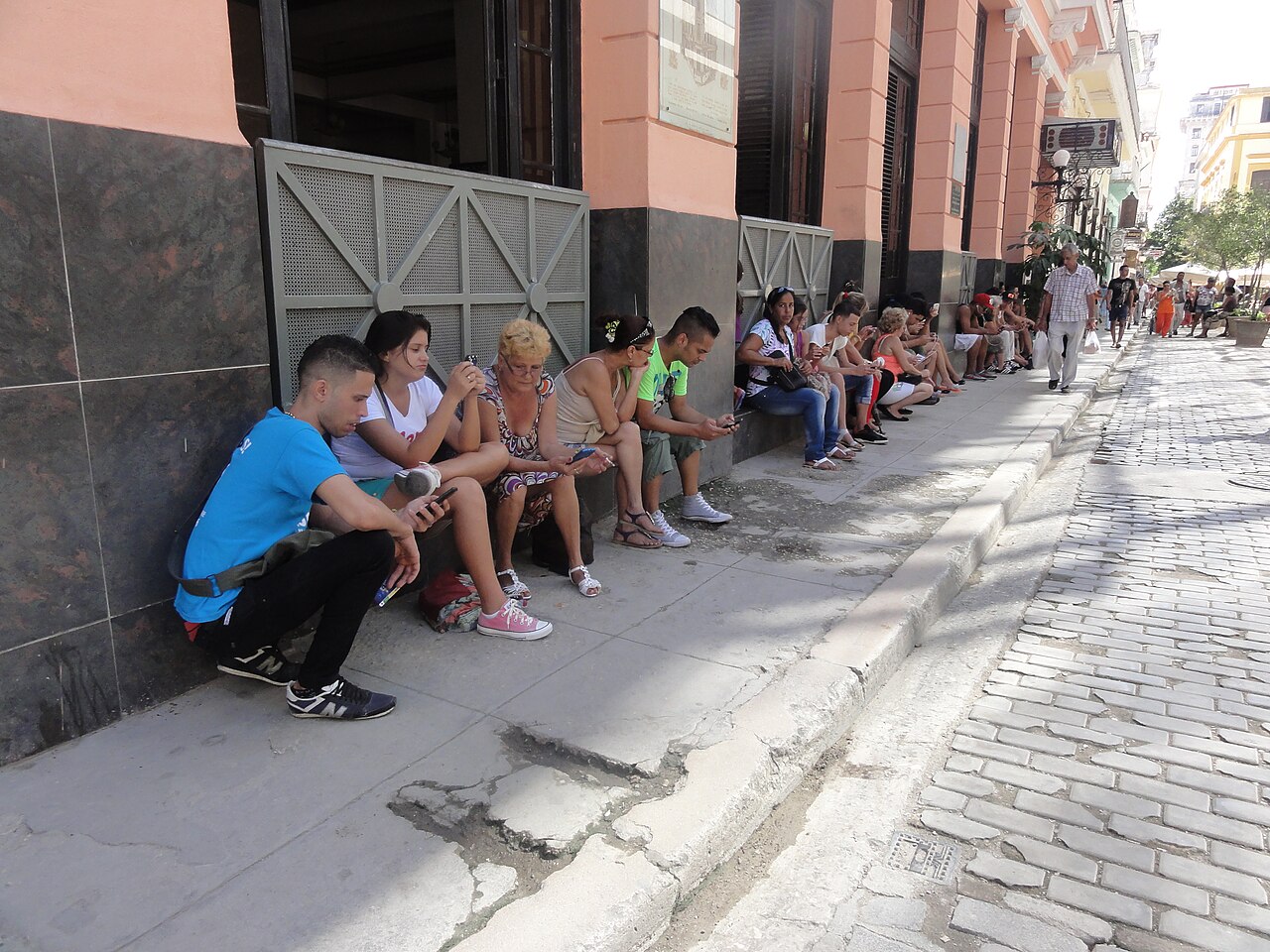
By 2022 about 68% of Cubans had internet access, but a high share of access still does not mean a fast connection, which is why speed and reach are best read side by side. Our guide to the countries with the most internet users covers the reach half of that picture, while the stories of the two Asian pioneers are told in more depth in the pages on the economy of Singapore and the economy of South Korea.