
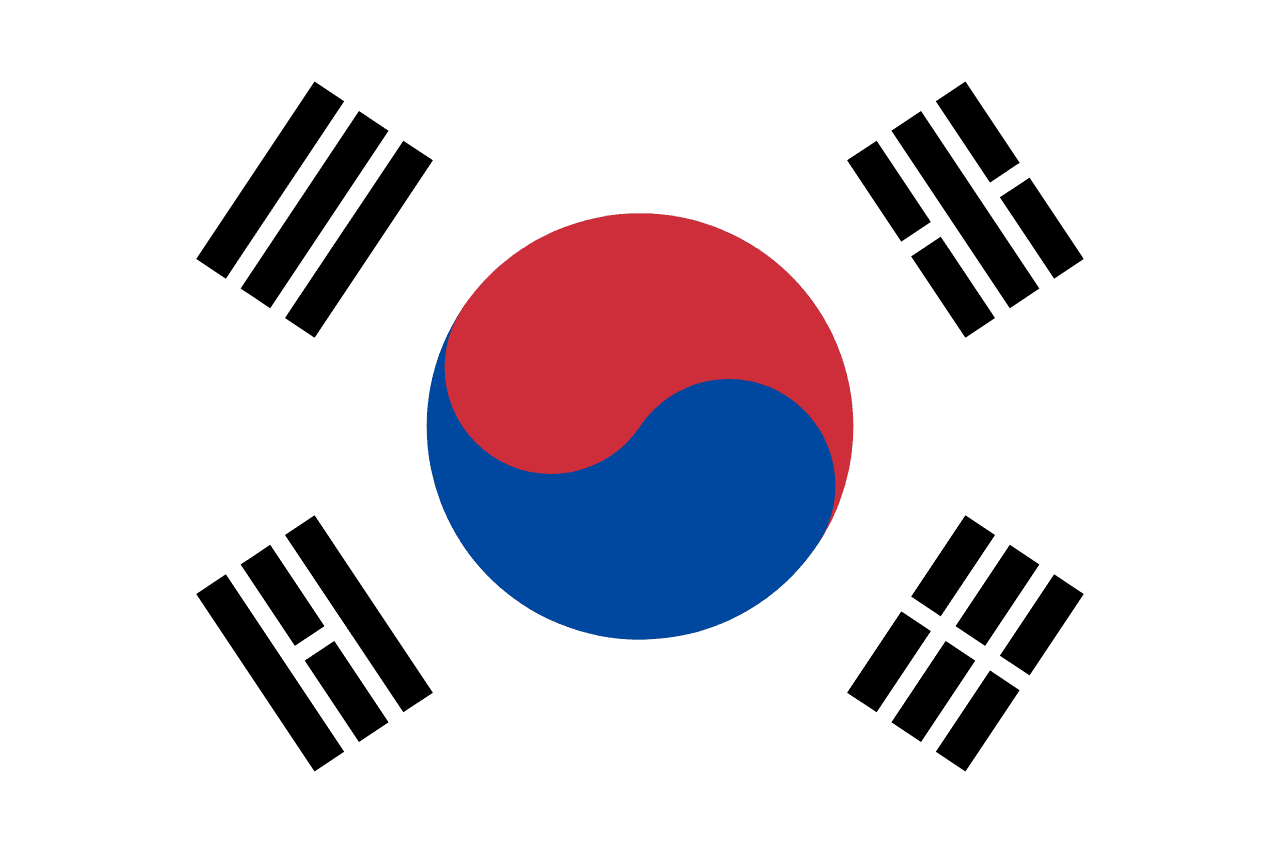
Few national flags pack as much philosophy into a single rectangle as the Taegukgi, the flag of South Korea. Against a clean white field sits a red-and-blue circle that anyone familiar with East Asian thought will recognize as a yin-yang, and around it hover four sets of broken and unbroken bars that look almost like a code waiting to be deciphered. They are, in fact, a kind of code: an ancient one drawn from cosmology and the cycles of nature. While most flags lean on stripes, stars, or heraldry, South Korea's banner is essentially a diagram of how the universe holds itself in balance. It is elegant, unusual, and instantly identifiable on any podium or stadium screen.
A Flag Built From Cosmology
The Taegukgi rejects the busy heraldry common to many European-derived flags in favor of something closer to a meditation. The white field is not blank by accident; in Korean culture white carries deep meaning, associated with peace, purity, and the everyday clothing worn for centuries by ordinary people. Onto that calm background the design places a single charged symbol at the exact center, then anchors it with four corner emblems. The result is a flag that reads as deliberately, almost mathematically composed, balanced along both diagonals. Where other flags shout, this one invites you to look twice and ask what the marks actually mean.
The Taegeuk and the Meaning of Red, Blue, White, and Black
At the heart of the flag is the taegeuk, the circular emblem split by a flowing S-curve into two teardrops. The upper portion is red and the lower portion is blue, and together they express a worldview built on complementary opposites. The red half stands for the positive cosmic forces, known as yang, while the blue half stands for the negative cosmic forces, or yin. This is not "good versus bad" but rather a dance of paired energies: light and dark, heat and cold, masculine and feminine, motion and rest. Neither side dominates; each curls into the other, suggesting that harmony comes from balance rather than conquest.
The white background represents peace and purity, framing the colored symbol in stillness. The fourth color, black, appears in the trigrams arranged around the center. Across the whole design the palette stays disciplined: just white, red, blue, and black, with no gold trim, no shading, and no extra ornament. That restraint is part of why the flag feels so timeless and reproduces so cleanly at any size, from a lapel pin to a banner draped over a stadium.
How the Four Trigrams Are Arranged
The four corner symbols are trigrams, each made of three stacked lines that are either solid or broken. They are drawn directly from the I Ching, the ancient Chinese divination text, and each represents one of the fundamental elements in Eastern philosophy. Geon (☰), three solid lines, sits in the top-left corner and signifies heaven. Gon (☷), three broken lines, occupies the bottom-right and represents earth. Gam (☵) in the top-right stands for water, and Ri (☲) in the bottom-left stands for fire. The pairs sit diagonally opposite one another, so heaven faces earth and water faces fire, reinforcing the theme of opposites in equilibrium that the central taegeuk already announces. The official proportions of the flag are a 2:3 ratio, giving the composition room to breathe.
From 1882 to the Republic of Korea
The Taegukgi is older than the modern state that flies it. The design was first created in 1882 by Park Yeong-hyo, a Korean official who needed an emblem to represent the country abroad, and it drew on traditional Korean philosophy and the symbolism of the I Ching. For decades it served as a banner of national identity even as Korea's political fortunes shifted dramatically. During the Japanese occupation from 1910 to 1945, displaying the flag was forbidden, which only deepened its emotional power: to raise the Taegukgi in those years was an act of defiance and a statement of Korean independence. When the Republic of Korea was established in 1948, the design was formally standardized, fixing the placement and proportions of the taegeuk and trigrams into the official version still flown today.
What Sets It Apart From Look-Alikes
If a yin-yang on a flag rings a bell, there is a good reason. South Korea is one of only two countries whose national flag features the yin-yang symbol, the other being Mongolia, whose soyombo emblem incorporates a small yin-yang within a vertical column of other symbols. The two are easy to tell apart: Mongolia's flag uses bold vertical bands of red and blue with a golden emblem on the hoist side, while South Korea's keeps a white field and centers a much larger, more prominent taegeuk. Casual viewers sometimes confuse the Korean trigrams with generic decorative marks, but the I Ching origins make them precise and meaningful rather than ornamental. No other national flag combines a centered red-and-blue taegeuk with four black trigrams, which makes the Taegukgi genuinely one of a kind. For more on the country behind the banner, see our south korea country guide.
National Identity and the Flag in Modern Life
The Taegukgi is woven tightly into Korean identity, expressing a cultural longing for harmony, balance, and peace that runs through Confucian and Taoist thought alike. Because it was a rallying point during the occupation and the independence movement, it carries the weight of resistance as well as philosophy. Today South Koreans raise it on national holidays, most notably National Liberation Day on August 15 and National Foundation Day on October 3. Beyond official occasions, the flag has become a fixture of global pop culture and sport. It waves at the Olympic Games and the FIFA World Cup, where it became a worldwide symbol during the tournament South Korea co-hosted in 2002. It appears in e-sports arenas where Korean teams are perennial contenders, and it shows up in crowds at K-pop concerts on nearly every continent, a small white banner with its unmistakable swirl carried far from home.
Quick Facts Worth Knowing
- South Korea is one of only two countries with a flag featuring the yin-yang symbol; Mongolia is the other.
- The four trigrams come from the I Ching, an ancient Chinese divination text used for cosmology and divination.
- White was traditionally worn by Koreans, earning them the nickname the "white-clad people," which echoes in the flag's white field.
- The flag was banned throughout the Japanese occupation, from 1910 to 1945.
- During the 2002 World Cup, hosted in part by South Korea, the Taegukgi became a global symbol seen by audiences everywhere.
- The flag uses just four colors and a strict 2:3 ratio, keeping the design clean and easy to reproduce.
Frequently Asked Questions
When was the South Korean flag adopted?
The design dates back to 1882, when it was first created by Park Yeong-hyo, but the flag in its standardized modern form was officially adopted in 1948 with the establishment of the Republic of Korea.
What do the colors and symbols on the flag mean?
The white field represents peace and purity. The central taegeuk balances red (the positive yang forces) against blue (the negative yin forces) to express the harmony of the universe. The four black trigrams in the corners represent heaven, earth, water, and fire.
Who designed the Taegukgi?
The flag is credited to Park Yeong-hyo, a Korean official who created it in 1882. It draws on long-standing Korean philosophy and the symbolism of the I Ching rather than being invented from scratch.
What continent is South Korea on, and which flag is it most similar to?
South Korea is in Asia. Its closest relative is the flag of Mongolia, the only other national flag to include a yin-yang symbol, though Mongolia uses vertical red-and-blue bands and a golden emblem rather than a centered taegeuk on a white field.