
The Taklamakan Desert is the second-largest shifting sand desert in the world, covering approximately 337,000 square kilometers of China's Xinjiang Uygur Autonomous Region. Its name, often translated as "Place of No Return" or "Sea of Death," reflects the terror it has inspired in travelers for millennia.
Introduction
Surrounded by some of the highest mountain ranges on Earth including the Tian Shan to the north, the Kunlun Mountains to the south, and the Pamir Mountains to the west, the Taklamakan sits in the heart of the Tarim Basin like a vast bowl of sand. Despite its fearsome reputation, it played a crucial role in the ancient Silk Road trade network.
Geography & Location
- Area: 337,000 km²
- Location: Tarim Basin, Xinjiang, China
- Highest Dunes: Up to 300 m
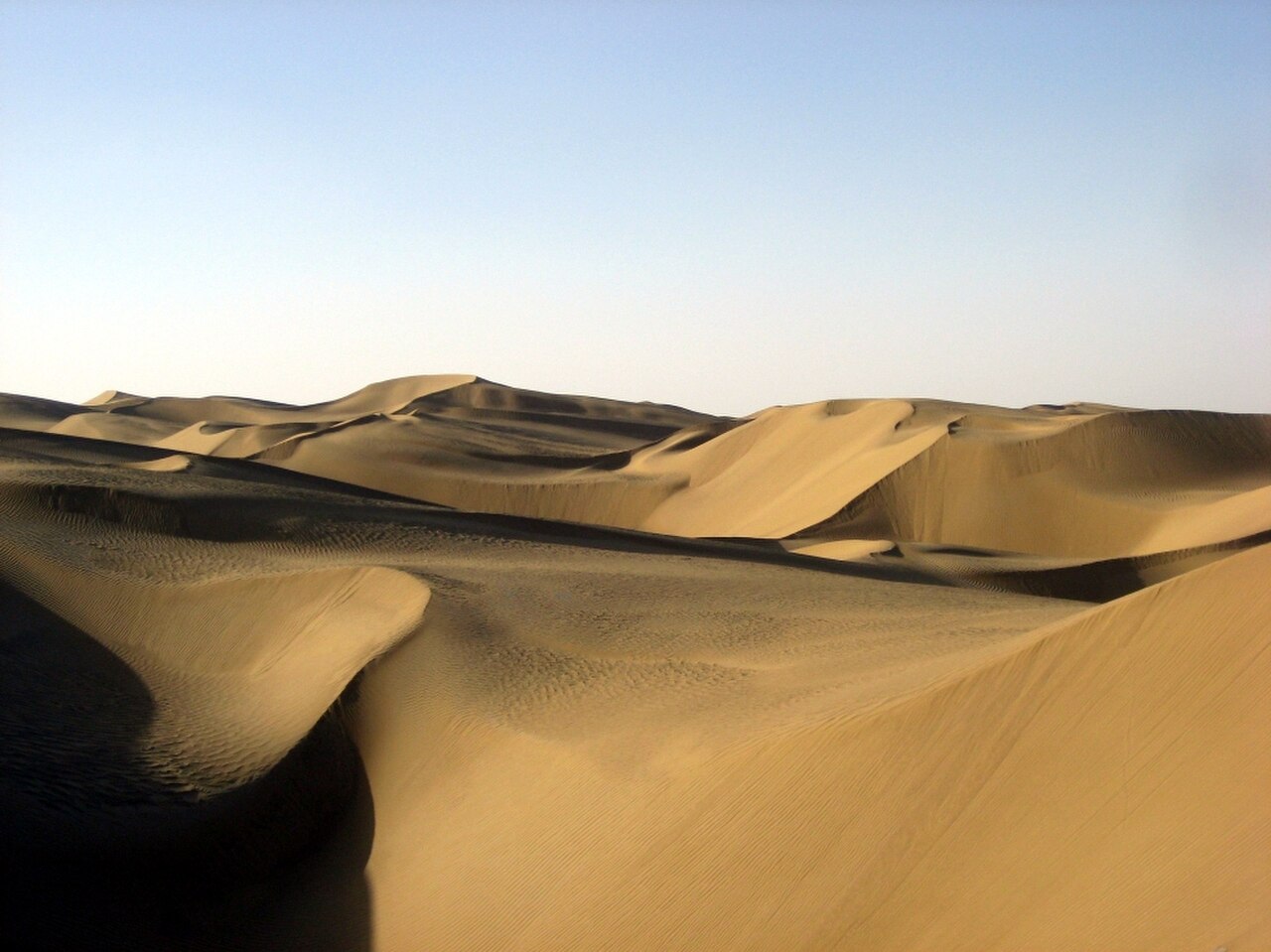
The Taklamakan fills almost the entire Tarim Basin, enclosed by mountain ranges on three sides. The Tarim River skirts the desert's northern edge, while the Hotan and Yarkand rivers penetrate from the south before vanishing into the sand. About 85% of the desert consists of shifting crescent-shaped and linear sand dunes.
The dunes can reach heights of 200 to 300 meters, making them among the tallest in the world. Fierce sandstorms can rage for days, reshaping the landscape and burying everything in their path. The desert's center is almost entirely devoid of water sources.
Climate & Weather
- Summer Highs: 40°C+ (104°F)
- Winter Lows: -20°C (-4°F)
- Annual Rainfall: Less than 40 mm
The Taklamakan is a cold desert with extreme temperature swings. Summer days regularly exceed 40 degrees Celsius, while winter nights plummet to minus 20. The sand surface temperature can reach 70 degrees Celsius in midsummer, hot enough to fry an egg.
Precipitation is almost nonexistent in the interior, with some areas receiving less than 10 millimeters per year. Violent sandstorms, called burans or kara-burans (black storms), can darken the sky for days and carry dust thousands of kilometers, even reaching Beijing and beyond.
Silk Road History
- Trade Era: 2nd century BCE to 15th century CE
- Key Routes: Northern and Southern Silk Road branches
- Buried Cities: Loulan, Niya, Dandan Oilik
The Silk Road did not cross the Taklamakan directly but skirted its edges along two main branches. The northern route followed the Tian Shan foothills, passing through oasis cities like Kucha and Turpan. The southern route hugged the Kunlun Mountains through Khotan and Niya. Both converged at Kashgar to the west.
The desert has preserved remarkable archaeological treasures. The ancient city of Loulan, abandoned around the 4th century, was rediscovered in 1900 by Swedish explorer Sven Hedin. Desiccated mummies, Buddhist murals, and manuscripts in multiple languages have been found, revealing the multicultural character of Silk Road civilization.
Wildlife & Ecology
- Notable Species: Wild Bactrian camel, long-eared jerboa
- Vegetation: Tamarisk, Populus euphratica along rivers
- Protected Area: Taklimakan Desert Poplar National Nature Reserve
Life clings to the edges of the Taklamakan where rivers and groundwater support narrow corridors of vegetation. The Populus euphratica (desert poplar) forms forests along the Tarim River that are vital habitat for wildlife. These ancient trees can survive salt concentrations that would kill most other species.
The critically endangered wild Bactrian camel, numbering fewer than 1,000, roams the desert's fringes. The long-eared jerboa, one of the world's smallest rodents, hops across the sand on oversized hind legs. Gazelles and wolves occasionally venture into the desert margins.
Modern Exploration & Development
- Desert Highway: 522 km cross-desert road (1995)
- Oil Reserves: Significant deposits beneath the sand
- Research: Chinese Academy of Sciences desert stations
In 1995, China completed the Tarim Desert Highway, a 522-kilometer road cutting straight through the heart of the Taklamakan from Luntai to Minfeng. Millions of drought-resistant shrubs were planted along both sides to prevent sand from burying the road, kept alive by drip irrigation from underground wells.
Significant oil and natural gas reserves lie beneath the desert sands. The Tarim Basin is one of China's largest petroleum-producing regions. Research stations operated by the Chinese Academy of Sciences study desertification, sand movement, and climate change in this extreme environment.
Key Facts
- The Taklamakan is the second-largest shifting sand desert in the world at 337,000 km².
- Its name translates roughly to "Place of No Return" or "Sea of Death."
- Sand dunes can reach heights of up to 300 meters.
- The 522 km Tarim Desert Highway crosses the desert's heart, completed in 1995.
- Ancient Silk Road cities like Loulan lie buried beneath the sands.
Fun Facts
- Taklamakan sand surface temperatures can reach 70°C in summer, hot enough to cook on.
- Swedish explorer Sven Hedin rediscovered the lost city of Loulan in 1900 after it had been abandoned for 1,500 years.
- Dust from the Taklamakan has been detected as far away as the Arctic ice cap.
- The desert occasionally experiences snowfall in winter, creating surreal white-on-gold landscapes.
Final Thoughts
The Taklamakan Desert stands as one of Earth's most formidable landscapes, a vast sea of shifting sand that has swallowed cities and challenged travelers for thousands of years. Yet its role in connecting East and West along the Silk Road, and the archaeological treasures preserved beneath its sands, make it one of the most historically significant deserts on the planet.
Test Your Knowledge!
Think you know your deserts? Try our interactive geography quiz!
Play Geographic Features Quiz →