
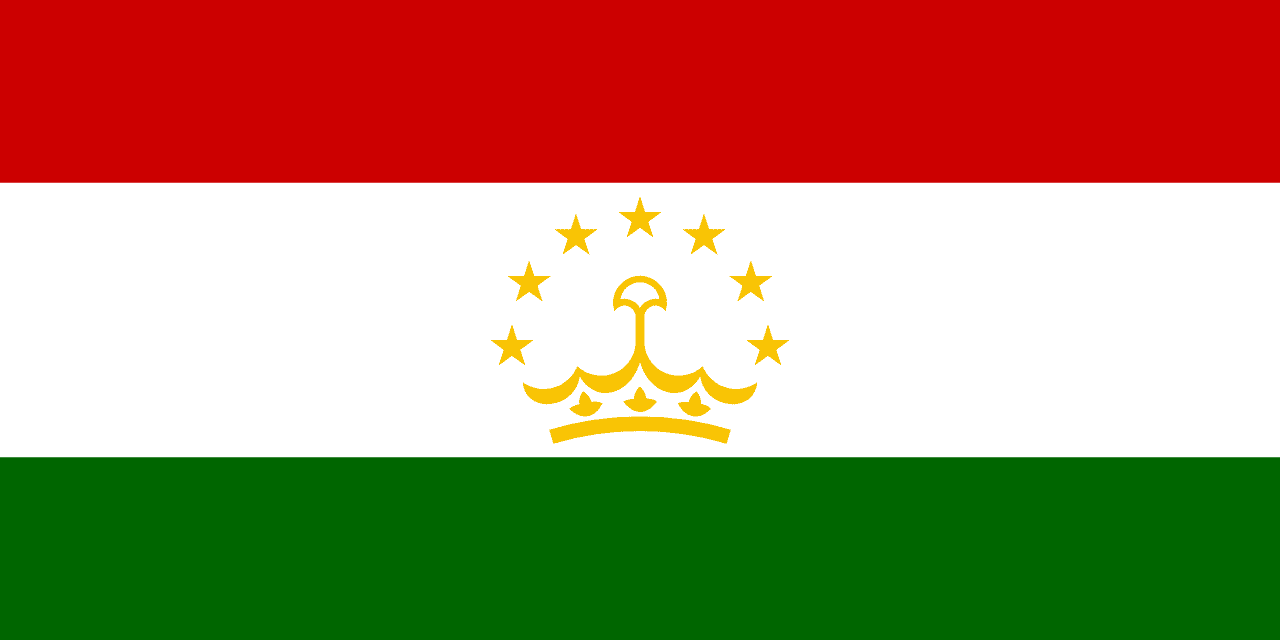
Few flags pack as much quiet ambition into a strip of fabric as the banner of Tajikistan. At first glance it looks like a familiar horizontal tricolor, but the eye is quickly drawn to its glowing center: a golden crown topped by an arc of seven stars. This is a flag that wants to tell you something about who the Tajik people believe themselves to be. Adopted in 1992, in the first uncertain months after the collapse of the Soviet Union, it announced a young republic stepping out from under a much larger shadow and reaching for symbols rooted in its own land, agriculture, and ancient sense of perfection.
A Tricolor With a Golden Heart
The design is, in structure, a horizontal triband: three stripes running left to right in red, white, and green, with a central emblem placed over the white. The red band sits at the top, the green at the bottom, and the broader white stripe between them carries the flag's most distinctive feature. Centered on that white field is a stylized golden crown, and arcing above it, a semicircle of seven five-pointed stars, all rendered in the same warm yellow.
The proportions give the white stripe more visual weight than the other two, which is unusual and deliberate. By widening the middle band, the designers created a generous stage for the crown and stars rather than crowding them into a thin slot. The result reads less like a plain tricolor and more like a coat of arms unfurled across cloth, where the emblem is the point and the colors are its setting.
What the Colors Are Meant to Say
Each color on the flag carries a specific job, and together they sketch a small portrait of the nation. According to the official symbolism, red stands for the unity of the nation and the bonds that hold its people together. White represents the cotton industry, a crop so central to Tajik economic life that it earned its own place on the national banner. Green speaks to agriculture more broadly and the fertile valleys that sustain the country.
The yellow of the crown and stars points toward national sovereignty and statehood. A crown is an old shorthand for legitimate rule, and placing it at the literal and figurative center of the flag declares that Tajikistan governs itself. The palette is warm and earthbound: it celebrates the things a mountainous, agrarian country actually depends on, rather than reaching for abstractions alone.
The Seven Stars and Their Meaning
The arc of seven stars is the detail visitors remember most, and it is loaded with meaning drawn from local tradition. In Tajik culture the number seven is associated with perfection and happiness, an idea with deep roots in regional folklore where seven is treated as a sacred, complete number. The stars are not merely decorative filler; they crown the crown, so to speak, turning a simple monarchic symbol into something aspirational and almost poetic.
By choosing seven stars rather than, say, a single emblem or a row of identical bars, the flag's authors tied the new state to an older cultural imagination. It is a reminder that Tajik identity did not begin in 1992. The arc gestures back toward a heritage of poetry, philosophy, and Persianate culture that long predates the Soviet borders, even as the flag itself was a thoroughly modern creation.
From Soviet Banner to Independent Standard
For most of the twentieth century, the territory flew the flag of the Tajik Soviet Socialist Republic, a red banner in the Soviet mold with stripes and the hammer and sickle. When the USSR dissolved and Tajikistan declared independence, the country needed a flag that was unmistakably its own. The new design was adopted in 1992, among the early acts of the fledgling republic.
The choice to keep red, while reinterpreting it as national unity rather than communist revolution, was a graceful piece of continuity. Rather than erasing the past entirely, the new flag repurposed familiar colors and layered fresh meaning over them. The crown and seven stars supplied the clean break: imagery that had nothing to do with Soviet iconography and everything to do with sovereignty and indigenous tradition. If you want the broader story of the country behind the banner, the tajikistan country guide fills in the geography and culture that the flag distills.
Family Resemblances and Telling Differences
The red-white-green combination is a popular one, which makes Tajikistan's flag part of a wide visual family. Iran flies a red-white-green horizontal tricolor, and the shared palette is no accident: it reflects a common Persianate cultural sphere. Hungary, Italy, and Bulgaria all use variations of red, white, and green as well, though their histories are entirely separate. To a casual observer flipping through a flag chart, several of these can blur together.
What sets Tajikistan apart is immediate once you look at the center. No other national flag pairs that particular golden crown with an arc of exactly seven stars. The stripe order also differs from country to country, and the unusually wide central band gives Tajikistan's banner a distinctive balance. Where Iran fills its margins with stylized script and an emblem, and Italy leaves its tricolor entirely plain, Tajikistan stakes out a middle path: a tricolor that is clearly emblem-led without being busy.
The Flag in National Life
Inside Tajikistan, the flag is a constant presence at the seams of public life. It flies over government buildings, schools, and border posts, and it appears at national celebrations such as Independence Day. The country has also taken pride in raising the flag to record-setting heights: a towering flagpole in the capital, Dushanbe, has been among the tallest in the world, turning the banner itself into a landmark visible across the city.
On the international stage, the flag travels with Tajik athletes at the Olympics and other competitions, and it represents the country at the United Nations and in diplomatic settings. For a nation that spent decades folded inside a larger union, these everyday and ceremonial appearances carry real weight. Each raising of the crown-and-stars is a small restatement of independence won and maintained.
Quick Facts at a Glance
- The flag was adopted in 1992, shortly after independence from the Soviet Union.
- It is a horizontal triband of red, white, and green, with the white stripe widened to hold the emblem.
- The central golden crown symbolizes national sovereignty and statehood.
- The arc of seven stars represents perfection and happiness, drawing on local tradition.
- Red signals unity, white the cotton industry, and green agriculture.
- Tajikistan is located in Central Asia, part of the continent of Asia.
Frequently Asked Questions
When was the flag of Tajikistan adopted?
The current flag was adopted in 1992, in the period right after Tajikistan declared independence from the Soviet Union. It replaced the Soviet-era banner of the Tajik SSR and gave the new republic a design centered on its own symbols of sovereignty and tradition.
What do the colors and stars on the flag mean?
Red represents the unity of the nation, white stands for the cotton industry, and green symbolizes agriculture. The golden crown denotes national sovereignty, while the seven yellow stars arcing above it represent perfection and happiness, a meaning tied to the special significance of the number seven in Tajik culture.
What continent is Tajikistan on?
Tajikistan is in Central Asia, on the continent of Asia. It is a landlocked, mountainous country, and its flag's emphasis on cotton and agriculture reflects the importance of farming in its river valleys.
How does Tajikistan's flag compare to similar flags?
It shares the red-white-green palette with flags such as Iran, Italy, Hungary, and Bulgaria, which can make them look related at a glance. The defining difference is the central emblem: a golden crown beneath an arc of seven stars, a combination unique to Tajikistan that no other national flag uses.
