
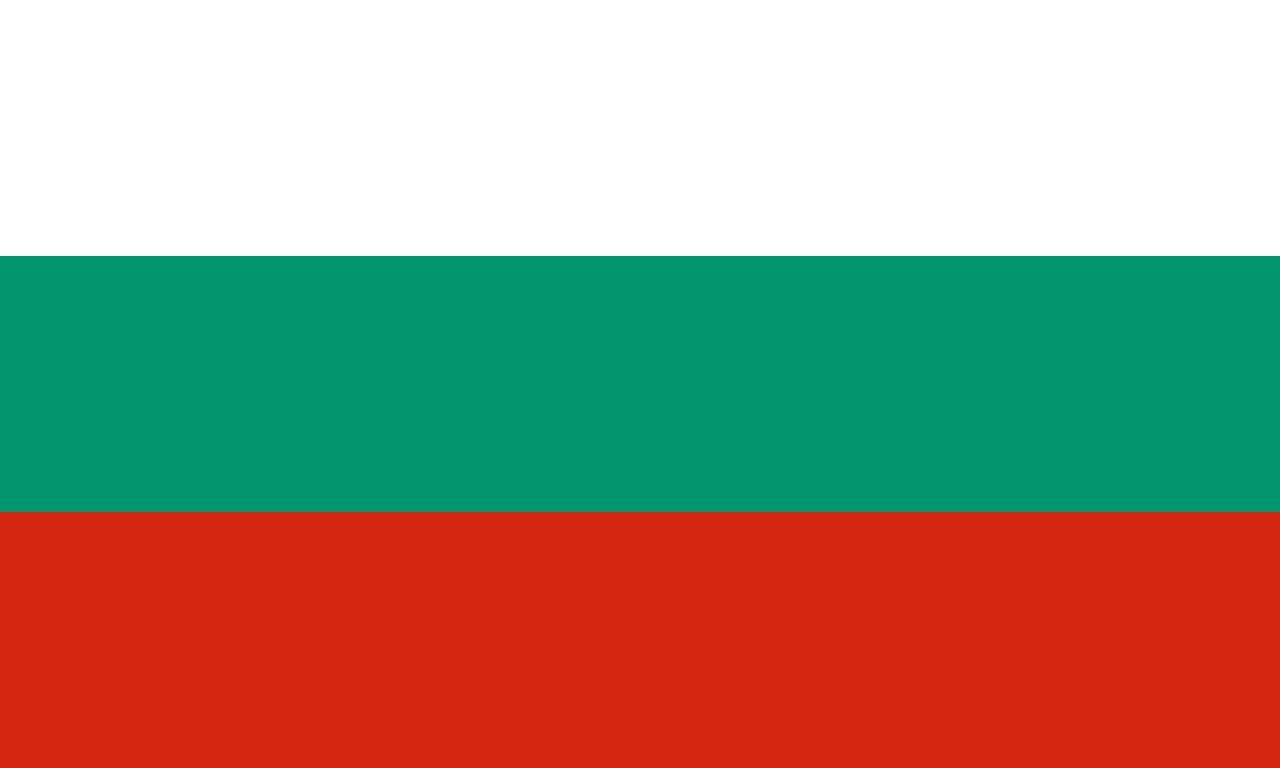
Stretched across stadium stands, fluttering above the Black Sea coast, and stitched onto the shoulders of soldiers, the Bulgarian flag is a study in calm confidence. Three horizontal bands—white on top, green in the middle, red at the bottom—carry a nation's story without a single ornament. There is no crest, no star, no slogan. Yet within that restraint lies a deliberate set of choices about peace, land, and sacrifice that Bulgarians have debated, defended, and rallied behind for well over a century. This guide unpacks what each stripe means, how the design arrived at its current form, and why a flag so simple feels so unmistakably Bulgarian.
What the Three Colors Stand For
Bulgaria's tricolor assigns a distinct idea to each band, and the meanings are unusually grounded in everyday national life. The top stripe of white represents peace, a quality the country prizes after centuries of conflict and foreign rule. The central green band speaks to agriculture and the fertility of Bulgarian soil—a fitting tribute for a land long known for its roses, wheat, and vineyards. The bottom stripe of red honors military courage and the blood shed in the struggle for independence.
What makes this palette quietly remarkable is the green. Most observers expect a Slavic nation to reach for the familiar white-blue-red of pan-Slavic identity. Bulgaria broke ranks. Rather than blue, it placed a band of green at the heart of its flag, anchoring the country's symbolism in its fields and farms instead of in shared Slavic heritage alone. That single substitution is the flag's defining signature.
A Triband Built on Simplicity
The design is a horizontal triband: three equal stripes running side to side, white over green over red. There are no charges, no emblems, no fringe—just clean color blocks of identical height. This stripped-down geometry is the modern civil and state flag used by citizens and government alike.
That clarity is intentional and practical. A triband reads instantly from a distance, reproduces cleanly at any size, and looks correct whether printed on a tiny lapel pin or draped down the side of a building. The absence of complex heraldry also means the flag belongs to everyone equally; nothing on it privileges a dynasty, a region, or an institution. The colors do all the talking, and they do it in a vocabulary—peace, land, courage—that any Bulgarian can recite.
From Pan-Slavic Roots to a National Banner
The tricolor's lineage reaches back to the nineteenth-century national revival, when Bulgarians sought to throw off Ottoman rule and assert a distinct identity. The pan-Slavic colors—white, blue, and red—were circulating across the Slavic world as a badge of solidarity. Bulgaria adapted that scheme but swapped blue for green, producing the white-green-red arrangement that has endured ever since. After liberation, the tricolor became the banner of the new Bulgarian state.
Through the twentieth century the basic stripes stayed constant, but what sat on top of them changed with the politics of the day. During the communist era, the flag carried a state emblem in the white band, featuring symbols of the socialist republic. When communism ended, that emblem was removed, and the plain triband was restored and formalized in 1990. The result is the flag flown today—a return to the unadorned colors, free of any single regime's mark.
How It Compares to Look-Alike Flags
A horizontal white-green-red tricolor is not unique to Bulgaria, which can cause moments of confusion. The closest sibling is the flag of Hungary, which uses red, white, and green—but Hungary stacks its colors in a different order (red on top, white in the middle, green at the bottom) and orients the relationships differently from Bulgaria's white-green-red. The shared three colors are coincidental rather than related in meaning.
Other tricolors share two of Bulgaria's three colors without matching the whole set. Italy and Mexico use green, white, and red in vertical bands, an entirely different layout. Among Slavic neighbors, the more typical white-blue-red pan-Slavic flags—such as those of Russia, Slovakia, and Slovenia—diverge precisely where Bulgaria did, in that middle band. The quickest way to identify the Bulgarian flag is the combination of horizontal stripes and the white-green-red sequence read from top to bottom. Once you fix that order in mind, it stops blending in with its relatives.
A Symbol Woven Into National Identity
For Bulgarians, the tricolor is more than state decoration—it is shorthand for the homeland itself. The colors appear in folk embroidery, in the red-and-white martenitsa tokens exchanged each spring, and in the patriotic imagery of the national revival period that schoolchildren still study. The flag's restraint suits a culture that often expresses pride through endurance rather than spectacle. To learn more about the nation behind the banner, see our bulgaria country guide.
Because the design carries no political emblem, it has remained a unifying object across very different chapters of Bulgarian history. The same three stripes flew over a fledgling principality, a kingdom, a socialist republic, and today's democratic state. That continuity gives the flag an unusual weight: it is one of the few national symbols that survived the country's twentieth-century upheavals essentially intact.
The Flag in Modern Bulgarian Life
Today the tricolor is woven into the civic calendar and the sporting life of the country. It is hoisted on national holidays, including Liberation Day on March 3, which commemorates the end of Ottoman rule, and on Bulgarian Independence Day on September 22. Public buildings, schools, and town squares fly it year-round, and citizens raise it during commemorations and celebrations alike.
On the international stage, the flag travels with Bulgarian athletes to the Olympics and to football and volleyball matches, where fans paint the white-green-red across their faces and unfurl enormous banners in the stands. It also represents Bulgaria within the European Union, flying alongside the EU's circle of stars at official ceremonies. In each of these settings the same plain triband does its quiet, recognizable work.
Interesting Facts About the Bulgarian Flag
- The current plain triband was restored and formalized in 1990, after the state emblem was removed at the end of the communist period.
- Green replaced the blue of the traditional pan-Slavic palette, making Bulgaria's flag stand apart from most Slavic tricolors.
- Each color maps to a single idea: white for peace, green for agriculture, and red for military courage.
- The three stripes are of equal height, and the flag carries no charge, star, or coat of arms.
- It shares its three colors with Hungary's flag, but the stripe order and orientation set the two clearly apart.
- The white-green-red theme echoes through Bulgarian folk crafts and seasonal traditions, not just official flags.
Frequently Asked Questions
When was the Bulgarian flag adopted?
The plain horizontal white-green-red triband used today was formalized in 1990, when the communist-era state emblem was removed from the white band. The underlying tricolor itself, however, dates back to Bulgaria's nineteenth-century national revival and has represented the country in various forms ever since.
What do the colors of the Bulgarian flag mean?
White stands for peace, green represents agriculture and the fertility of the land, and red symbolizes the courage and sacrifice of those who fought for the nation. The three meanings together capture a country defined by its soil, its struggles, and its hopes.
Why is the Bulgarian flag green instead of blue?
Bulgaria adapted the pan-Slavic color scheme of white, blue, and red but replaced the blue with green. The substitution ties the flag to Bulgarian agriculture and the richness of the land, distinguishing it from the white-blue-red flags of many other Slavic nations.
What continent is Bulgaria on, and which flag is it most similar to?
Bulgaria is in Europe, in the southeastern Balkans along the Black Sea. Its flag most closely resembles Hungary's, which uses the same red, white, and green colors—but the two differ in stripe order and orientation, so the Bulgarian white-green-red sequence remains distinct on close inspection.