
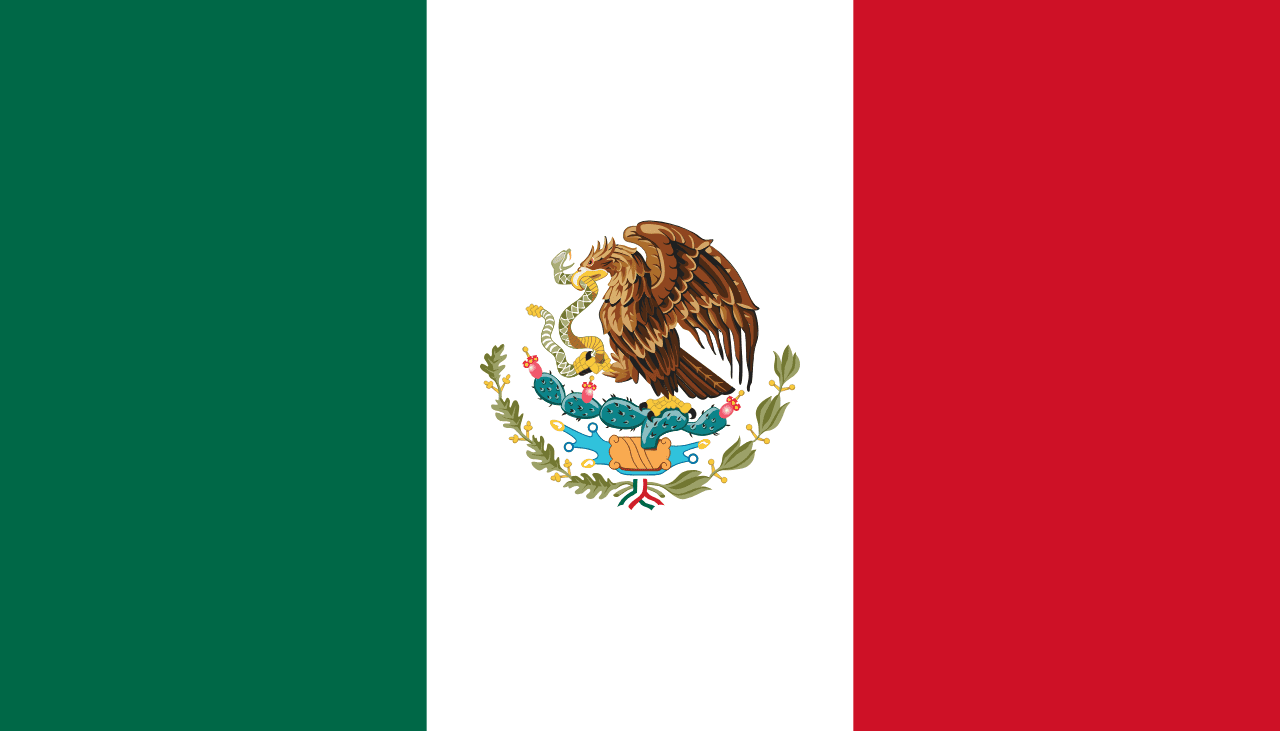
Few national emblems pack as much story into a single rectangle as the flag of Mexico. At a glance it is a clean tricolor of green, white, and red, but planted at its heart is an image straight out of Aztec mythology: a golden eagle perched on a cactus, a writhing rattlesnake clutched in its beak and talons. That coat of arms turns an otherwise familiar three-stripe layout into something unmistakably Mexican, binding together centuries of indigenous legend, colonial history, and modern national pride. This article walks through the colors, the design, the long evolution of the banner, how it stacks up against its tricolor cousins, and the role it plays in Mexican life today.
A Tricolor Anchored by an Eagle
The flag of Mexico is built from three vertical bands of equal width, ordered green, white, and red from the hoist (the edge nearest the pole) to the fly. Its official proportions are 4:7, making it noticeably longer than the squarer ratios used by some neighbors. The current version was officially adopted on September 16, 1968, a date chosen to coincide with Independence Day, though the basic tricolor scheme is far older. What separates this flag from any other on Earth is not the stripes themselves but the elaborate escudo nacional, the national coat of arms, set squarely in the middle of the white band.
What the Green, White, and Red Stand For
The meaning of Mexico's three colors has shifted over the generations, which is part of what makes them so interesting. When the tricolor first appeared, the symbolism was tied directly to the cause of independence: green stood for independence itself, white for religion (specifically Roman Catholicism), and red for union between Mexicans and the Spaniards who chose to stay. As Mexico became a secular republic, the official readings were updated to reflect a modern nation. Today green is generally understood to represent hope, white to stand for unity, and red to honor the blood of the national heroes who fought for the country. The colors stayed the same; the story behind them grew up alongside the nation.
The Legend Inside the Coat of Arms
The centerpiece is a compact retelling of one of the most famous origin myths in the Americas. According to Aztec tradition, the wandering Mexica people were told by their god to settle where they found an eagle perched on a prickly pear cactus, devouring a serpent. They spotted exactly that sign on an island in Lake Texcoco and there founded Tenochtitlan, the city that would eventually become Mexico City. The flag's emblem captures this scene faithfully: a golden eagle stands on a cactus growing from a rock in the water, a rattlesnake in its grasp, the whole image cradled by a wreath of oak and laurel branches tied with a ribbon in the national colors. Oak traditionally signals strength and laurel signals victory, framing the founding legend with the virtues of the republic.
From Independence Banner to Modern Standard
The green-white-red tricolor was first raised in 1821, during the closing months of the Mexican War of Independence. Its design grew out of the Army of the Three Guarantees, the force that united formerly opposing factions around three principles: independence, religion, and union. Each guarantee mapped onto one of the three colors, giving the new flag instant political meaning. Over the following century and a half the central emblem changed repeatedly to match whichever government held power. The eagle faced different directions, perched in different postures, and in some earlier versions was shown crowned during imperial periods or even without the serpent at all. The design we know now, with the eagle in profile turned toward the hoist and gripping the snake, was standardized and made official in 1968, the same year Mexico City hosted the Summer Olympics and wanted a definitive national image to present to the world.
Telling It Apart From Italy and Ireland
Because it shares a green-white-red palette and a vertical layout, Mexico's flag is most often confused with the flag of Italy. The decisive difference is the coat of arms: Italy's tricolor carries no central emblem, so a plain green-white-red banner is Italian, while the eagle-and-serpent device marks the Mexican one. There are subtler distinctions too. Mexico's green tends to be a deeper, darker shade, and its 4:7 ratio makes it longer than Italy's squarer 2:3 proportions. The flag of Ireland is another relative in spirit, though its order runs green, white, and orange rather than red, and it likewise carries no emblem. Among this family of tricolors, the Aztec coat of arms makes Mexico's flag instantly recognizable and impossible to mistake once you know to look for it.
A Symbol of Identity and Heritage
For Mexicans, the flag does more than mark a state; it carries a sense of continuity reaching back well before Spanish arrival. The eagle-and-serpent motif is woven through the national imagination, appearing on coins, official seals, sports jerseys, and countless everyday objects. By placing an indigenous legend at its very center, the flag asserts that modern Mexico is rooted in the civilizations that flourished on its land long before colonization. That heritage is taken seriously in law: it is illegal to use the coat of arms without government permission, a measure of how protected the emblem is. To learn more about the country behind the banner, see our mexico country guide.
The Flag in Everyday and Civic Life
The banner is woven into the Mexican calendar. Flag Day (Día de la Bandera), celebrated every February 24, is a major civic occasion marked by ceremonies, school assemblies, and patriotic displays. The flag flies most prominently on Independence Day, September 16, when streets and balconies fill with green, white, and red. It is a fixed presence at government buildings and schools, where students take part in honor-guard ceremonies and salutes. Beyond officialdom, it is a fixture of sport: Mexican football fans wave it through every FIFA World Cup, and athletes carry it into the Olympic Games and other international competitions, where its central emblem makes the country instantly identifiable in any crowd of spectators.
Quick Facts Worth Knowing
- The coat of arms is the single feature that distinguishes Mexico's flag from Italy's lookalike tricolor.
- Mexico sits in North America, the continent it shares with the United States and Canada.
- The current emblem was finalized in 1968, the year Mexico City hosted the Olympic Games.
- Earlier versions sometimes showed the eagle without the serpent in its grip.
- Using the national coat of arms without official permission is against the law.
- The wreath around the emblem combines oak for strength and laurel for victory.
Frequently Asked Questions
When was the flag of Mexico adopted?
The green-white-red tricolor was first used in 1821 during the Mexican War of Independence, but the current design, with its standardized eagle-and-serpent coat of arms, was officially adopted on September 16, 1968, to coincide with Independence Day and the year Mexico City hosted the Olympics.
What do the colors of the Mexican flag mean?
The meanings have evolved over time. Originally green represented independence, white religion, and red union. In the modern republic, green is read as hope, white as unity, and red as the blood of the national heroes who fought for the country.
What does the eagle on the Mexican flag represent?
The eagle perched on a cactus and devouring a serpent depicts the Aztec legend of the founding of Tenochtitlan, the city that became Mexico City. According to myth, the Mexica people were told to build their capital where they saw exactly this sign, so the emblem links the modern nation to its indigenous origins.
What continent is Mexico on, and how does its flag compare to Italy's?
Mexico is located in North America. Its flag is frequently confused with Italy's because both use a green-white-red vertical tricolor, but Mexico's carries the national coat of arms in the center of the white band, while Italy's is plain. Mexico's green is also darker and its proportions longer.