

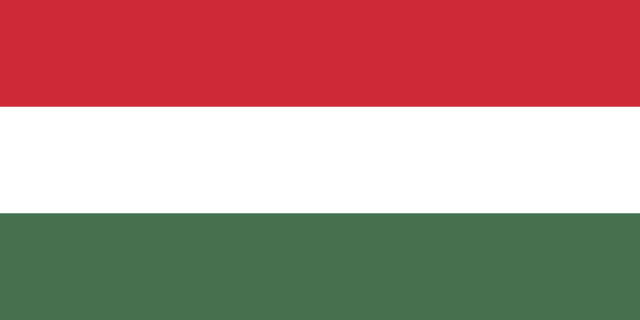
Few flags manage to feel both quietly modest and deeply patriotic at once, but Hungary's red-white-green triband pulls it off. Three equal horizontal stripes, no crest, no star, no fuss — and yet to Hungarians these colors carry centuries of struggle, pride, and survival in the heart of Central Europe. The flag you see flying over the Hungarian Parliament along the Danube today is the product of revolutions, foreign empires, and a stubborn national identity that refused to be erased. Let's unpack what those stripes mean, where they came from, and why this simple design resonates so strongly.
A Tricolor at First Glance
The Hungarian flag is a horizontal triband: a band of red on top, white in the middle, and green at the bottom, each stripe of equal height. There is no coat of arms, no emblem, no decorative flourish in the standard civil and national version — just three clean fields of color stacked one above the other. This restraint is part of its charm. The design reads instantly from a distance, photographs cleanly, and translates beautifully onto everything from stadium banners to lapel ribbons. The simplicity is deceptive, though, because each of those three plain bands is doing a lot of symbolic heavy lifting.
What the Red, White, and Green Mean
Hungarians attach a clear moral vocabulary to their flag's palette. Red stands for strength — the blood and resilience of those who fought to defend the nation. White represents faithfulness, the loyalty and purity of purpose that binds the people together. Green signifies hope, the enduring optimism for the country's future even through its hardest chapters.
This strength-faithfulness-hope reading gives the flag an almost narrative quality: the courage to fight, the loyalty to stand together, and the hope to keep going. It's a triad that maps neatly onto the way many Hungarians describe their own history — repeatedly tested, repeatedly defiant, and repeatedly rebuilding. The colors themselves are far older than the modern symbolism, having appeared in Hungarian heraldry and royal insignia for centuries before anyone codified what each band "officially" meant.
Design and Layout
The construction could hardly be simpler. Take a rectangle, divide it horizontally into three equal stripes, and assign red, white, and green from top to bottom. That's it. The proportions and the strict horizontal arrangement are what give the flag its identity and keep it from being confused with vertically striped tricolors that share the same hues.
There is also a state variant used by the government that places the Hungarian coat of arms — featuring the silver double cross on red and the red-and-white Árpád stripes, topped by the Holy Crown of St. Stephen — toward the hoist side of the white band. For everyday civic use, sporting events, and the flags ordinary people wave, however, the plain triband is the version you'll encounter. The absence of the arms in the common flag keeps it democratic and uncomplicated: a banner that belongs to everyone, not just the state.
How the Flag Evolved
The red-white-green combination grew out of medieval Hungarian heraldry, but the flag as a tricolor owes its form to the wave of national awakening that swept Europe in the late eighteenth and nineteenth centuries. The horizontal triband was directly inspired by the French Revolutionary tricolor, whose bold three-color scheme became a template for emerging nations expressing liberty and self-determination. Hungarians adapted that revolutionary idea to their own historic colors during the surge of patriotic feeling around the Revolution of 1848.
From there the flag traveled a turbulent road. Hungary spent decades inside the Austro-Hungarian Empire, lived through two world wars, lost territory, and then fell under communist rule, during which various emblems and a Soviet-style coat of arms were grafted onto the design. The version recognized today dates to 1957, when the plain red-white-green triband — free of the heavy communist insignia that had marked the immediately preceding flags — was reaffirmed. The 1956 Hungarian Revolution had famously seen protesters cut the communist emblem out of the center of their flags, leaving a hole that became one of the most powerful images of twentieth-century resistance. The clean tricolor that followed carries an echo of that defiance.
Same Colors, Different Flag: Hungary Versus Its Look-Alikes
If you've ever mixed up the Hungarian and Italian flags, you're in good company — and the explanation is geometry, not color. Italy uses the very same green, white, and red, but arranges them in vertical stripes. Hungary's are horizontal. Orientation is the single distinguishing feature, and it's the first thing to check when you're trying to tell them apart.
The horizontal red-white-green also invites comparison with other regional tricolors. Bulgaria flies a white-green-red horizontal triband, which can momentarily fool the eye, but its top stripe is white rather than red and it swaps in green where Hungary has white in the middle. Iran's flag shares the green-white-red horizontal sequence as well, but adds distinctive emblems and script. What sets Hungary apart in this crowd is the specific top-to-bottom order — red, then white, then green — paired with the bare, emblem-free field. Once you've internalized "red on top, green on the bottom, stripes lying down," the Hungarian flag becomes unmistakable.
The Flag in National Life
For a country that sits squarely in Central Europe — Hungary is firmly a European nation, landlocked among neighbors like Austria, Slovakia, Romania, and Serbia — the flag is a constant companion to public life. It flies over government buildings, schools, and the grand neo-Gothic Parliament on the banks of the Danube. National holidays bring it out in force: March 15th commemorates the 1848 Revolution, August 20th honors St. Stephen and the founding of the state, and October 23rd marks the 1956 uprising. On those days the tricolor appears on balconies, bridges, and as ribbons pinned to coats across Budapest and beyond.
It is just as visible in sport. When the Hungarian national football and water polo teams take the field — or the pool, given the country's storied aquatic tradition — the stands fill with red, white, and green. The colors function as instant shorthand for "us," a visual rallying cry that needs no words. If you want to dig deeper into the country behind the banner, our hungary country guide covers its regions, culture, and history in detail.
Quick Facts Worth Knowing
- The flag is a simple horizontal triband of red, white, and green in equal stripes.
- The colors mean strength (red), faithfulness (white), and hope (green).
- The current plain tricolor was reaffirmed in 1957.
- Its triband form was inspired by the French Revolutionary tricolor.
- It uses the same colors as Italy's flag but arranged horizontally instead of vertically.
- During the 1956 revolution, protesters cut the communist emblem from the center, creating an iconic "hole flag."
- The state version adds the national coat of arms with the Holy Crown of St. Stephen.
Frequently Asked Questions
When was the Hungarian flag adopted?
The plain red-white-green tricolor in its current, emblem-free form was reaffirmed in 1957. The red-white-green color scheme itself, however, reaches back through Hungarian heraldry for centuries, and the horizontal tricolor flag dates from the national revival of the 1800s.
What do the colors of the Hungarian flag mean?
Red symbolizes strength, white symbolizes faithfulness, and green symbolizes hope. Together they form a triad that Hungarians often connect to their long history of struggle, loyalty, and resilient optimism for the future.
Who designed the Hungarian flag?
There is no single named designer. The flag emerged organically from centuries-old Hungarian heraldic colors, reshaped into a horizontal tricolor under the influence of the French Revolutionary tricolor during the patriotic movements of the nineteenth century, particularly around the 1848 Revolution.
What continent is Hungary on, and how does its flag compare to similar ones?
Hungary is a landlocked country in Central Europe. Its flag shares the green, white, and red palette with Italy, but Italy's stripes run vertically while Hungary's run horizontally. It also resembles Bulgaria's and Iran's horizontal tricolors, though the specific red-white-green order from top to bottom — and the absence of any emblem on the common version — keeps it distinct.