
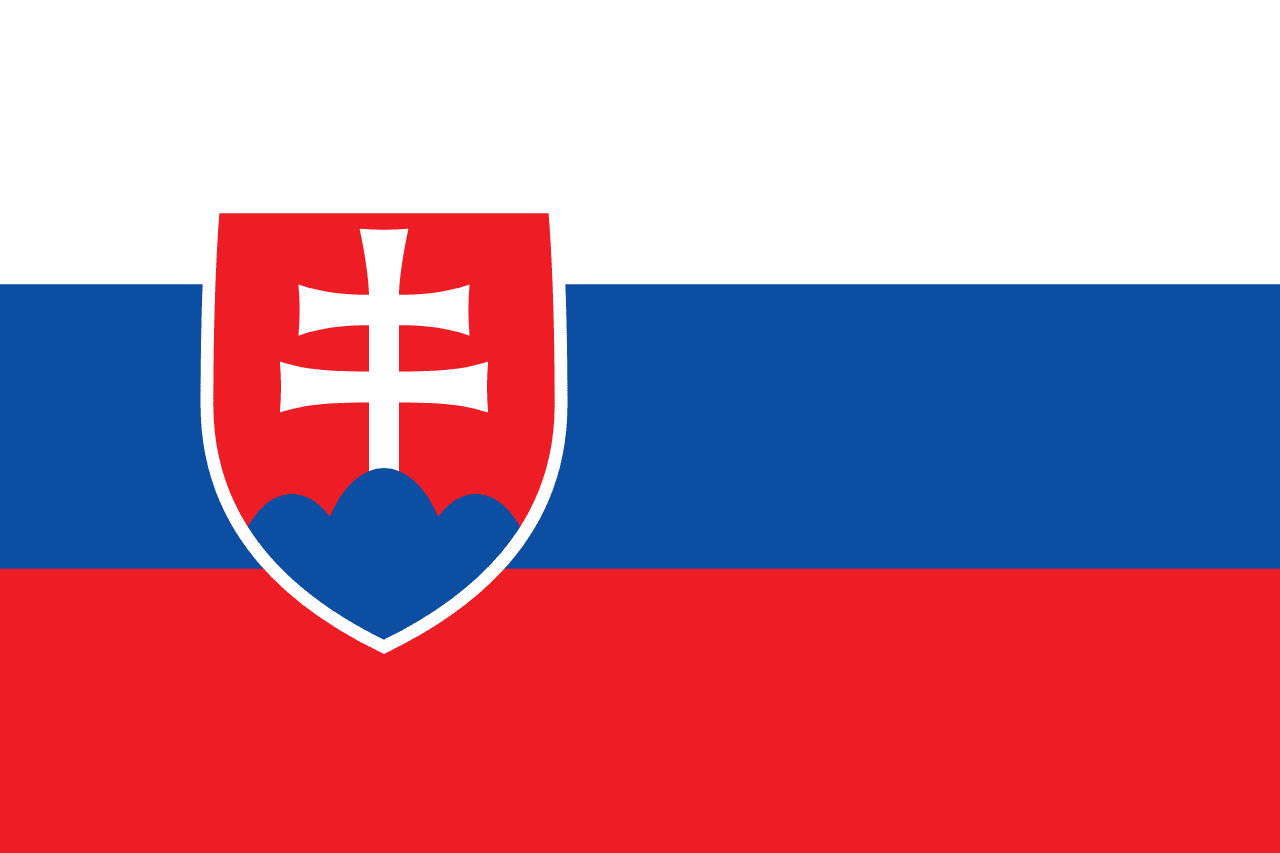
Hang the flag of Slovakia next to those of its neighbors and you'd be forgiven for a moment of hesitation. Three horizontal bands of white, blue, and red appear again and again across Central and Eastern Europe, a visual handshake among Slavic nations. But linger on the Slovak banner a moment longer and you'll notice what sets it apart: an ornate coat of arms riding just left of center, crowned by a striking double cross planted atop three blue hills. That emblem is the whole story compressed into a single shield, and it's the reason no one who knows their flags ever mistakes Slovakia's for anyone else's.
The modern flag was raised in 1992, in the final months before Czechoslovakia split into two independent states. Yet the symbols stitched into it reach back many centuries further, drawing on medieval heraldry and a religious motif older than most European nations. It is, in that sense, a young flag carrying very old ideas.
A Palette Shared Across the Slavic World
White, blue, and red are the so-called Pan-Slavic colors, a trio that became shorthand for Slavic identity and solidarity during the nationalist awakenings of the nineteenth century. The combination is often traced to the Russian flag, which itself borrowed from Dutch maritime colors, and it spread rapidly as Slavic peoples across Europe sought emblems of common heritage and the dream of self-determination.
For Slovakia, these colors carry a double weight. They speak to the broad family of Slavic nations to which the Slovaks belong, while also rooting the country in a specific history of struggle for recognition. There is no single official dictionary that assigns one fixed virtue to each stripe in the way some national flags do; instead the colors are understood collectively as a declaration of belonging, of a people taking their place among kindred nations. The white sits at the top, blue in the middle, and red along the bottom, the standard reading order from peak to base.
Reading the Design from Hoist to Fly
The structure begins simply enough: a horizontal triband, three equal bands of white, blue, and red running the full width of the cloth. Were that all, the flag would be nearly identical to several others. What rescues it from anonymity is the coat of arms, positioned toward the hoist (the side nearest the pole) and shifted slightly above the vertical center so that it sits balanced rather than buried in the blue.
The arms take the form of a red shield. Inside it rises a white (silver) double cross standing on the central and tallest of three blue hills or mounds. The cross has two horizontal bars rather than one, and its limbs flare gently outward at the ends. The three peaks beneath it are commonly understood to represent three mountain ranges associated with the Slovak lands. Placing the emblem partly over each colored band ties the heraldry and the tricolor together, so the shield reads as belonging to the whole flag rather than floating on top of it.
From Medieval Shield to National Banner
The double cross on its triple hill is far older than the country flying it today. The motif appears in the heraldry of the Kingdom of Hungary, of which the Slovak territories were long a part, and the symbol itself descends from a Byzantine tradition where the patriarchal or double cross signified Christian faith and ecclesiastical authority. Over the centuries the emblem became firmly attached to the Slovak homeland, surviving the rise and fall of empires.
The colors and a tricolor arrangement had been associated with Slovak national aspirations since the revolutionary ferment of the mid-1800s. Through the twentieth century the Slovak lands passed through the Austro-Hungarian Empire, the first Czechoslovak Republic, the upheavals of the Second World War, and the long postwar communist period within a reunited Czechoslovakia. When that federation peacefully dissolved in what became known as the Velvet Divorce, Slovakia needed a flag of its own, distinct from the shared Czechoslovak banner. The answer, adopted in 1992 as independence approached, married the Pan-Slavic tricolor to the historic coat of arms, fusing centuries of heraldic memory with the colors of modern Slavic nationhood. You can read more about the country's broader story in our slovakia country guide.
Telling It Apart from the Look-Alikes
This is where the Slovak flag earns its identity. The white-blue-red triband is genuinely crowded territory. Russia flies a plain version with no emblem at all. Slovenia uses the very same band order topped by its own coat of arms near the hoist, featuring a stylized mountain and stars. The historic Pan-Slavic flag and several other regional banners share the palette too. To an untrained eye, a quick glance can blur them together.
The distinguishing details reward a closer look. Slovakia's emblem is a red shield bearing a white double cross on three blue hills, an unmistakable heraldic device that neither Russia nor Slovenia carries. Slovenia's arms, by contrast, show a white mountain with wavy lines beneath and three gold stars above, set on a blue field. Russia, having no charge whatsoever, is the easiest of the three to rule out. Once you train your eye on the shape of the central emblem rather than the stripes, the confusion dissolves almost instantly. The double cross is the single feature that anchors the Slovak flag in its own clear identity.
What the Flag Means to Slovaks
For a nation that only became fully independent in the early 1990s, the flag does real emotional work. It is a relatively recent symbol of a sovereignty that many generations hoped for but did not live to see. The double cross in particular links the present-day republic to a deep well of cultural and religious heritage, a reminder that the Slovak people and their symbols long predate the modern state.
The flag appears on government buildings, at official ceremonies, and in the hands of citizens during national commemorations. Its use is governed by national regulations, as is typical for state symbols, and the coat of arms doubles as a standalone emblem of the republic on documents, seals, and official insignia. To fly the flag is to claim a place in the family of European nations under colors that announce both Slavic kinship and a distinctly Slovak past.
The Flag in Everyday and Public Life
Beyond formal state occasions, the Slovak tricolor turns up wherever national feeling runs high. Sports are perhaps the most visible arena. Slovak ice hockey fans are famous for filling arenas with white, blue, and red, and the flag and coat of arms travel with the national teams to international tournaments where the double cross becomes an instantly recognizable badge of support. The same colors decorate civic celebrations, public holidays marking moments in the nation's history, and the everyday displays of pride that any country shows for its banner.
Here are a few quick facts worth remembering about the flag of Slovakia:
- It was adopted in 1992, on the eve of independence from Czechoslovakia.
- Its colors, white, blue, and red, are the classic Pan-Slavic palette shared with many Slavic nations.
- The double cross is a Byzantine symbol of Christianity, far older than the modern state.
- The three blue hills beneath the cross are linked to mountain ranges of the Slovak lands.
- Slovakia sits in Central Europe, bordered by countries including the Czech Republic, Poland, Ukraine, Hungary, and Austria.
- The coat of arms near the hoist is what distinguishes it from the similar Russian and Slovenian flags.
Frequently Asked Questions
When was the flag of Slovakia adopted?
The current flag was adopted in 1992, during the breakup of Czechoslovakia and just before Slovakia became a fully independent state in 1993. While the colors and the historic coat of arms had been associated with the Slovak lands long before, the flag in its present official form dates to that pivotal moment of national rebirth.
What do the colors of the Slovak flag mean?
White, blue, and red are the Pan-Slavic colors, a combination adopted by many Slavic nations in the nineteenth century to express shared heritage and the aspiration to nationhood. Rather than each stripe standing for a separate virtue, the colors are read together as a statement of Slavic identity and Slovakia's place among kindred peoples.
What is the double cross on the Slovak flag?
The white double cross standing on three blue hills sits within the red shield of the coat of arms. The double, or patriarchal, cross is a Byzantine Christian symbol that became attached to the Slovak homeland through centuries of heraldic tradition, while the three hills are commonly understood to represent mountain ranges of the region.
Which continent is Slovakia on, and which flags look similar?
Slovakia is a landlocked country in Central Europe. Its white-blue-red triband closely resembles the flags of Russia and Slovenia, both of which use the same colors. The decisive difference is Slovakia's coat of arms near the hoist, with its distinctive double cross on three hills, an emblem neither of the other two flags carries.