
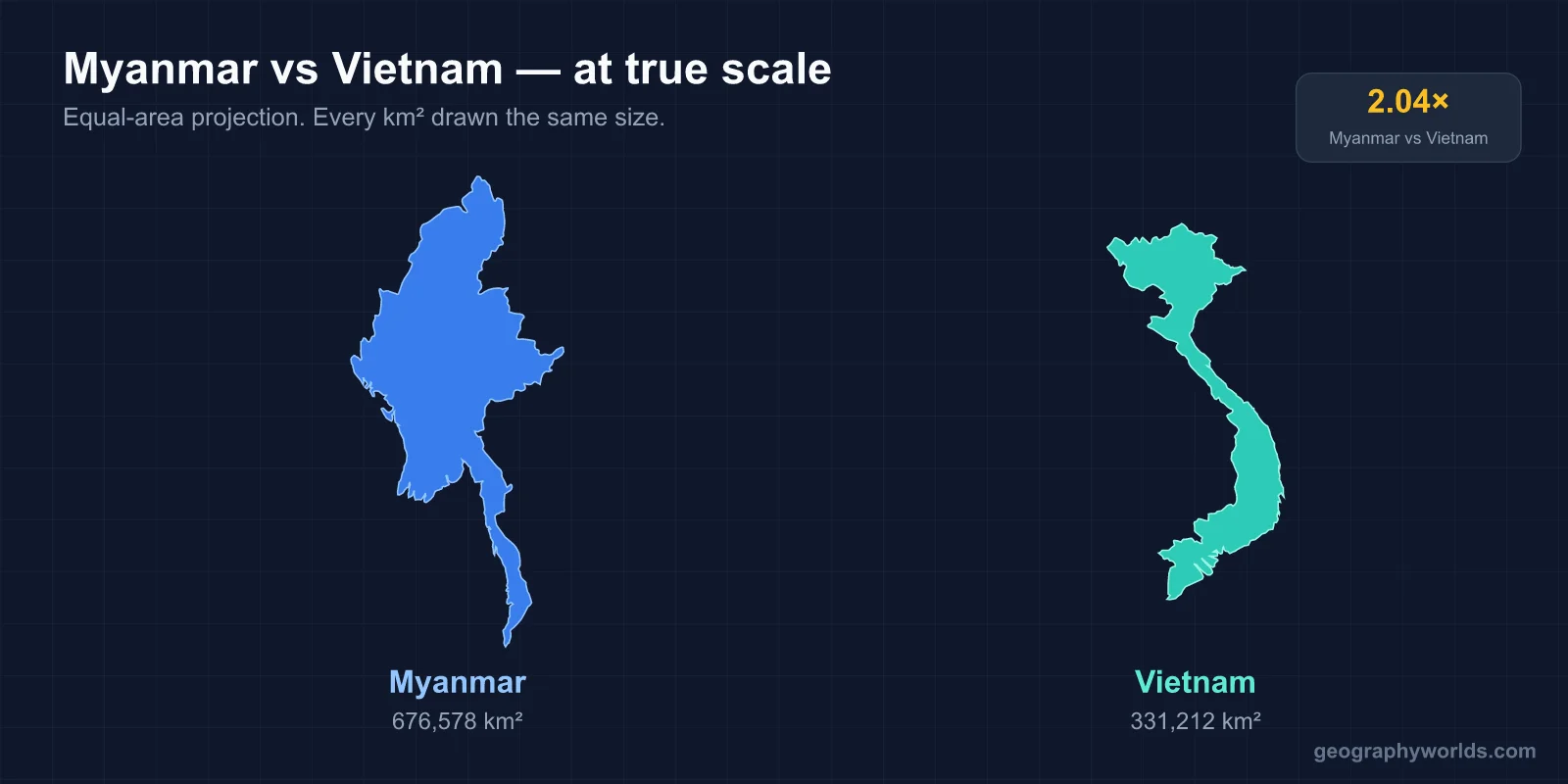
Myanmar is the bigger country and Vietnam is the more populous and far richer one. Myanmar covers about 676,600 km², roughly twice Vietnam’s 331,300 km², yet Vietnam had an estimated 102.3 million people in 2025 against Myanmar’s 55.8 million (2022 estimate). The IMF puts Vietnam’s GDP per person at about $5,100 for 2026, more than four times Myanmar’s roughly $1,100 for 2025. Myanmar’s capital is Naypyidaw and its main language is Burmese; Vietnam’s capital is Hanoi and its language is Vietnamese. The two do not touch: Laos lies between them, and each faces a different ocean, Myanmar the Bay of Bengal and Andaman Sea, Vietnam the South China Sea.
| Myanmar | Vietnam | |
|---|---|---|
| Area | 676,579 km² | 331,345 km² |
| Population | 55.8 million (2022 est.) | 102.3 million (2025 est.) |
| Capital | Naypyidaw | Hanoi |
| Largest city | Yangon | Ho Chi Minh City |
| Highest point | Hkakabo Razi, 5,881 m | Fansipan, 3,143 m |
| Coastline | 1,930 km | 3,444 km |
| GDP per person (nominal) | about $1,110 (2025) | about $5,115 (2026) |
The Irrawaddy Basin Against Vietnam’s 3,444 km Coastline
Myanmar is built around one river valley. Four mountain systems, the Rakhine Yoma, the Bago Yoma, the Shan Hills and the Tenasserim Hills, run north to south off the eastern end of the Himalayas, and between them flow three rivers: the Irrawaddy, the Salween (Thanlwin) and the Sittaung. The Irrawaddy is the spine of the country. At nearly 2,170 km it runs the length of Myanmar before spreading into a delta and reaching the Gulf of Martaban, and most of the population lives in its valley, between the Rakhine Yoma and the Shan Plateau. In the far north, in Kachin State, Hkakabo Razi rises to 5,881 m, the highest point in the country. Forests, including the teak stands of lower Myanmar, still cover more than 49 per cent of the land.

Vietnam is shaped the other way round. It is a long S-shaped strip whose 3,444 km coastline is about three-quarters the length of its 4,639 km of land borders with China, Laos and Cambodia. Two deltas hold the country at either end. In the north the Red River flows past Hanoi into the Gulf of Tonkin, building a flat, roughly triangular plain of about 15,000 km². In the south the Mekong, the longest river in Vietnam, fans out below Ho Chi Minh City. Between and around them, highlands cover about two-thirds of Vietnam’s territory. The top of the country, Fansipan, on the border of Lào Cai and Lai Châu provinces, reaches 3,143 m. That makes it the highest mountain on the Indochinese Peninsula, though it stands more than 2,700 m lower than Hkakabo Razi.
Both countries live by the monsoon, but in different ways. Myanmar’s coastal regions can receive more than 5,000 mm of rain a year, and the low Irrawaddy delta is exposed to storms. Cyclone Nargis did its worst damage there in May 2008. Vietnam’s length gives it two climates. Temperatures around Hanoi and the Red River Delta range from about 15 to 33 °C over the year, while the southern plains around Ho Chi Minh City and the Mekong Delta stay between about 21 and 35 °C. Vietnam also has two natural World Heritage Sites, Hạ Long Bay and Phong Nha-Kẻ Bàng National Park.

135 Recognised Groups Against a Kinh Majority of 85 Per Cent
Myanmar’s government recognises 135 distinct ethnic groups. The Bamar form an estimated 68 per cent of the population and dominate the central Irrawaddy plain, which is organised into “regions”. The minorities hold much of the hill country around it, organised into “states” named after them. The Shan make up about 10 per cent, the Kayin (Karen) about 7 per cent, the Rakhine about 4 per cent and overseas Chinese about 3 per cent. That geography matters, because many of Myanmar’s long-running conflicts have been fought in the minority states around the Bamar heartland: in 2012, for example, they included the Kachin conflict in the north, fighting in Rakhine State on the western coast, and conflicts involving Shan, Lahu and Karen groups in the east.
Vietnam officially recognises 54 ethnic groups, but one of them overwhelms the rest. The 2019 census counted 82,085,826 Kinh (also called Viet), 85.32 per cent of the population. The Tày, Thái, Mường, Hmong, Nùng and Dao live mostly in the highlands, while the Kinh fill the two deltas and the coastal strip. The same census found 96.2 million people in total; by 2025 the estimate had passed 102 million.
The result is a large gap in how crowded the two countries feel. Vietnam packs about 309 people into each square kilometre. Myanmar has about 82, fewer than a third as many, because so much of its territory is mountain and forest and its population is roughly half the size.
Rubies and Jade Against Cashews, Pepper and Coffee
Myanmar’s economy still rests heavily on what can be dug or grown. The country is rich in jade, gems, oil, natural gas and teak. About 90 per cent of the world’s rubies come from Myanmar, and it supplies around 10 per cent of the world’s rare earths. Rice covers about 60 per cent of its cultivated land and makes up 97 per cent of its food-grain output by weight. Under British rule Burma was the world’s largest rice exporter. Its 2025 GDP of about $60.6 billion equals roughly $1,110 a person. Many Burmese work abroad: they make up about 80 per cent of all migrant workers in Thailand.
Vietnam took a different path in 1986. That year the Sixth National Congress of the Communist Party launched Đổi Mới (“Renovation”), a shift from central planning to what the party calls a socialist-oriented market economy. Private farms and factories were allowed, and foreign investment followed. Vietnam is now the world’s largest producer of cashew nuts and of black pepper, with about a third of the world market in each, the second-largest rice exporter after Thailand, and the second-largest coffee exporter. The United States buys the biggest share of its exports, while China supplies the most imports. The IMF puts its 2026 GDP at about $527 billion, nearly nine times Myanmar’s.
Theravada Pagodas and Round Letters Against Chữ Quốc Ngữ and Tết
Myanmar’s culture took its shape in the Pagan Kingdom, founded in the 1050s, when Burmese language and Theravada Buddhism spread across the Irrawaddy valley. Pagan’s rulers and wealthy patrons built more than 10,000 Buddhist temples in the capital zone alone; the survivors make up the plain of Bagan. Buddhism is still the faith of about nine in ten people, and the constitution recognises its “special position”. Christianity is strongest among the Chin, Kachin and Karen, and Islam among groups including the Rohingya. Burmese is written in a script of circular and semi-circular letters adapted from the Mon script, with the oldest known inscriptions dating from the 11th century. The same alphabet is used for the liturgical languages Pali and Sanskrit, and the related Shan and modern Mon alphabets have been restructured to follow its standard.
Vietnam’s older layers came from China. After more than a thousand years under Chinese rule, which ended with independence in 939, successive dynasties kept absorbing Confucianism and Buddhism from the north. Today Vietnamese is written in chữ Quốc ngữ, a Latin-based alphabet of 29 letters first developed by the Portuguese Jesuit Francisco de Pina and his colleagues in the early 17th century, with extra marks for the language’s tones. Religion looks very different too. About 73 per cent of people report no religion or follow folk practice, 14.3 per cent are Buddhist and 7.1 per cent Catholic. The biggest date in the year is Tết, the lunar new year, when city workers return to their home villages. On the table, phở and bánh cuốn began in the north before spreading south with migrants.
A 2021 Coup Against a Single-Party State Led by Tô Lâm
The two histories diverge sharply after independence. Burma became independent from Britain on 4 January 1948. The military seized power in 1962, crushed the 8888 Uprising in 1988, and ruled directly until the junta was dissolved in 2011. The National League for Democracy won the 2015 election and a larger majority in 2020. The army, the Tatmadaw, then seized power again in the coup of 1 February 2021. Mass protests turned into a civil war that is still being fought in 2026. A nominally civilian government took office that year after elections widely described as a sham, and the coup leader, Min Aung Hlaing, is now president. The capital itself is an army project. The junta moved the government out of Yangon to a site near Pyinmana on 6 November 2005, and revealed the name Naypyidaw, “abode of the king”, on Armed Forces Day, 27 March 2006. More on its oversized avenues is in our guide to Naypyidaw, Myanmar’s purpose-built capital.
Vietnam’s independence was declared on 2 September 1945. After France was defeated at Điện Biên Phủ in 1954, the Geneva Conference split the country in two. North Vietnam’s forces took Saigon on 30 April 1975, and in 1976 the country was reunified as a socialist state under the Communist Party of Vietnam. The party still governs alone, and its general secretary, Tô Lâm, also holds the state presidency. That one-party system has stayed in place through four decades of market reform. Hanoi, which has been the capital since reunification, sits on the Red River; our guide to Hanoi as Vietnam’s capital covers its Old Quarter and lakes.
Both countries belong to ASEAN, and both were ruled from abroad in the 19th and 20th centuries, Burma by Britain after three Anglo-Burmese Wars and Vietnam by France. The difference is what came after. Vietnam converted a single-party state into an export economy, while Myanmar has spent the years since 2021 in coup and civil war. If Myanmar’s past appeals more than its present, the temple plain described in our guide to Bagan’s World Heritage site is where Burmese history is most visible.