

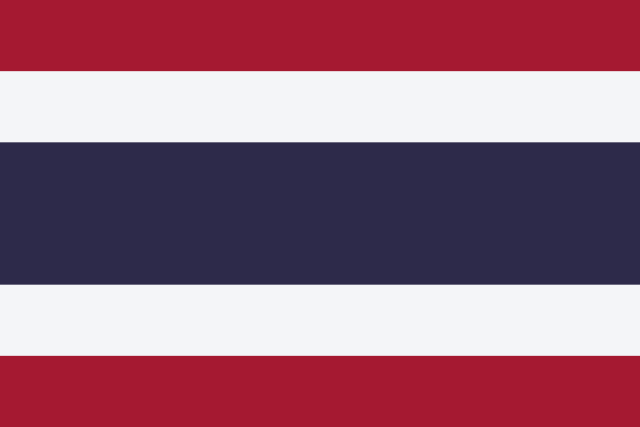
Few flags pack as much meaning into so simple a shape as the banner of Thailand. Known to Thais as the Thong Trairong, or "tricolour flag," it is a crisp arrangement of five horizontal stripes in red, white, and blue. There is no emblem, no crest, no animal or star to decode. Yet behind those plain bands lies a story of war-era diplomacy, royal authorship, and a national philosophy condensed into three colours. Adopted in 1917, the design has flown unchanged for more than a century, making it one of the most stable and recognisable identities in Southeast Asia.
A Quick Look at the Tricolour
The flag's layout is deliberately balanced. Five horizontal stripes run across the field: a narrow red band at the top, a white band beneath it, a wider blue band through the centre, then another white band, and finally a red band along the bottom. The arrangement is symmetrical, so the flag reads the same whether viewed from above or below the centre line. The double-width blue stripe through the middle is the visual anchor, and the symmetry gives the banner a steady, formal character that suits its ceremonial role. Because the design carries no charge or text, it is easy to reproduce at any size, from a tiny lapel pin to a stadium-sized sheet draped across the stands.
What the Three Colours Mean
Each colour stands for a pillar of Thai life. Red represents the nation and the blood of the people who have defended it. White stands for religion and purity, a nod to the central place of Buddhism in Thai culture. Blue, occupying the broad central stripe, represents the monarchy. Placing blue at the heart of the flag is no accident: the institution of the king sits, both literally and symbolically, between the nation and its faith, binding the three together.
Together these colours express what is often described as Thailand's unofficial national motto: Nation, Religion, King. It is a tidy piece of design thinking, encoding a whole civic creed into a sequence of stripes that any schoolchild can name and explain. The fun of the Thai flag is that its meaning is not buried in obscure heraldry; it is right there on the surface, one idea per colour.
How the Flag Took Its Present Form
Thailand's earlier flags leaned heavily on red, and for a long time featured a white elephant — a sacred royal animal — on a red field. The shift to stripes came in the early twentieth century, and the decisive change arrived during the First World War. The blue stripe was added in 1917 to show Thailand's solidarity with its Allied partners, whose own flags — those of France, Britain, the United States and Russia among them — shared the red-white-and-blue palette. Adding blue brought the Thai banner into visual harmony with the wartime coalition while simultaneously giving the monarchy its own dedicated colour at the flag's centre.
That dual purpose is part of what makes the 1917 redesign so elegant. A single new stripe accomplished a diplomatic gesture abroad and a symbolic statement at home. Once settled, the tricolour stuck. While many nations have revised their flags repeatedly through coups, constitutions, and changes of government, Thailand has kept the same five-stripe arrangement for over a hundred years, an unusual continuity for a country that has seen plenty of political turbulence in that time. To place the country in its wider regional context, see our thailand country guide.
How It Compares to Look-Alike Flags
The red-white-blue combination is one of the most common in the world, so the Thai flag inevitably invites comparisons. The closest visual cousin is the flag of Costa Rica, which uses the very same five-stripe structure — red and white outer bands framing a wide central blue stripe — but in a different colour order, with blue on the outside and red in the middle on the Thai version's mirror. Many observers do a double take when the two are shown side by side. Costa Rica's flag also typically carries a coat of arms on the state version, which immediately sets it apart.
What distinguishes Thailand's tricolour from the broader red-white-blue family — think France, the Netherlands, or the United States — is its purely horizontal, symmetrical banding and the prominence of the central blue stripe. There are no stars, no crosses, no vertical divisions. The Thai flag's restraint is its signature: it relies entirely on proportion and colour order rather than added symbols to make itself unmistakable. Once you know to look for the double-thick blue stripe in the middle, you will never confuse it with anything else.
A Banner Woven into National Identity
For Thais, the tricolour is more than a state emblem; it is a daily presence. The national anthem, Phleng Chat, is broadcast twice a day, at eight in the morning and six in the evening, and in public spaces people pause as the flag is raised or lowered. This twice-daily ritual ties the physical act of honouring the flag to the rhythm of ordinary life in a way few other countries practise so consistently.
Because the colours map so cleanly onto Nation, Religion, and King, the flag also functions as a teaching tool. Children learn the creed by learning the stripes, and the banner reinforces a shared civic story every time it appears at a temple festival, a school assembly, or a government building. Its very simplicity makes it a vessel that ordinary citizens feel they understand and own.
The Flag in Modern Thai Life
You will see the tricolour everywhere across contemporary Thailand. It flies over ministries and embassies, decorates the kits and banners of national sports teams, and appears in dense rows along streets during royal birthdays and national holidays. Major events such as the king's birthday and other royal occasions bring out flags by the thousands, often paired with colours associated with the reigning monarch.
Thailand also marks a dedicated National Flag Day, commemorating the date the tricolour was officially adopted. The observance reinforces the public's connection to the banner and to its wartime origins. In sport, the flag travels with Thai athletes to regional and global competitions, where it serves as instant shorthand for the country on a crowded international stage. Whether stitched onto a Muay Thai fighter's shorts or hoisted at a Southeast Asian Games medal ceremony, the tricolour carries the same message it has since 1917.
Interesting Facts About the Thai Flag
- The Thai name Thong Trairong literally means "tricolour flag," referring to its three colours.
- It is fully symmetrical: flip it top to bottom and the design looks identical.
- The central blue stripe is twice the width of each of the other four stripes.
- Blue was introduced in 1917 partly to align the flag with Thailand's First World War allies.
- The flag carries no emblem, text, or symbol — its meaning rests entirely on colour and arrangement.
- The colour scheme encodes the national triad of Nation (red), Religion (white), and King (blue).
Frequently Asked Questions
When was the flag of Thailand adopted?
The current five-stripe tricolour was adopted in 1917. That year saw the addition of the central blue stripe, finalising the design that has remained in use ever since.
What do the colours of the Thai flag mean?
Red represents the nation and the blood of its people, white stands for religion and purity, and blue represents the monarchy. Together they express the national ideal of Nation, Religion, and King.
What continent is Thailand on?
Thailand is located in Southeast Asia, on the continent of Asia. It sits at the heart of the Indochinese mainland, sharing borders with Myanmar, Laos, Cambodia, and Malaysia.
How is the Thai flag different from the flag of Costa Rica?
Both use a five-stripe horizontal layout with a wide central band, but the colour order differs: Thailand places blue in the centre with red on the outer edges, while Costa Rica places red in the centre with blue on the outer edges. Costa Rica's state flag also includes a coat of arms, which Thailand's flag does not.