
Few flags pack their meaning into stripes quite as deliberately as Malaysia's. At first glance it reads like a cousin of the American Stars and Stripes, but look closer and you'll find a banner built around a precise piece of arithmetic: fourteen stripes, fourteen points on a star, and a federation that had to count its parts before it could fly its colors. Known affectionately as the Jalur Gemilang, or "Stripes of Glory," this red-and-white field with its blue canton, crescent, and star tells the story of a young Southeast Asian nation stitching disparate states into a single whole.
A Banner of Counted Parts
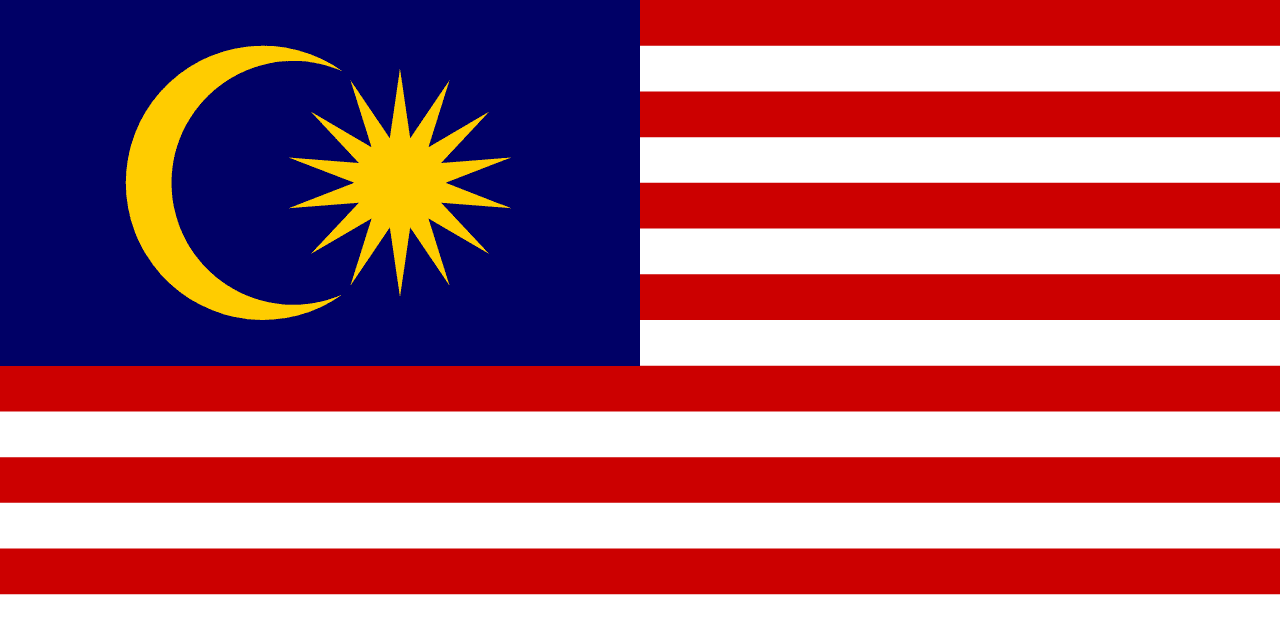
The Malaysian flag is what vexillologists call a "stripe-and-canton" design. The field is divided into fourteen horizontal bands of equal width that alternate between red and white, beginning and ending with red. In the upper hoist corner sits a dark blue rectangle, the canton, which extends down over the top several stripes. Resting inside that blue field are two golden emblems: a crescent moon opening upward and, beside it, a many-pointed star. The overall palette is tight and confident, just four colors, red, white, blue, and yellow, arranged so that the eye is pulled first to the bright canton and then out across the rhythm of the stripes.
That fourteen-fold rhythm is not decorative. Each stripe stands for a component of the federation, and the count was chosen so the numbers in the field and the numbers in the star would agree. It is a flag that rewards a second look, because the symbolism is literally embedded in the geometry rather than printed alongside it.
What the Colors and Symbols Mean
The official symbolism is straightforward and tied directly to the structure of the country. The fourteen alternating red and white stripes represent the thirteen states of Malaysia together with the federal government, treating the union itself as the fourteenth equal partner. The crescent in the canton represents Islam, the country's official religion, while the star alongside it stands for unity, its points echoing the same fourteen members of the federation that the stripes describe.
The colors carry their own associations within the design. The deep blue of the canton is read as a symbol of the unity of the Malaysian people, and it provides the calm backdrop against which the religious and national emblems sit. The golden yellow of the crescent and star is the royal color in Malay tradition, linking the flag to the country's sultans and the institution of monarchy. Red and white, the colors of the stripes, lend the banner its energy and clarity, and they are shades shared with several neighboring nations' flags across the region.
How the Flag Came to Be
Malaysia's flag was adopted in 1963, the same year the modern federation took shape, but its design did not appear from nothing. It was modified from the flag of the Federation of Malaya, the predecessor state that had used a very similar stripe-and-canton banner. When Malaya expanded into the wider federation of Malaysia, the flag was updated so that its counts reflected the enlarged union, with the stripes and the points of the star adjusted to match the new membership.
This continuity matters. Rather than inventing an entirely new symbol, the framers of independent Malaysia chose to evolve an existing one, preserving the familiar red-and-white stripes and the blue canton while recalibrating the arithmetic. The result is a flag that feels both rooted and renewed, carrying forward the look of the colonial-era federation while encoding the structure of the sovereign nation that succeeded it. If you want the broader story of the country behind the banner, our malaysia country guide traces its geography and history in more depth.
Look-Alikes and What Sets It Apart
The Malaysian flag is frequently compared to the flag of the United States, and the resemblance is real: both use a field of red-and-white horizontal stripes with a blue canton in the upper hoist. The similarity is one of structure rather than borrowing, and the two diverge immediately on the details. Where the American canton holds fifty white stars on blue, Malaysia's holds a single golden crescent and a single fourteen-pointed star, a combination that signals Islam and federal unity rather than a count of states.
Within Southeast Asia the flag also sits in a family of crescent-and-star banners. Neighboring Singapore uses a red-and-white field with a white crescent and a ring of stars, and several Muslim-majority nations across the wider region pair crescents and stars on their flags. What distinguishes Malaysia's version is the specific marriage of features: the fourteen stripes, the fourteen-pointed star, and the yellow-on-blue canton together form a signature that no other national flag duplicates. The crescent-and-star tells you something about faith; the striped count tells you something about the shape of the state.
A Symbol of National Identity
For Malaysians the flag is inseparable from the idea of the federation as a partnership of equals. The deliberate counting of states and federal government into the stripes makes the banner a kind of constitutional diagram in cloth, a daily reminder that the country is a union of distinct parts rather than a single undivided block. The crescent and royal-yellow star tie that union to the religious and monarchical traditions that anchor Malay civic life.
The name itself reinforces the sentiment. Jalur Gemilang, "Stripes of Glory," was adopted as the flag's popular name to celebrate the banner and rally national pride, turning a description of the design into a phrase of affection. It is a name that puts the stripes, the most distinctive feature, at the heart of how Malaysians talk about their flag.
The Flag in Everyday Life
The Jalur Gemilang is a constant presence in Malaysian public life. It flies over government buildings, schools, and homes, and it appears in enormous numbers during the country's national celebrations, when streets, cars, and storefronts are draped in red, white, blue, and gold. National Day and the anniversary of the federation's formation are peak moments for the flag, with citizens encouraged to display it as a gesture of shared belonging.
Beyond civic ceremony, the flag travels with the country into the wider world. Malaysian athletes carry it at international sporting events, where the crescent-and-star canton makes the team instantly recognizable in opening ceremonies and on podiums. In each of these settings the banner does the same quiet work: it gathers thirteen states and a federal government under one piece of cloth and presents them, to Malaysians and to outsiders alike, as a single nation.
Interesting Facts About the Flag
- The flag's popular name, Jalur Gemilang, translates to "Stripes of Glory," foregrounding the banner's most recognizable feature.
- It carries exactly four colors, red, white, blue, and yellow, with no shading or gradients.
- The number fourteen appears twice over: fourteen stripes and a fourteen-pointed star, both standing for the thirteen states plus the federal government.
- The design was modified from the earlier Federation of Malaya flag rather than created entirely fresh.
- The golden crescent represents Islam while the golden star represents national unity.
- Its stripe-and-canton layout invites comparison with the United States flag, though the emblems in the canton are entirely different.
Frequently Asked Questions
When was the Malaysian flag adopted?
The flag was adopted in 1963, the year the modern federation of Malaysia was formed. Its design was modified from the flag of the Federation of Malaya, with the stripe count and the points of the star adjusted to reflect the enlarged union.
What do the colors and symbols mean?
The fourteen red and white stripes represent the thirteen states and the federal government. The crescent in the blue canton represents Islam, the country's official religion, and the star represents the unity of the federation. Blue stands for the unity of the people, and the yellow of the crescent and star is the traditional royal color.
Who designed the Malaysian flag?
The flag evolved from the earlier Federation of Malaya banner rather than being invented wholesale, and it was modified for the new federation when Malaysia was formed in 1963. Because it grew out of an existing design, it is best understood as an adaptation of that predecessor flag rather than the work of a single, solitary creator.
What continent is Malaysia on, and how does its flag compare to similar ones?
Malaysia is in Asia, specifically Southeast Asia. Its flag's red-and-white stripes and blue canton draw frequent comparison to the United States flag, but the canton holds a crescent and a single fourteen-pointed star rather than rows of stars. Among its Southeast Asian neighbors it belongs to a broader family of crescent-and-star flags, distinguished by its precise stripe count and royal-yellow emblems.