

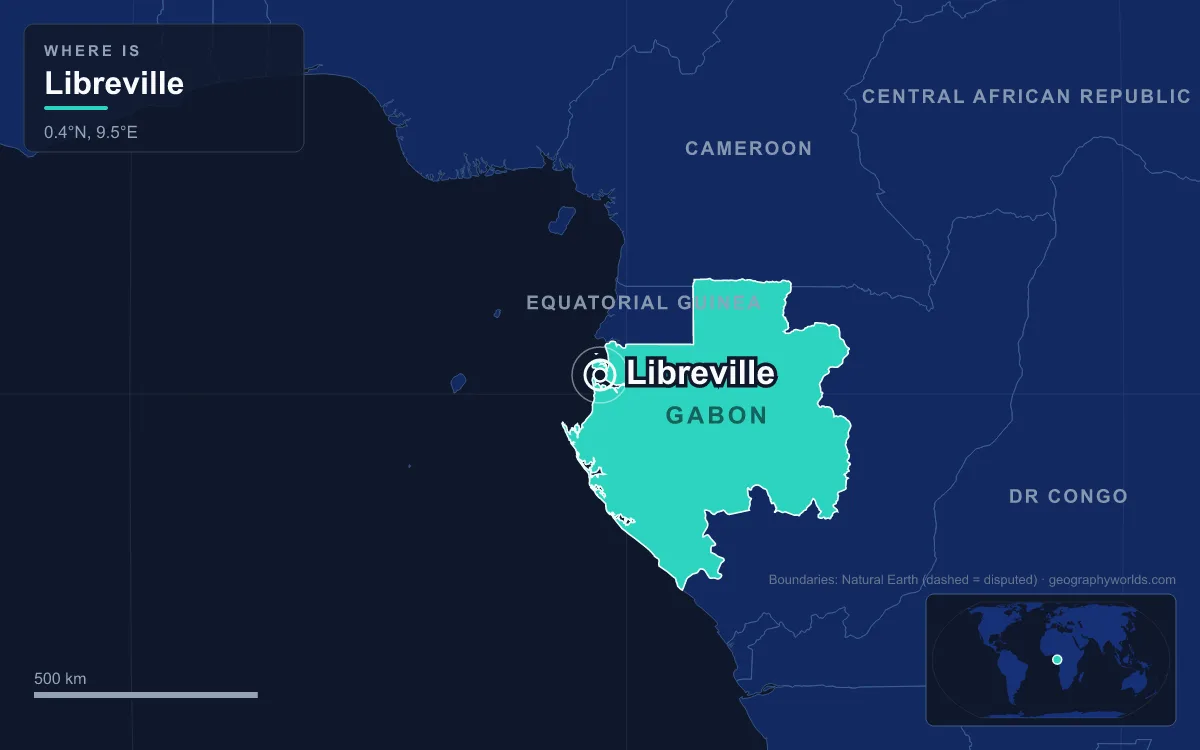
Libreville is the capital and largest city of Gabon. It stands on the northern shore of the Gabon Estuary, where the estuary opens into the Gulf of Guinea, in the northwestern province of Estuaire. The 2013 census counted 703,904 people in the city, and the capital holds roughly one third of the country's population. Its defining feature is its name. Libreville is French for "Freetown", and the town began in 1849 as a village for 52 Africans freed from a captured slave ship. From that village it grew into the seat of government of one of the most urbanised countries in Africa.
Before 1849: Mpongwe Clans, King Denis and the Treaty of 1839
Long before any French flag flew over the estuary, its shores belonged to the Mpongwe, a Myene-speaking people who made their living as brokers between the forest interior and the ships offshore. Portuguese navigators reached the estuary in the 1470s. According to the usual explanation, the name "Gabon" comes from the Portuguese gabão, a hooded cloak, which the sailors thought the estuary's outline resembled. European merchants frequented the coast over the following centuries, but Mpongwe middlemen controlled the trade between the ships and interior peoples such as the Bakèlè and Séké. From about the 1770s they also traded in captives, and by the 1830s their exports included slaves, dyewood, ebony, rubber, ivory and gum copal, exchanged for cloth, iron, firearms and alcohol. By the 1840s the Mpongwe numbered some 6,000 to 7,000 free people and about 6,000 slaves, organised into roughly two dozen clans, each ruled by an oga, a title Europeans translated as "king".
France's claim started with a signature. In 1839 Admiral Édouard Bouët-Willaumez negotiated a trade and protection treaty with Antchoué Komé Rapontcombo, a Mpongwe ruler the French called King Denis. American missionaries from New England followed in 1842 and set up a mission at Baraka, on ground that is now inside the city. A year later the French built Fort d'Aumale on the north shore, on the site of a village ceded by the ruler they called King Louis. Glass, today a district of central Libreville, is remembered as the first European settlement in Gabon. King Glass of the Agekaza-Glass clan submitted to the French only after a bombardment in 1845.
1849–1888: The Freed Captives of the L'Elizia
The town has an unusually exact founding story. In 1846 the French navy, which was helping enforce the British blockade of the slave trade, captured the Brazilian slaver L'Elizia near Loango. The ship was carrying captives from the Congo. In 1849, 52 of the people freed from it were resettled on the estuary shore. The settlement was named Libreville as a deliberate echo of Freetown in Sierra Leone, which the British had founded for freed slaves.
The founding also caught a political moment in France. The 1848 revolution had just created the Second Republic and abolished slavery in French colonies, and the former captives organised an election to choose the village's leaders. A former slave named Mountier was elected mayor. For the next four decades Libreville stayed small. It functioned mainly as a trading post and mission centre, shipping out timber, rubber and cocoa from the interior.
1888–1940: Capital of Congo-Gabon, Then Overtaken by Pointe-Noire
As France pushed inland in the 1880s, Libreville got its first spell as a capital. From 1888 to 1904 it was the administrative capital of the combined Congo-Gabon colony. The weight of French interest then moved east and south. In 1904 the capital went to Brazzaville on the Congo River, and in 1910 Gabon became part of French Equatorial Africa (AEF), which was governed from Brazzaville as well.
A railway decision set the town back further. Brazzaville needed a line to the Atlantic, because rapids made the Congo impassable below the city. Libreville had once been considered for the coastal terminus, but planners wanted a site suitable for a deep-water port and chose Pointe-Noire instead. Work on the Congo–Ocean Railway began in 1921, and Pointe-Noire grew fast at Libreville's expense. The Gabonese town kept exporting timber, above all okoumé logs for European plywood mills. It got its first bank branch only in 1930, when the Paris-based Banque de l'Afrique Occidentale opened an office there.
The Second World War made Libreville briefly a strategic prize. After France fell in June 1940, most of French Equatorial Africa declared for Charles de Gaulle, but Gabon's colonial government stayed loyal to Vichy. In November 1940 Free French forces, supported by the Royal Navy, attacked in what became known as the Battle of Gabon. They took Libreville and brought all of French Equatorial Africa over to Free France.
1956–1967: Léon M'ba's Town Hall and the Coup of February 1964
The road to independence went through the city's town hall. In 1956 Léon M'ba won Libreville's first free mayoral election, and he went on to become the first president of Gabon. When the country became independent in 1960, its capital was modest: a trading post and minor administrative centre of about 32,000 people.
Four years later the new state's politics played out on the city's streets and airwaves. On 21 January 1964 M'ba dissolved the legislature. Between 17 and 19 February 1964, about 150 soldiers, gendarmes and police arrested him and most of his cabinet. The plotters broadcast on Radio Libreville, asking for calm and promising that Gabon's pro-French foreign policy would not change, and they named the opposition leader Jean-Hilaire Aubame as president. The coup lasted two days. Invoking a 1960 defence treaty, Charles de Gaulle sent French paratroopers, who overthrew the provisional government during the night of 19 February and put M'ba back in office. M'ba died in 1967. His vice-president, Omar Bongo, succeeded him and made Gabon a one-party state under the new Gabonese Democratic Party.

1970–1990: Oil Money, the 1977 OAU Summit and the Transgabonais
Oil changed the city's scale. Offshore petroleum was discovered in the 1970s, and although the crude was pumped near Port-Gentil, the revenue flowed to the capital. It paid for ministries, housing and boulevards. Omar Bongo University opened in 1970. France based its 6th Marine Infantry Battalion at Camp de Gaulle, near the airport, from 1975, and the garrison became a fixture of the city's economy for the next fifty years. When Libreville hosted the Organisation of African Unity summit in 1977, the government built a first wave of prestige projects for it, including hotels, the Palais du Sénat and modernised seafront avenues.
The most expensive project began south of the city at Owendo. The Trans-Gabon Railway, a single-track standard-gauge line of about 670 kilometres to Franceville, opened in stages between 1978 and 1986, and its cost nearly bankrupted the state. Together with the new deep-water port at Owendo, it finally gave Libreville the export corridor that Pointe-Noire had taken sixty years earlier. Manganese ore from Moanda and timber from the interior now came down to the estuary by rail. In 2022 the line carried about 10.9 million tonnes of freight.

Growth came quickly and unevenly. Mont-Bouët and Nombakélé became the commercial core, and the Marché du Mont-Bouët grew into Gabon's largest market. Oloumi and the Owendo zone took on industry: breweries, flour mills, cement grinding and shipyards. Batterie IV on the northern seafront is now one of the city's affluent oceanfront districts. Poorer neighbourhoods spread inland behind the coastal districts.
1990 to Today: Multiparty Politics, the 2023 Coup and the Baie des Rois
Protests and strikes in 1990 led to a national conference, the first multiparty National Assembly elections in almost thirty years and, in 1991, a new constitution. The ruling party kept its national majority, but in the 1997 local elections Libreville chose an opposition mayor. Omar Bongo nonetheless stayed in power until his death in 2009, and his son Ali Bongo followed him. On 30 August 2023, shortly after Ali Bongo was declared the winner of that year's election, officers led by Brice Oligui Nguema, commander of the Republican Guard and a cousin of the president, removed him. The coup ended 56 years of rule by father and son. Oligui Nguema won the 2025 presidential election and has been president since May 2025. That same year the French garrison at Camp de Gaulle was turned into a jointly run military academy, and the French contingent was cut to about 200 personnel.
The city has kept building. The Nkok Special Economic Zone, 27 kilometres east of the capital, was set up from 2010 alongside a ban on exporting unprocessed logs. It covers 1,126 hectares of sawmills, veneer plants and other factories. On the seafront, the 40-hectare Baie des Rois redevelopment on the Champ Triomphal is meant to add offices, housing and a conference centre by 2035. It includes the 50-storey Tour du Futur, which is designed to be Gabon's tallest building and is due for completion in 2027. A satellite city called Libreville 2 was launched in April 2024 to help with a housing shortage estimated at 200,000 homes. Léon-Mba International Airport, about 11 kilometres north-west of the centre, handled 939,521 passengers in 2023. The capital is also costly to live in: an October 2025 survey of expatriate living costs ranked it the most expensive city in Africa.
The estuary's weather has not changed. Libreville has a tropical monsoon climate with a long wet season from September to May. In June, July and August the cold Benguela Current reaches its northernmost point and suppresses rain, although the sky stays heavily overcast. Average highs stay close to 29 °C all year.
In 175 years the freed captives' village has become a capital of roughly a third of the nation. More about the country around it is in our Gabon country guide. For the rest of the coastline Libreville faces, see our guide to the Gulf of Guinea. And for the city that took Libreville's role as capital in 1904 and kept it for French Equatorial Africa, read about Brazzaville on the Congo River.
Quick Facts About Libreville
- Country: Gabon
- Continent: Africa (Central Africa)
- Country population: approximately 2.6 million
- Capital city status: Libreville is the capital of Gabon, the seat of national government, and the location of foreign embassies, parliament, and the head of state's official residence.
Frequently Asked Questions
What is the capital of Gabon?
The capital of Gabon is Libreville. Libreville is the seat of national government, hosts most foreign embassies and consulates, and is typically where the head of state and parliament are located.
What continent is Libreville in?
Libreville, the capital of Gabon, is located in Africa, in the Central Africa region. As Gabon's capital, Libreville serves as the country's primary connection to the broader African political, economic, and cultural sphere.
Why is Libreville the capital of Gabon?
Libreville was chosen as the capital of Gabon for reasons that typically combine geography, history, and politics. Capital city selections often reflect a desire for centrality (being accessible from across the country), historical importance (being a longstanding seat of government or culture), or neutrality (being acceptable to multiple regions or ethnic groups within the country). The specific reasons for Libreville's designation are detailed in the city's history above.
What is Libreville known for?
As the capital of Gabon, Libreville is best known for housing the country's central government institutions — parliament, presidential or royal residences, supreme court, and key ministries. It is also typically a major cultural and economic center within Gabon, hosting national museums, embassies, and signature monuments. The introduction and history sections above provide detailed coverage of the city's specific notable institutions and landmarks.
Related Pages
- Gabon Country Guide — full geography, climate, economy, and culture overview
- Flag of Gabon — meaning, history, and design of Gabon's national flag