

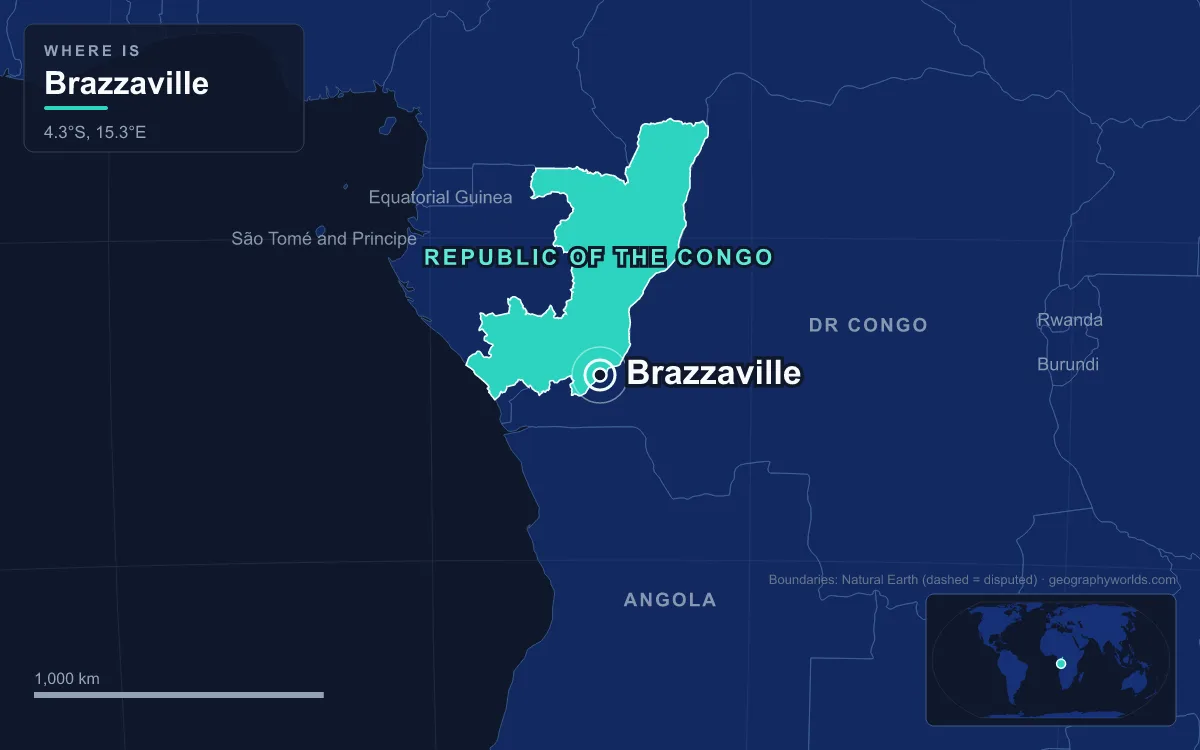
Brazzaville is the capital and largest city of the Republic of the Congo, on the north bank of the Congo River just below Pool Malebo, directly opposite Kinshasa. The 2023 census counted about 2.15 million residents, more than a third of the country's 6.1 million people. It holds the title because of choices made over nearly 80 years: a French treaty signed there in 1880, its selection as capital of French Equatorial Africa in 1910, its role as the wartime capital of Free France, and a 1958 decision to take the capital back from the coastal city of Pointe-Noire. Those moves explain why a river port 506 kilometres from the Atlantic, rather than the country's seaport, runs the Republic of the Congo today.
1880–1934: Makoko Iloo's Treaty and the Race With Léopoldville
The city began as a move in the Scramble for Africa. Before Europeans arrived, the north shore of the pool held two trading centres, Mfwa and Mpila, within the Tio kingdom of the Eastern Teke. In 1880 the Italian-born explorer Pierre Savorgnan de Brazza, a French citizen since 1874, reached the Tio king, Makoko Iloo I, and persuaded him to place his lands under French protection. The treaty was signed on 10 September 1880, and the king arranged for a French post at Mfoa on the pool. Iloo died the same year, but his widow, Queen Ngalifourou, upheld the agreement.
Speed mattered because Henry Morton Stanley was working the other bank for King Leopold II. Brazza passed Stanley near Vivi without mentioning the treaty, and it took Stanley months to realise he had been beaten. To hold the site, Brazza left a Senegalese sergeant, Malamine Camara, with a handful of men from October 1880 to May 1882. France formally established the French Congo on 30 November 1882, and the Berlin Conference of 1884–85 confirmed its claim. Large-scale building began soon after, as the French settlement competed with Léopoldville rising across the water.
Brazzaville's decisive advantage was its position inside a larger French empire. It became capital of the French Congo in 1904, and when France created French Equatorial Africa (AEF) in 1910 it chose Brazzaville as the seat of the governor-general, running a federation that stretched from Gabon to Ubangi-Shari and Chad. Between 1910 and 1915 the major public buildings went up, including a courthouse, the headquarters of the Banque de l'AEF and an Institut Pasteur. The Church arrived alongside the administration. The French missionary Prosper Philippe Augouard settled in Brazzaville in 1887, many Congolese converted to Catholicism during the colonial period, and the city became the seat of a Catholic archdiocese; among its landmark churches is the Basilica of Sainte-Anne-du-Congo.

The new capital had one weakness: the Livingstone Falls on its outskirts, where the Djoué River meets the Congo, blocked the river route to the sea. France's answer was the Congo–Ocean Railway, 502 kilometres to Pointe-Noire, built with forced labour from 1921 and opened in 1934. More than 17,000 workers died building it, and anger over the conscription fed the Kongo-Wara rebellion of 1928 to 1931.
1940–1944: The Wartime Capital of Free France
The Second World War briefly made Brazzaville the political centre of a whole government in exile. When France fell in 1940, French Equatorial Africa broke with Vichy in August, except for Gabon, which held out until 12 November 1940. The federation became the base of Free French operations in Africa, and Brazzaville served as the capital of Free France from 1940 until roughly 1943 (sources differ on the end date). Félix Éboué was installed at Brazzaville as governor-general, and the architect Roger Erell designed a residence in the city for Charles de Gaulle.
From 30 January to 8 February 1944 de Gaulle hosted the Brazzaville Conference, bringing Free French leaders together with governors and officials from France's African colonies. The resulting declaration promised to end forced labour, to abolish the special legal regime for indigenous people, to create elected territorial assemblies and to give the colonies representation in Paris. It also ruled out independence or even limited self-government. The meeting made the city's name a byword for colonial reform, and it confirmed Brazzaville as the political centre of French Central Africa as the postwar era began.
1950–1960: How Pointe-Noire Lost the Capital
Brazzaville's claim was less secure than it looked. It was the capital of the AEF federation, but the colony of Middle Congo, the territory that would become the Republic of the Congo, was run from Pointe-Noire from 1950. The Atlantic port was then a town of about 20,000 people, with the railway terminus and the harbour, which gave it a practical claim to govern a coastal colony.
Politics settled the question. When France reorganised its empire in 1958, the AEF dissolved and Middle Congo became the autonomous Republic of the Congo on 28 November 1958. Incidents during the 1958 legislative elections persuaded the leaders of the Democratic Union for the Defence of African Interests (UDDIA) to transfer the capital to Brazzaville, because Pointe-Noire was dominated by the opposition. The UDDIA leader was Fulbert Youlou, a former priest who had become the first Black mayor elected in French Equatorial Africa. Rivalry between the Lari and Kongo, who backed Youlou, and the Mbochi, who backed Jacques Opangault, erupted into riots in Brazzaville in February 1959 that the French army suppressed. The new republic became fully independent on 15 August 1960 with Youlou as its first president and Brazzaville as its capital.
Nine Arrondissements Facing Kinshasa: What Being Capital Means Now
Since independence, holding the capital has meant holding power, and Brazzaville has paid for it. Marien Ngouabi, who took the presidency on 31 December 1968, declared Africa's first "people's republic" a year later and was assassinated on 18 March 1977; his mausoleum stands in the city. Denis Sassou Nguesso ruled from 1979 to 1992, lost power in the multiparty era, and returned after the civil war of 1997, which began on 5 June when government forces surrounded his Brazzaville compound. In more than four months of fighting, until Sassou Nguesso's Cobra militia and Angolan troops took the city in October, both sides shelled densely populated districts, causing a high civilian death toll; renewed fighting with Ninja rebels in the Pool region in 2016 drove about 80,000 people from their homes. Sassou Nguesso has been president since 1997.
The clearest symbol of the capital is the Nabemba Tower on the riverbank, the country's tallest building at 106 metres and 30 floors. Built between 1983 and 1986 with loans from the oil company Elf Aquitaine, it was inaugurated on 3 February 1990, badly damaged in 1997 and rebuilt for about £6 million, more than its original cost. The state has also invested in memory: on 3 October 2006 the remains of Brazza, his wife and four children were reburied in a marble mausoleum that cost about US$10 million, after being exhumed from their resting place in Algiers.
Daily life in the capital runs on the road. The city is relatively flat, at about 317 metres above sea level, and there is no organised public transport system; privately owned buses fill the gap, and taxis, painted with a green body and a white top, make up about a fifth of all vehicles in Brazzaville. Collective taxis follow fixed routes for a flat fare. Companies based here include the national airline, Equatorial Congo Airlines, and the capital's river port still takes in rubber, timber and farm produce from upriver for the railway to carry on to Pointe-Noire, the division of labour that the 1958 decision fixed in place: the coast earns, the river city governs.
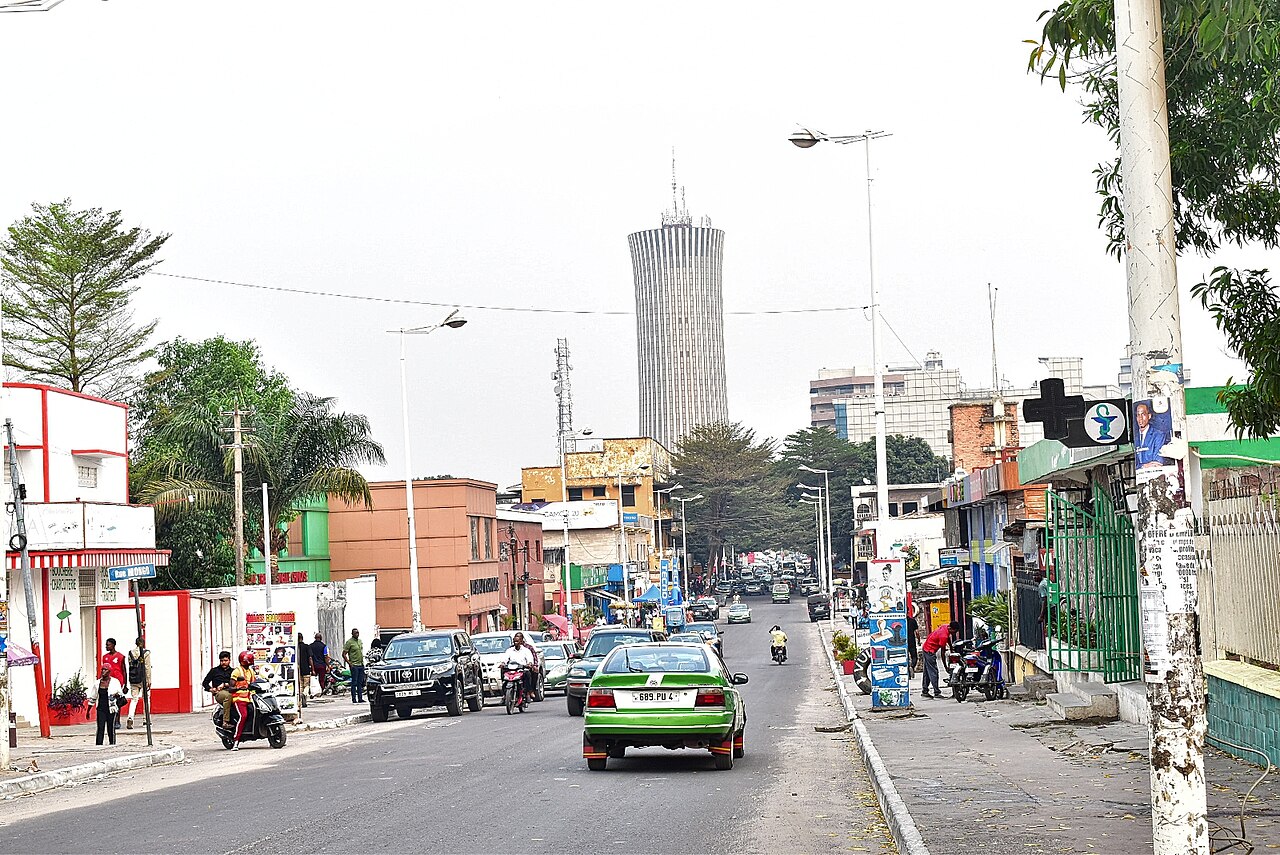
Administratively the city is both a commune and a department. In 1980 it was separated from the surrounding Pool region and divided on the French model into numbered arrondissements, now nine: Makélékélé, Bacongo, Poto-Poto, Moungali, Ouenzé, Talangaï, Mfilou, Madibou and Djiri. Until the 1960s Poto-Poto, Bacongo and Makélékélé were the African quarters, set apart from the European centre. The department added the island of Mbamou in 2011 and, in October 2024, the northern town of Kintélé, reached by a viaduct of almost 7 kilometres and home to the sports complex built for the 2015 African Games.
Being capital also makes Brazzaville an international address. The World Health Organization runs its Regional Office for Africa here, Marien Ngouabi University, founded in December 1971, teaches about 26,000 students, and UNESCO designated the city a City of Music in 2013. The Poto-Poto School of Painting and the Basilica of Sainte-Anne draw visitors to the old African quarters. Maya-Maya Airport sits in the middle of the city, and a scheduled flight to Kinshasa lasts about five minutes. Most people cross by ferry or fast boat instead, while a road and rail bridge, revived with African Development Bank backing in 2018, reached a new agreement on customs and tax rules in February 2026 but has still not been built. The city's name has also gone back into diplomacy: the Brazzaville Declaration of March 2018, signed by the two Congos and Indonesia, committed them to protect the peat swamp forests of the Cuvette Centrale, the world's largest tropical peatland. The two capitals face each other across a few kilometres of river and remain rivals in trade, sport and politics; see how the other side grew in our guide to Kinshasa, explore the wider Republic of the Congo, or trace the Congo River that divides them.
Quick Facts About Brazzaville
- Country: Republic Of The Congo
- Continent: Africa (Central Africa)
- Country population: approximately 6.6 million
- Capital city status: Brazzaville is the capital of Republic Of The Congo, the seat of national government, and the location of foreign embassies, parliament, and the head of state's official residence.
Frequently Asked Questions
What is the capital of Republic Of The Congo?
The capital of Republic Of The Congo is Brazzaville. Brazzaville is the seat of national government, hosts most foreign embassies and consulates, and is typically where the head of state and parliament are located.
What continent is Brazzaville in?
Brazzaville, the capital of Republic Of The Congo, is located in Africa, in the Central Africa region. As Republic Of The Congo's capital, Brazzaville serves as the country's primary connection to the broader African political, economic, and cultural sphere.
Why is Brazzaville the capital of Republic Of The Congo?
Brazzaville was chosen as the capital of Republic Of The Congo for reasons that typically combine geography, history, and politics. Capital city selections often reflect a desire for centrality (being accessible from across the country), historical importance (being a longstanding seat of government or culture), or neutrality (being acceptable to multiple regions or ethnic groups within the country). The specific reasons for Brazzaville's designation are detailed in the city's history above.
What is Brazzaville known for?
As the capital of Republic Of The Congo, Brazzaville is best known for housing the country's central government institutions — parliament, presidential or royal residences, supreme court, and key ministries. It is also typically a major cultural and economic center within Republic Of The Congo, hosting national museums, embassies, and signature monuments. The introduction and history sections above provide detailed coverage of the city's specific notable institutions and landmarks.
Related Pages
- Republic of the Congo Country Guide — full geography, climate, economy, and culture overview
- Flag of Republic of the Congo — meaning, history, and design of Republic of the Congo's national flag