
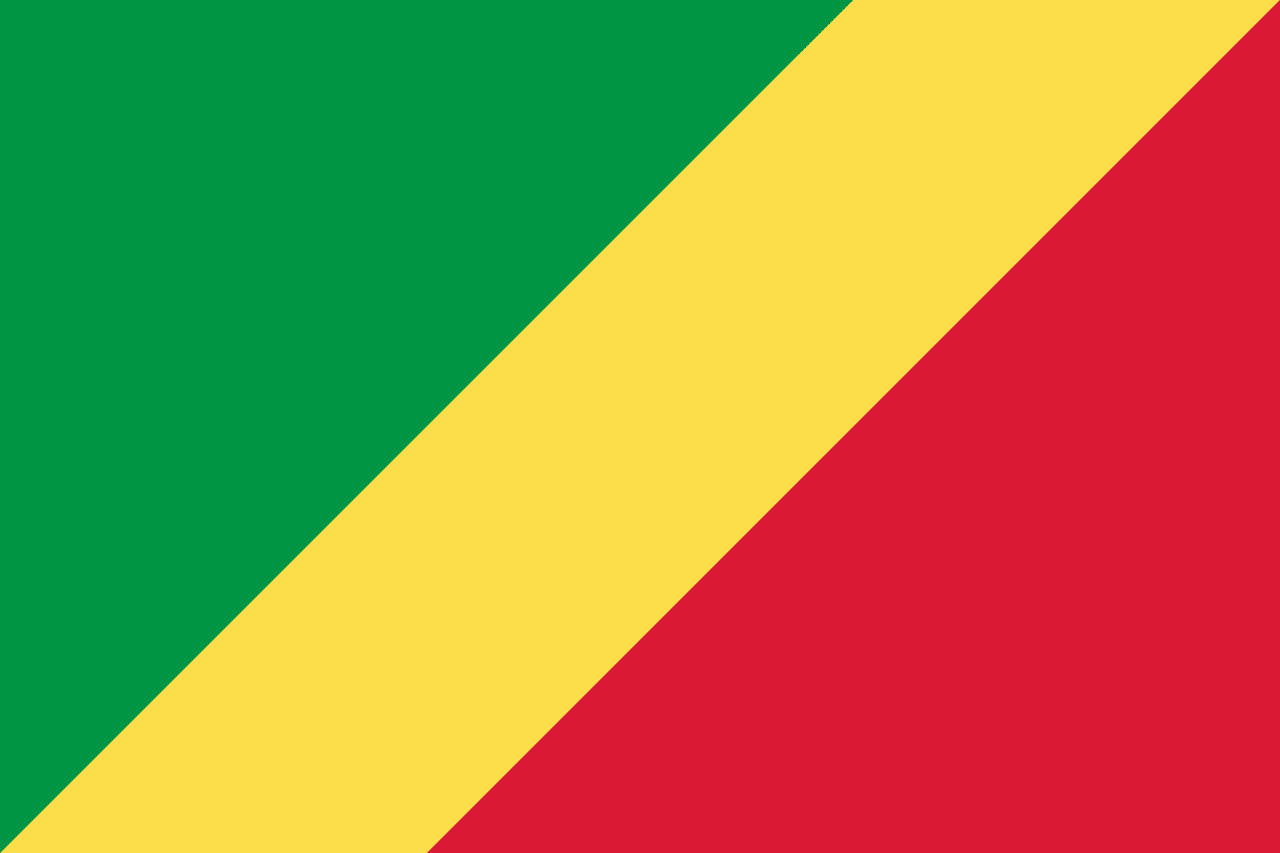

Few flags in the world catch the eye quite like the banner of the Republic of the Congo. Instead of the familiar horizontal or vertical stripes that dominate most national flags, this Central African nation runs its three colors on a bold diagonal, slicing from the lower corner near the flagpole up to the opposite top edge. The result feels dynamic and unmistakable, even at a glance. Behind that distinctive layout sits a story of independence, political upheaval, and a country deciding what symbols best represent who it wants to be.
A Flag of Three Diagonal Colors
The flag is built from three colors: green, yellow, and red. Rather than stacking them, the design arranges them as a diagonal triband. A central yellow band runs from the lower hoist (the corner closest to the pole) toward the upper fly, with a green triangle above the hoist and a red triangle anchoring the lower fly. This slanting arrangement is what makes the flag so recognizable, placing the Republic of the Congo among a small group of nations that have embraced diagonal stripes rather than the more conventional straight bands.
The flag flies in a 2:3 ratio, the proportion most widely used among the world's national banners. The diagonal is not a mere decorative flourish: by running the dividing lines corner to corner, the design turns the entire field into movement, an impression of forward motion that horizontal bands rarely achieve.
The colors are the classic pan-African palette of green, yellow, and red, a combination shared by many African states that drew inspiration from Ethiopia, one of the few African nations never fully colonized. Yet the way the Republic of the Congo deploys them, on the angle, gives the flag a personality all its own.
What the Colors Stand For
Each color carries meaning rooted in the nation's land and history. Green speaks to agriculture and the forests and farmland that sustain the country. Yellow represents friendship and the goodwill of the Congolese people. Red honors the struggle for independence and the sacrifices made along the way. Together they tell a compact story: a people working the land, bound by fellowship, who fought to govern themselves.
The order of the colors matters too. With green resting in the upper hoist, the position of greatest visual prominence on any flag, the design quietly foregrounds the land and its bounty, while red sweeps along the lower fly as a reminder of the cost of nationhood. Yellow, holding the center, becomes the bridge between the two, much as friendship and unity bind a people together.
How the Flag Came to Be
The Republic of the Congo gained its independence from France in 1960, and this green-yellow-red diagonal design was its first flag. The country emerged from the colonial federation of French Equatorial Africa, and the choice of pan-African colors over the inherited tricolor of the former ruling power was itself a statement: the new nation was looking to the continent and its own future rather than to Europe.
But the banner did not fly uninterrupted. In 1970 the country was reconstituted as the People's Republic of the Congo, a one-party Marxist-Leninist state, and it adopted a new flag: a red field charged with a socialist emblem, a crossed hoe and hammer beneath a star. The change marked a sharp break from the diagonal triband and aligned the nation visually with other socialist states.
That chapter closed in 1991, when the country moved away from its socialist orientation amid the wave of democratic change sweeping much of Africa at the end of the Cold War, and restored the original flag. The decision to bring back the 1960 design was more than cosmetic. It was a deliberate reconnection with the symbols of the early independence period, a way of signaling continuity with the nation's founding identity after years under a different emblem. Since 1991, the diagonal green, yellow, and red has stood as the official flag once again.
The Flag and National Identity
For Congolese citizens, the restored flag represents both heritage and a fresh start. Its return in 1991 coincided with a broader political transition, so the banner carries the weight of that turning point. To raise it is to recall not only independence in 1960 but also the later choice to reclaim the symbols of that moment.
The flag appears across civic life, on government buildings, at official ceremonies, and at the borders that mark the country's place in Central Africa. Visitors curious about the broader culture, geography, and travel context can explore our republic of the congo country guide for a fuller picture of the country behind the banner.
How It Compares to Other Flags
Because it shares the green-yellow-red of the pan-African tradition, the Republic of the Congo's flag belongs to a large family that includes Ghana, Senegal, Mali, Guinea, and Cameroon, all tracing the palette back to Ethiopia's enduring tricolor. What separates the Congolese flag from nearly all of them is the diagonal. Where most of these countries arrange their colors in horizontal stripes or vertical panels, the Republic of the Congo tilts the whole composition onto a slant.
Diagonal national flags are genuinely rare. The most frequently cited companions are Tanzania and the Democratic Republic of the Congo, both featuring a diagonal stripe, along with Namibia. Yet none uses a full diagonal triband of three equal-feeling fields the way Brazzaville's flag does, keeping it distinctive even within that small club.
A Note on Confusion: The Two Congos
One persistent source of mix-ups is that there are two neighboring countries with "Congo" in their names: the Republic of the Congo (often called Congo-Brazzaville after its capital) and the much larger Democratic Republic of the Congo (Congo-Kinshasa). Their flags, however, are entirely different. The Republic of the Congo flies the diagonal green-yellow-red triband described here, while its neighbor uses a sky-blue field with a red diagonal stripe and a yellow star. Knowing the flags is one of the quickest ways to tell the two nations apart.
The Flag in Modern Life
Today the diagonal triband shows up wherever national pride is on display. It flies on Independence Day commemorations each August, accompanies the country's athletes at the Olympic Games and the Africa Cup of Nations, and represents the nation at the United Nations and other global forums. Football supporters wave it behind the national side known as the Red Devils. Its strong, simple geometry makes it easy to reproduce and easy to spot in a sea of flags.
Interesting Facts at a Glance
- It is one of relatively few national flags to use diagonal stripes rather than straight horizontal or vertical bands.
- The design dates to independence in 1960 and was officially restored in 1991 after a period under a socialist-era flag.
- Its green, yellow, and red belong to the pan-African color tradition shared across the continent.
- The diagonal runs from the lower hoist to the upper fly, with green on top, yellow in the middle, and red at the bottom.
- Despite the shared name, its flag looks nothing like that of the neighboring Democratic Republic of the Congo.
Frequently Asked Questions
When was the flag of the Republic of the Congo adopted?
The diagonal green-yellow-red design first appeared in 1960 when the country gained independence from France. It was set aside during a socialist period and then officially restored in 1991, which is why that year is associated with the current flag.
What do the colors of the flag mean?
Green stands for agriculture, yellow represents friendship, and red symbolizes the struggle for independence. The three together capture the land, the people, and the fight for self-rule.
Why does the flag use diagonal stripes?
The diagonal layout was a deliberate choice at independence that set the new nation apart from the many African countries adopting horizontal tricolors at the time. It gives the flag a sense of motion and makes it instantly recognizable, and it is one of the very few national flags to use a full diagonal arrangement of its colors.
What continent is the Republic of the Congo on?
The Republic of the Congo is located in Central Africa. It sits along the Congo River and shares its western region with the Atlantic coast, neighboring countries such as Gabon and the Democratic Republic of the Congo.
How is its flag different from the Democratic Republic of the Congo's flag?
The Republic of the Congo uses a diagonal triband of green, yellow, and red. The Democratic Republic of the Congo, a separate and much larger country, uses a sky-blue field crossed by a red diagonal stripe with a single yellow star. The two flags are easy to distinguish once you know what to look for.
