
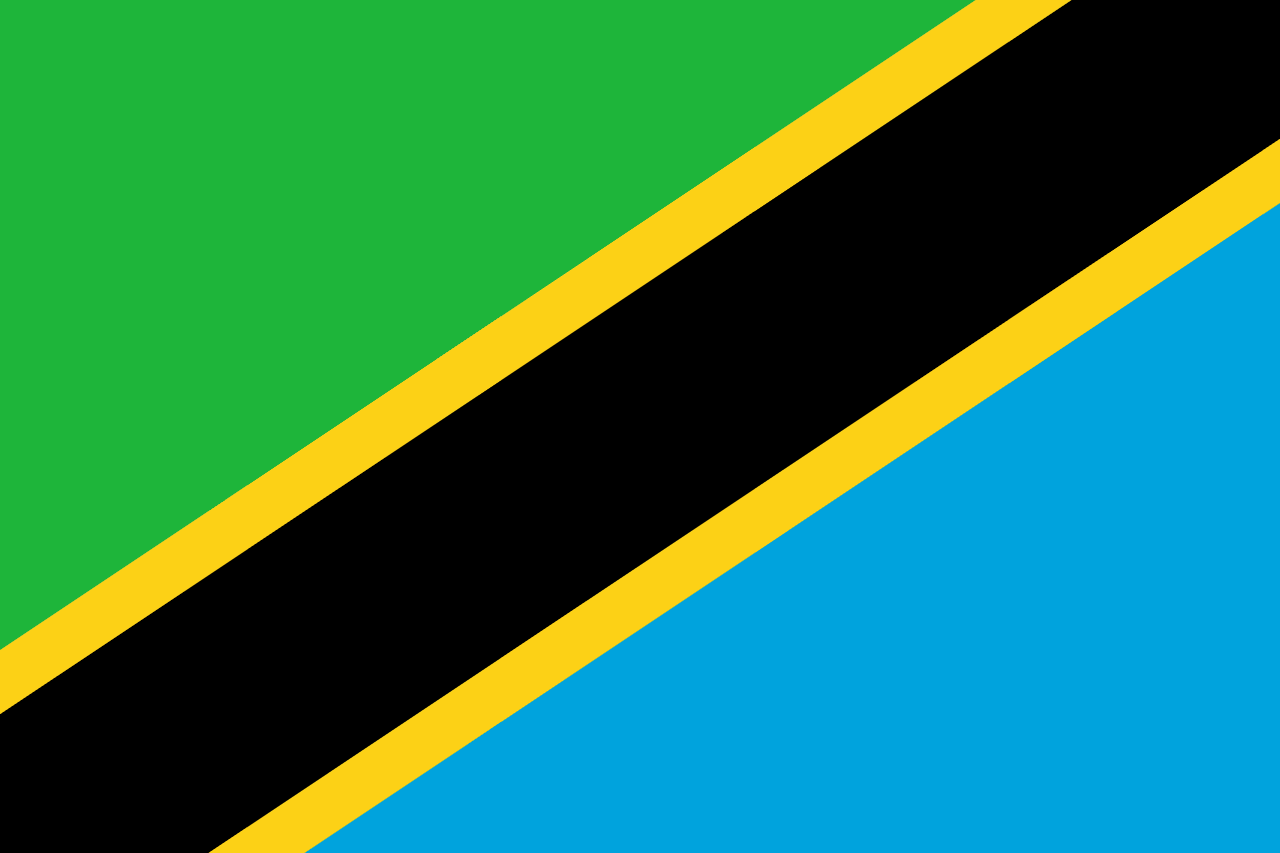
Few national flags carry their whole origin story in their geometry, but Tanzania's does. That bold diagonal stripe slicing from the lower hoist to the upper fly is not just an eye-catching design choice — it is a record of a political marriage. When mainland Tanganyika joined the island archipelago of Zanzibar in 1964, the new union needed an emblem that honored both partners without erasing either. The result is one of the most distinctive banners in the world: green and blue triangles separated by a yellow-edged black band, a flag deeply tied to the land and people of East Africa.
A Flag Born From a Union
To understand the Tanzanian flag, you have to understand the year it appeared. In 1964, two newly independent entities — Tanganyika on the African mainland and the islands of Zanzibar off the coast — agreed to merge into a single sovereign state. That state took the name Tanzania, a portmanteau stitched together from the two names, and its flag was assembled in the same spirit.
Tanganyika had become independent from British administration in 1961, and at first flew three horizontal bands — green, black bordered by thin yellow fimbriations, and green again — colors taken from the Tanganyika African National Union, the movement led by Julius Nyerere that carried the territory to self-rule. Zanzibar had been a sultanate before the revolution of January 1964 swept away the ruling order; its new revolutionary government adopted a flag of blue, black, and green. When the two governments agreed to unite that April, neither earlier banner could be imposed on the other.
The designers combined elements from both so that neither partner could feel overlooked. The diagonal black band is the descendant of Tanganyika's central stripe, and the blue triangle is the visible nod to the islands, the revolution, and the ocean. The flag is less an invention than a deliberate fusion, which is why it was adopted within months of the union being declared.
Reading the Colors
Tanzania's flag uses four colors, and each one is tied to something concrete about the country rather than to an abstract slogan. The official symbolism is refreshingly grounded:
- Green stands for the land's natural vegetation — the forests, savannas, and fertile ground that sustain agriculture across the mainland.
- Yellow represents the country's mineral wealth, a reminder that Tanzania sits on significant deposits of gold, gemstones, and other resources beneath its soil.
- Black honors the people of Tanzania — the Swahili-speaking population whose identity anchors the nation.
- Blue evokes the water: the Indian Ocean lapping the coast and the islands, along with the great lakes and rivers that define so much of the region's geography.
What makes this palette satisfying is how literally it maps onto the place. A traveler could point to the green hills, the blue coastline, and the golden glint of mineral country and see the flag reflected in the landscape. The yellow is more than decoration: Tanzania is home to tanzanite, a violet-blue gemstone found nowhere else on Earth, and to gold mining in the north.
The Geometry of the Design
The construction is simple but visually striking. A black band runs diagonally from the lower corner nearest the flagpole (the hoist) up to the opposite corner on the fly side, bordered on both sides by thin yellow stripes that keep it crisp against the surrounding fields. The diagonal divides the rectangle into two triangles: green in the upper hoist and blue in the lower fly. The flag flies at the standard 2:3 proportion used by many former British territories.
Diagonal divisions are rare in world vexillology. Most flags rely on horizontal or vertical bands, crosses, or central emblems, so Tanzania's slanting band sets it apart and gives the design a sense of motion that horizontal stripes cannot match. The yellow edging is a device known as a fimbriation — a narrow border that separates two strong colors so they never touch, keeping the black sharp against the green and blue.
How It Compares to Related Flags
Tanzania's green, yellow, and black sit within the broad family of African flags that draw on the Pan-African palette. Yet the flag avoids being just another tricolor. Its closest visual cousin is the flag of Trinidad and Tobago, adopted in 1962, which also uses a single diagonal band edged in a contrasting color across a solid field — though that flag is red, white, and black rather than Tanzania's quartet of hues. The shared instinct is the same: a diagonal reads as dynamic and instantly memorable.
What truly distinguishes Tanzania is the four-color split into two triangles, a layout almost no other sovereign state uses. Even Zanzibar's present-day regional flag places the national design in the canton of a sea-blue field, deferring to the union banner rather than competing with it. The takeaway for flag-spotters is simple: a green-and-blue field divided by a black-and-yellow diagonal can belong to only one country.
Cultural Weight and National Identity
For Tanzanians, the flag is a shorthand for the idea that held the country together from the start: unity across difference. The mainland and the islands had distinct histories and political movements, yet the flag insists they belong to one nation — a message that has aged well in a region where national cohesion is never guaranteed.
The banner also reinforces a sense of place. Tanzania sits in East Africa — a country of Kilimanjaro, the Serengeti, Lake Victoria's shoreline, and the spice islands of Zanzibar. If you want the fuller picture of the nation behind the flag, the tanzania country guide lays out its geography, culture, and landmarks in detail.
The Flag in Everyday Life
You will find the Tanzanian flag flying over government buildings, schools, and embassies, but its presence extends beyond officialdom. It is raised with particular ceremony on Union Day every April, commemorating the 1964 merger, and on Independence Day in December, marking Tanganyika's 1961 break from colonial rule. On those mornings the flag appears at parades, on classroom walls, and in the hands of children along the route.
Sport gives the flag another stage. Supporters of the national football team, the Taifa Stars, drape it across stadium stands, and Tanzanian athletes carry it into international competition. Because the design is so recognizable, it lends itself to merchandise and tourism branding for a country that draws visitors to its parks and coastline. The diagonal band has become a kind of logo for the nation — instantly legible and hard to confuse with anyone else's.
Interesting Facts at a Glance
- The flag was adopted in 1964, the same period in which Tanganyika and Zanzibar united to form the country.
- It is one of the relatively few national flags in the world built around a diagonal band rather than horizontal or vertical stripes.
- Its colors and structure draw directly from the earlier flags of Tanganyika and Zanzibar, making it a literal blend of its two founding parts.
- The thin yellow stripes are a fimbriation — a vexillological term for a narrow border used to separate two contrasting colors cleanly.
- Each color points to something tangible: vegetation, minerals, people, and water, rather than to abstract virtues.
Frequently Asked Questions
When was the flag of Tanzania adopted?
The flag was adopted in 1964, around the time the mainland territory of Tanganyika and the islands of Zanzibar united to form the single state that became Tanzania. The design was created specifically to reflect that union.
What do the colors of the Tanzanian flag mean?
Green represents the country's natural vegetation, yellow stands for its mineral wealth, black honors the Tanzanian people, and blue symbolizes the ocean and other waters surrounding and within the country. Together they tie the flag directly to the nation's land and population.
What continent is Tanzania on?
Tanzania is located in East Africa, on the African continent. It borders the Indian Ocean to the east, and its territory includes both the mainland and the offshore islands of the Zanzibar archipelago.
Why does the Tanzanian flag have a diagonal stripe?
The diagonal black band, bordered by yellow, descends from the former Tanganyika flag and was carried into the united nation's banner. Diagonal layouts are uncommon among world flags, which is part of what makes Tanzania's so easy to recognize, and its combination with the green and blue triangles reflects the merging of Tanganyika and Zanzibar into one country.
What flag did Tanzania use before 1964?
There was no single Tanzania before 1964. Tanganyika, independent since 1961, flew a horizontal tricolor of green, black, and green with thin yellow borders around the central band, while Zanzibar used a separate flag after its 1964 revolution. The current national flag merged the colors and ideas of both into one unified design.
