

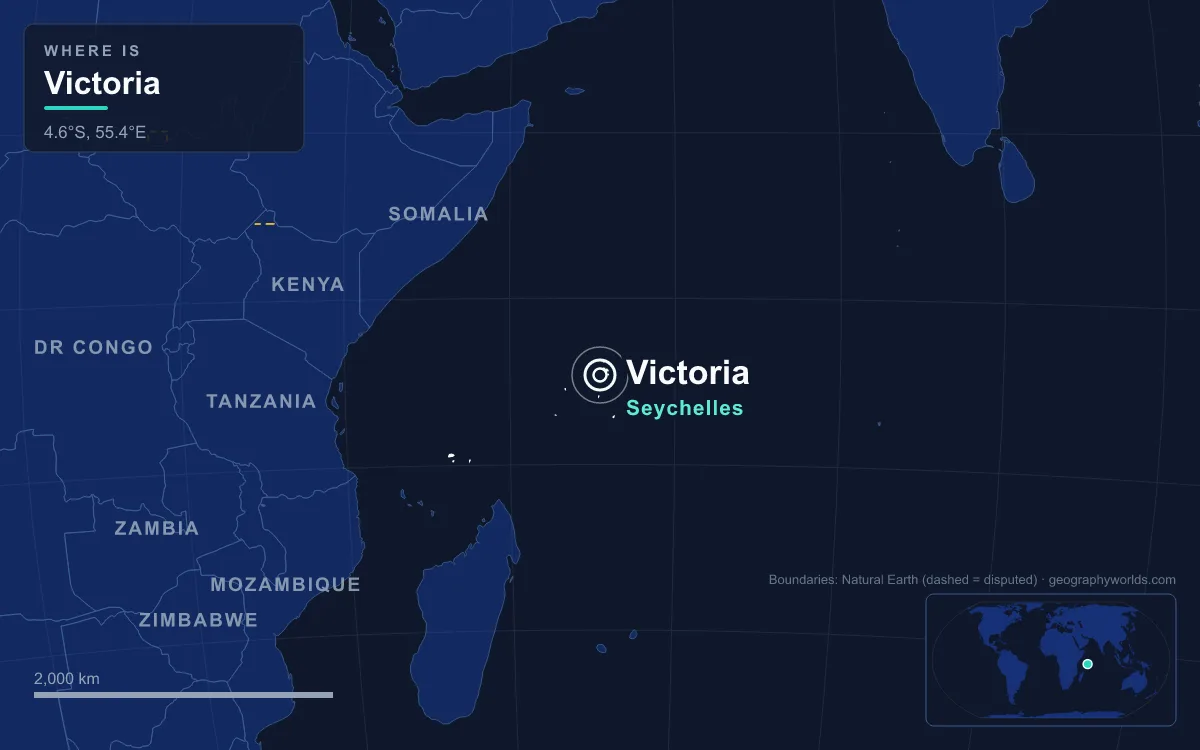
Victoria is the capital and largest city of Seychelles, set on the north-east coast of Mahé, the largest island of the 115-island archipelago, about 1,500 kilometres east of mainland Africa. The nine districts of the Central region, in and around the capital, had 30,145 residents in 2022, roughly 30 percent of a national population of about 100,000. Its harbour, Port Victoria, is the country's main port, and the city is the seat of the president, the National Assembly and the courts. It started life in 1778 as a small French garrison post called L'Établissement, was renamed after Queen Victoria in 1841, and has been the seat of government ever since: first of a French outpost, then of a British dependency run from Mauritius, then of a crown colony and, since 1976, of an independent republic.
Why a Bay on Mahé Became the Capital, 1742–1794
Victoria exists because France needed a harbour on the route to India. In 1735 Bertrand-François Mahé de La Bourdonnais became governor of Isle de France, today's Mauritius, and in 1742 he sent Lazare Picault to chart the unknown islands north-east of Madagascar. Picault anchored off Mahé at Anse Boileau on 21 November 1742 and named it the Island of Abundance. On a second voyage in 1744 he renamed the main island Mahé, after his patron. France formally took possession on 1 November 1756, when Captain Corneille Nicolas Morphey laid a Stone of Possession on Mahé and renamed the main island Isle de Séchelles after Jean Moreau de Séchelles, the finance minister of Louis XV; the name later passed to the whole group. That stone, the oldest monument in the country, is kept in the National Museum of History in Victoria.
The capital was not the first choice of site. In August 1770 the ship Thélémaque landed the first settlers, 15 white colonists with enslaved Africans and Indians, on Sainte Anne, a small island in the bay facing Mahé's north-east coast. The venture failed: ship captains complained that it could not supply fresh food, and by August 1772 the settlers had abandoned Sainte Anne for Mahé or gone home. Meanwhile, in 1771, Pierre Poivre, the intendant of Mauritius, sent Antoine Gillot to Mahé to start a spice garden at Anse Royale, planting nutmeg, cloves, cinnamon and pepper in the hope of breaking the Dutch spice monopoly. When British ships began appearing in the islands, the authorities in Mauritius sent a garrison under Lieutenant de Romainville, who built the Établissement du Roi, the Royal Settlement, on the site of modern Victoria. The settlement is usually dated to 1778, 22 years after France claimed the islands.
The site sat on the north-east side of the largest granitic island, looking across the bay to Sainte Anne, on a narrow strip of coast below the steep slopes of Mahé's mountains, which rise to 905 metres at Morne Seychellois. Voyages by the navigators Rochon and Grenier in 1769 had shown that a faster route to India could safely pass through Seychelles, which gave a permanent post here strategic value. In 1788 a new commandant, Jean-Baptiste Philogène de Malavois, issued 30 decrees protecting timber and giant tortoises from the settlers who were rapidly stripping both.
Governed from Mauritius: The Long Wait of L'Établissement, 1794–1903
The town's political status was settled by other people's wars. On 16 May 1794 the British frigate HMS Orpheus arrived at Mahé. The French administrator, Jean-Baptiste Queau de Quinssy, had no means of resisting and negotiated a capitulation the next day, under which the islands stayed in effect French while claiming neutrality. When HMS Centurion returned in September 1798, the capitulation was simply renewed. The real decision came after Britain captured Mauritius in December 1810. In April 1811 Captain Philip Beaver arrived on HMS Nisus to take possession, leaving a single Royal Marine lieutenant, Bartholomew Sullivan, in the town, and the 1814 Treaty of Paris made British rule permanent.
For almost a century L'Établissement was the capital of a dependency rather than a colony. Britain let French law and customs continue, and the islands were administered from Mauritius, which the planters of Mahé resented more than anything else about their new rulers. Slavery was abolished in 1835, and many plantations, their soils exhausted, sank into stagnation until coconuts proved more profitable than cotton, sugar or rice. In 1841 the British renamed the town Victoria, after the young queen. Over 13 years from 1861, about 2,400 Africans freed from slave ships by Royal Navy patrols were landed in Seychelles and apprenticed to planters.
Victoria grew slowly. On 12 October 1862 torrential rain brought an avalanche of mud and rocks down from the hills onto the town, killing an estimated 70 people or more. Business licences issued in 1879 give a snapshot of the place: a druggist, two auctioneers, five retailers, four liquor stores, a notary, an attorney, a jeweller and a watchmaker. Seychellois officials, backed by the governor of Mauritius, Sir Arthur Gordon, petitioned London to make the islands a colony in their own right.
Crown Colony Capital: Clock Tower, Government House and 29 June 1976
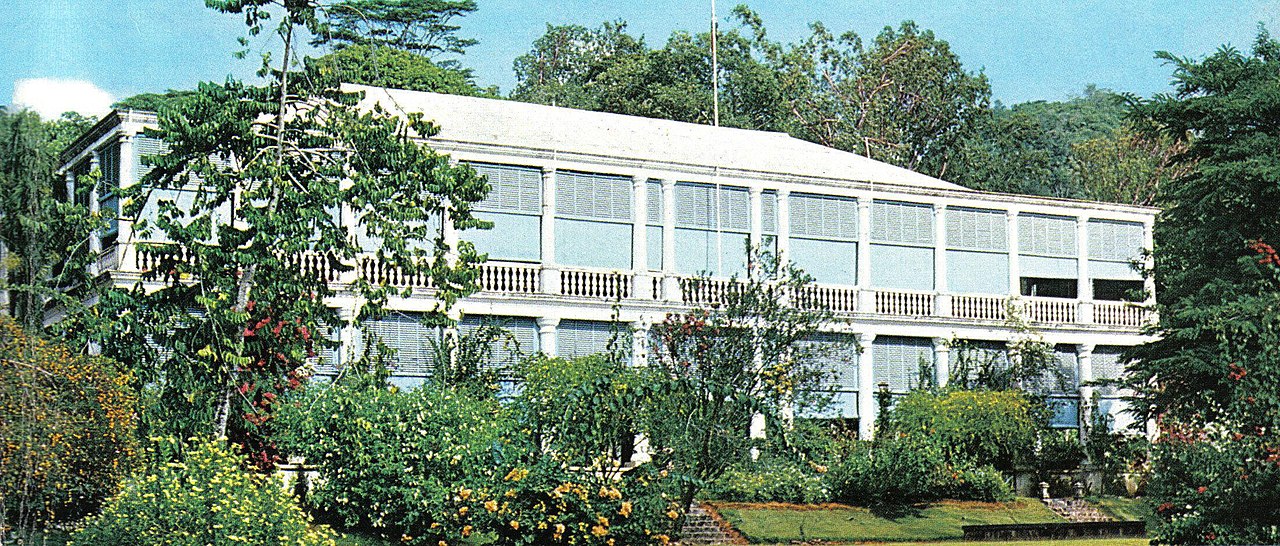
The petition succeeded in 1903, when Seychelles became a separate crown colony and Sir Ernest Bickham Sweet-Escott took office as its first governor. Victoria now had to look like a capital. It gained a botanical garden and, in the centre of town, the clock tower modelled on "Little Ben" in London, which still stands at the central crossroads. In 1910 a new Government House was built, designed by the Seychelles-born architect William Marshall Vaudin, with a two-storey portico of white pillars; Sir Walter Davidson became its first resident in 1912.
Britain, like France before it, also used the islands as a place of exile, long before and after they became a colony. Sultan Abdullah of Perak arrived in 1875, and his son is said to have taken home a local tune, "La Rosalie", which later became the melody of Malaysia's national anthem. Archbishop Makarios of Cyprus was held here from 1956. The First World War hit the town hard: imports stopped, prices rose by 150 percent, and of about 800 men sent to East Africa in the Seychelles Labour Contingent, 335 died. The population was about 24,000 at the war's end. When the first elections were held in 1948, only some 2,000 literate property owners out of 36,000 inhabitants could vote.
Modern politics grew up in Victoria's streets. In 1964 France-Albert René founded the Seychelles People's United Party, which campaigned for socialism and independence, while James Mancham's Seychelles Democratic Party spoke for planters and businessmen and wanted closer ties with Britain. The capital was then opened to the world by the airport at Pointe Larue, 11 kilometres south-east of the centre. The first pilot landed there in March 1971, before the runway was finished, and Queen Elizabeth II formally opened it on 20 March 1972. Independence came on 29 June 1976, with Mancham as president and René as prime minister. Government House was renovated for the occasion and became State House.
Capital of a Republic: Coups, Reclaimed Land and Four Districts
Being the capital of a small republic has meant that every crisis lands in Victoria. On 5 June 1977, while Mancham was in London, an almost bloodless coup made René president, and from 1979 to 1991 Seychelles was a one-party state. On 25 November 1981 Mike Hoare and 43 mercenaries flew into the airport posing as a rugby club. Their plan was to wait until René's cabinet met at the Maison du Peuple, then seize the assembly, the radio station, the army camp and the airport. A customs officer found an AK-47 in one bag, a six-hour gun battle followed, and the mercenaries hijacked an aircraft and fled to Durban. Multiparty politics returned in the early 1990s.
Today the city spans four of the country's districts: English River (La Rivière Anglaise) at the centre, Saint Louis, Mont Fleuri and Bel Air. The unicameral National Assembly sits here, and its 34 members, elected in September 2025, debate mainly in Seychellois Creole. State House remains the office of the president, and the Mont Fleuri campus of the University of Seychelles, two cathedrals, the Stade Linité national stadium and the Sir Selwyn Selwyn-Clarke Market all lie within a short distance of the clock tower.

The mountains that protected the first settlement also limit the modern city, which has little flat ground between the slopes and the sea. Mahé covers only 157 square kilometres yet holds about 86 percent of the country's people, and a large land reclamation project was undertaken around Port Victoria and Bel Ombre to relieve a housing shortage. The inner harbour, directly east of the town, is the base of the tuna fishing and canning industry, and the port handles the vanilla, coconut products and fish the islands export. The site carries risks too: waves from the 2004 Indian Ocean tsunami destroyed one of the largest bridges in Victoria. The city's tropical rainforest climate brings about 2,300 millimetres of rain a year, heaviest from December to February, with no true dry month.
Since 1778 the seat of government has stayed on the same stretch of Mahé's coast; what changed was who it answered to, whether Isle de France, Mauritius, London or its own voters. To see how the city fits among the granitic and coral islands around it, read our guide to the geography of the Seychelles islands, or compare it with Port Louis, the capital of Mauritius, which governed Victoria for most of the 19th century.
Quick Facts About Victoria
- Country: Seychelles
- Continent: Africa (East Africa)
- Country population: approximately 135 thousand
- Capital city status: Victoria is the capital of Seychelles, the seat of national government, and the location of foreign embassies, parliament, and the head of state's official residence.
Frequently Asked Questions
What is the capital of Seychelles?
The capital of Seychelles is Victoria. Victoria is the seat of national government, hosts most foreign embassies and consulates, and is typically where the head of state and parliament are located.
What continent is Victoria in?
Victoria, the capital of Seychelles, is located in Africa, in the East Africa region. As Seychelles's capital, Victoria serves as the country's primary connection to the broader African political, economic, and cultural sphere.
Why is Victoria the capital of Seychelles?
Victoria was chosen as the capital of Seychelles for reasons that typically combine geography, history, and politics. Capital city selections often reflect a desire for centrality (being accessible from across the country), historical importance (being a longstanding seat of government or culture), or neutrality (being acceptable to multiple regions or ethnic groups within the country). The specific reasons for Victoria's designation are detailed in the city's history above.
What is Victoria known for?
As the capital of Seychelles, Victoria is best known for housing the country's central government institutions — parliament, presidential or royal residences, supreme court, and key ministries. It is also typically a major cultural and economic center within Seychelles, hosting national museums, embassies, and signature monuments. The introduction and history sections above provide detailed coverage of the city's specific notable institutions and landmarks.
Related Pages
- Seychelles Country Guide — full geography, climate, economy, and culture overview
- Flag of Seychelles — meaning, history, and design of Seychelles's national flag