

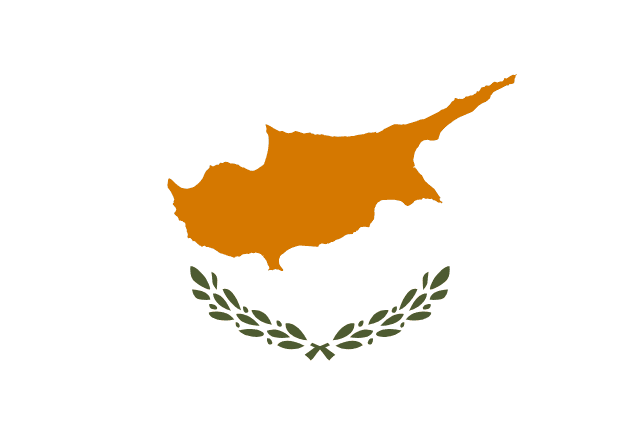
Most national flags lean on bold colors, stars, or stripes to make their statement. The flag of Cyprus does something almost unheard of: it draws a picture of the country itself. On a plain white field sits a copper-gold silhouette of the island, cradled beneath two crossed olive branches. It is quiet, almost diplomatic in tone, and that restraint is entirely deliberate. Adopted in 1960 when the island became an independent republic, the design was crafted to say as little as possible about ethnicity and as much as possible about peace. The result is one of the most unusual and thoughtful flags flown anywhere in the world.
A Flag Built on Neutrality
To understand the Cypriot flag, you have to understand the moment it was born. Cyprus gained independence from British rule in 1960, and its population was split between Greek Cypriots and Turkish Cypriots, two communities with deep ties to nations whose own flags carry powerful symbolism. A new state flag could not simply borrow the blue-and-white of Greece or the red-and-white crescent of Turkey without favoring one group over the other. Instead, the founders chose a design intentionally stripped of any partisan meaning. There is no red, no blue, no religious emblem, no crescent or cross. The flag was meant to belong to everyone on the island equally, and its careful avoidance of loaded symbols is itself a statement about the kind of country Cyprus hoped to become.
The Colors and What They Carry
The flag uses just three colors, and each was selected for a reason rooted in the land rather than in politics.
The white background is the canvas of peace and a clean slate, free of the historical baggage carried by other color choices. It signals openness and the hope of harmony between communities that had every reason to be wary of one another.
The copper shade of the island map is the flag's signature feature. Its warm, golden-brown tone is not a random decorative choice. Cyprus has been associated with copper since antiquity, and the metal is so bound up with the island that the very word "copper" traces back to the Latin name for Cyprus. By coloring the map in this distinctive copper hue, the flag turns geography into heritage, nodding to the mineral wealth and ancient mining tradition that helped make the island famous in the ancient Mediterranean world.
The green of the olive branches completes the palette. Olive trees are woven into the landscape and culture of the entire Mediterranean, and the green branches here speak directly to peace, growth, and reconciliation between the island's two main communities.
Reading the Design
The layout is simple to describe but loaded with meaning. Centered on the white field is a copper-colored map of the whole island of Cyprus, depicting the country in its entirety rather than any divided portion. Directly below the map are two olive branches, crossed and curving outward like a gentle embrace, their green leaves spreading toward the lower corners of the flag.
The choice to place the entire island on the flag is significant. It presents Cyprus as a single, unified whole, an aspiration baked into the national emblem even during periods when the reality on the ground was far more complicated. The olive branches beneath the map reinforce that message, framing the country in a universal symbol of peace. Together, map and branches form a compact visual argument: this is one island, and it wishes to live in peace with itself.
How the Flag Came to Be
When independence arrived in 1960, the new republic needed a flag that both Greek and Turkish Cypriots could accept. Rather than choosing between competing traditions, the designers worked from a brief that emphasized neutrality above all else. The winning concept rejected the politically charged colors and turned instead to the island's own outline and to symbols of peace.
That founding logic has proven durable. While the political situation in Cyprus shifted dramatically in the decades that followed, the official flag of the Republic of Cyprus has retained its core identity: the copper map, the olive branches, the white ground. The shade of copper used for the map has been refined over time to keep it consistent, but the essential idea conceived in 1960 endures, a reminder of the unifying intentions present at the country's birth. Readers who want the fuller story of the island's past and present can explore our cyprus country guide.
How It Compares to Other Flags
Cyprus belongs to a tiny and exclusive club. It is one of only two national flags in the world that feature a map of the country itself, the other being Kosovo, whose flag shows a golden silhouette of its territory beneath a row of stars. The two flags share the map concept but little else, and the differences highlight what makes Cyprus distinctive: where Kosovo adds stars and a blue field, Cyprus keeps things deliberately plain, with no extra emblems beyond the olive branches.
The Cypriot flag also stands apart in its color scheme. Very few national flags use copper or gold as a dominant element in the way Cyprus does, and almost none pair it with crossed olive branches. Compared with the bold reds, blues, and greens of most Mediterranean flags, the Cypriot design reads as understated and peaceful. Its closest spiritual relatives are not other map flags but flags that prize neutrality and reconciliation, such as those that lean on white fields and olive imagery to project calm rather than conquest.
The Flag in National Life
Today the flag of Cyprus appears across civic and everyday life, from government buildings and embassies to schools, ports, and international sporting events. As a member state of the European Union, Cyprus often flies its flag alongside the circle of EU stars, the copper island standing out among the blue and gold of its neighbors. On national occasions, including Cyprus Independence Day on the first of October, the flag is raised in public squares and carried in celebrations that mark the founding of the republic.
For Cypriots, the flag's message of unity remains aspirational and meaningful. It is a banner that asks the island to see itself as one place, and its peaceful palette continues to resonate as a hope written into the nation's most visible symbol.
Interesting Facts
- Cyprus is one of only two countries whose national flag depicts a map of the country, sharing that rare distinction with Kosovo.
- The copper color of the map honors the island's ancient copper deposits, and the English word "copper" ultimately derives from the Latin name for Cyprus.
- The flag was adopted in 1960, the same year Cyprus gained independence.
- It deliberately avoids the colors blue and red to remain neutral between Greek and Turkish Cypriot communities.
- The two olive branches beneath the map are a universal symbol of peace and reconciliation.
- The flag carries no religious symbols, no cross, and no crescent, a rarity among the flags of the region.
Frequently Asked Questions
When was the flag of Cyprus adopted?
The flag was adopted in 1960, the year Cyprus became an independent republic after the end of British rule. Its design has remained essentially unchanged since then, preserving the unifying vision of the country's founding.
What do the colors of the Cyprus flag mean?
The white field represents peace and a fresh start, the copper map reflects the island's historic copper deposits and ancient mining heritage, and the green olive branches symbolize peace and reconciliation between the Greek and Turkish Cypriot communities.
Why does the flag show a map of the island?
The map depicts the whole of Cyprus to present the island as a single, unified country and to stay neutral between its two main communities. It was a deliberate alternative to using politically charged colors or emblems, making Cyprus one of only two nations to put its own map on its flag.
What continent is Cyprus on?
Cyprus is an island nation in the eastern Mediterranean. It is geographically positioned at the crossroads of Europe, Asia, and Africa, and politically it is most often associated with Europe as a member state of the European Union.