

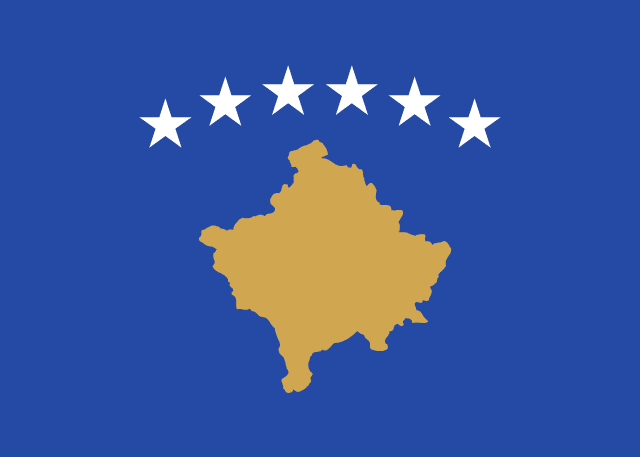
Among the world's national flags, the banner of Kosovo stands out for one striking and unusual choice: it shows the actual outline of the country itself, rendered in gold against a deep blue sky. Most flags rely on abstract bars, crosses, or crescents, leaving you to memorize which colors belong to which nation. Kosovo took a different path, putting a literal map of its own territory front and center. Adopted in 2008 on the very day the young Balkan state declared its independence, this is one of the newest national flags in the world, and its design tells a deliberate story about identity, neutrality, and a hopeful new beginning.
A Flag Born With a Nation
Kosovo's flag did not evolve gradually over centuries the way many European banners did. It arrived fully formed on 17 February 2008, unveiled at the moment Kosovo proclaimed itself an independent country. That timing is central to understanding the design. Before independence, Kosovo had operated under United Nations administration, and the leadership wanted a flag that would signal a fresh, inclusive start rather than tie the new state to the symbols of any single ethnic community or neighboring nation.
The result was chosen through an open international competition that drew nearly a thousand submissions. The winning concept came from a designer named Muhamer Ibrahimi, and the final flag was approved by Kosovo's assembly as part of the independence package. In that sense, the flag is inseparable from the founding of the state: there was no earlier official national flag for an independent Kosovo, so this design represents the country's debut on the world stage.
Reading the Blue, Gold, and White
The flag uses three colors, each pulling its own weight. The blue field forms the backdrop, a calm, deliberate shade that echoes the wider European tradition and signals Kosovo's aspiration to be part of the continental community of nations. Against that blue sits a golden-yellow map of Kosovo, the warm tone meant to suggest the land itself and the prosperity its people hope to build. Arched above the map are six white stars, the white reading as a color of peace and harmony.
What makes the palette especially interesting is what it avoids. The blue, gold, and white scheme was chosen precisely because it sidesteps the colors most loaded with ethnic meaning in the region. Red and black, for instance, are powerfully associated with Albanian identity, while other combinations carry Serbian connotations. By selecting blue and gold, the designers reached for a neutral, forward-looking visual language rather than a partisan one.
The Map and the Six Stars
The two key design elements are the territorial outline and the constellation of stars above it. The gold map is an unmistakable, almost cartographic depiction of Kosovo's borders, so that the flag is in a very real sense a portrait of the nation's geography. Few countries do this; the map device makes Kosovo's flag instantly identifiable and ties the symbol directly to the soil it represents.
The six white stars arc gently over the top of the map. They stand for the principal ethnic communities that make up Kosovo's population, traditionally counted as Albanians, Serbs, Turks, Bosniaks, Roma, and Gorani. Their arrangement in a smooth arch, none placed above the others in rank, is a quiet statement of equality and shared belonging. Where many flags use stars to count provinces or stripes to count founding regions, Kosovo's six stars are about people and the idea that the state belongs to all of its communities together.
How It Compares to Its Neighbors and Look-Alikes
Place Kosovo's flag beside others and its distinctiveness becomes clear. Its closest stylistic cousin is the flag of Bosnia and Herzegovina, which also uses a blue field with golden-yellow and white stars and was likewise crafted to be ethnically neutral after a period of conflict. Both flags share that EU-influenced blue-and-gold palette and a deliberate refusal to favor one community. Yet Bosnia's flag features a yellow triangle and a line of stars, while Kosovo's uses the unique map silhouette, so the two are never confused.
The map-on-flag idea also invites comparison with Cyprus, the other well-known national flag to depict the country's own outline in a coppery gold above stylized olive branches. Cyprus and Kosovo are, in fact, the two flags most often cited for this rare cartographic approach. Meanwhile, the broader blue-and-stars family that includes the European Union banner and the flag of Bosnia gives Kosovo's flag a recognizable regional accent without making it a copy of any of them. The combination of a literal map with six arched stars is unique to Kosovo alone.
A Symbol of Identity and Statehood
For a country whose independence is still recognized by some nations and contested by others, the flag carries unusual weight. It functions as visible proof of statehood: a flag of one's own is one of the clearest markers that a place considers itself a sovereign nation. Inside Kosovo, the banner flies over the assembly, government buildings, and schools, and it appears at official ceremonies marking the anniversary of independence each February.
Because the flag was engineered to be inclusive rather than ethnic, it also serves a delicate civic purpose. In a society where questions of identity remain sensitive, an emblem that explicitly honors six communities at once is meant to be something citizens of different backgrounds can, in principle, stand beneath together. To explore how this identity plays out across the country's culture, cities, and landscapes, see our kosovo country guide.
The Flag in Modern Life
In everyday Kosovo, the official map-and-stars flag shares space with other banners, most visibly the red Albanian flag with its black double-headed eagle, which many ethnic Albanians display with pride. This coexistence reflects the layered nature of identity in the region. On the international stage, though, it is the blue, gold, and white design that represents Kosovo, whether at diplomatic events, in front of recognizing embassies, or when Kosovar athletes compete. Kosovo's appearances at the Olympic Games and in international football have given the flag growing global exposure, carried by athletes who have helped put the young nation's colors on the world's screens.
Interesting Facts at a Glance
- Kosovo's flag was adopted on 17 February 2008, the same day the country declared independence, making it one of the youngest national flags in the world.
- It is one of only a small handful of national flags, alongside Cyprus, to feature an outline map of the country itself.
- The winning design came from Muhamer Ibrahimi through an open competition that received close to a thousand entries.
- The six stars represent six major ethnic groups, not provinces or states.
- The blue, gold, and white palette was chosen specifically to be ethnically neutral and to echo European symbolism.
- Kosovo sits in the Balkan region of southeastern Europe, bordered by Serbia, Montenegro, Albania, and North Macedonia.
Frequently Asked Questions
When was the flag of Kosovo adopted?
The flag was adopted on 17 February 2008, the day Kosovo declared its independence. This makes it one of the newest national flags in the world and ties its origin directly to the founding of the modern state.
What do the colors and symbols mean?
The blue field reflects Kosovo's European orientation, the golden map represents the land and territory of Kosovo, and the white of the six stars stands for peace. Each of the six stars symbolizes one of the country's main ethnic communities, expressing equality among them.
Who designed the Kosovo flag?
The design is credited to Muhamer Ibrahimi, whose entry won an open international competition held ahead of independence. The flag was then formally approved by Kosovo's assembly as part of its declaration of statehood.
What continent is Kosovo on, and what flag is it most similar to?
Kosovo is located in southeastern Europe, in the Balkan Peninsula. Its flag is most often compared to that of Bosnia and Herzegovina, which shares the blue, gold, and white palette and a deliberately neutral design, and to Cyprus, the other national flag that depicts its own map outline.