
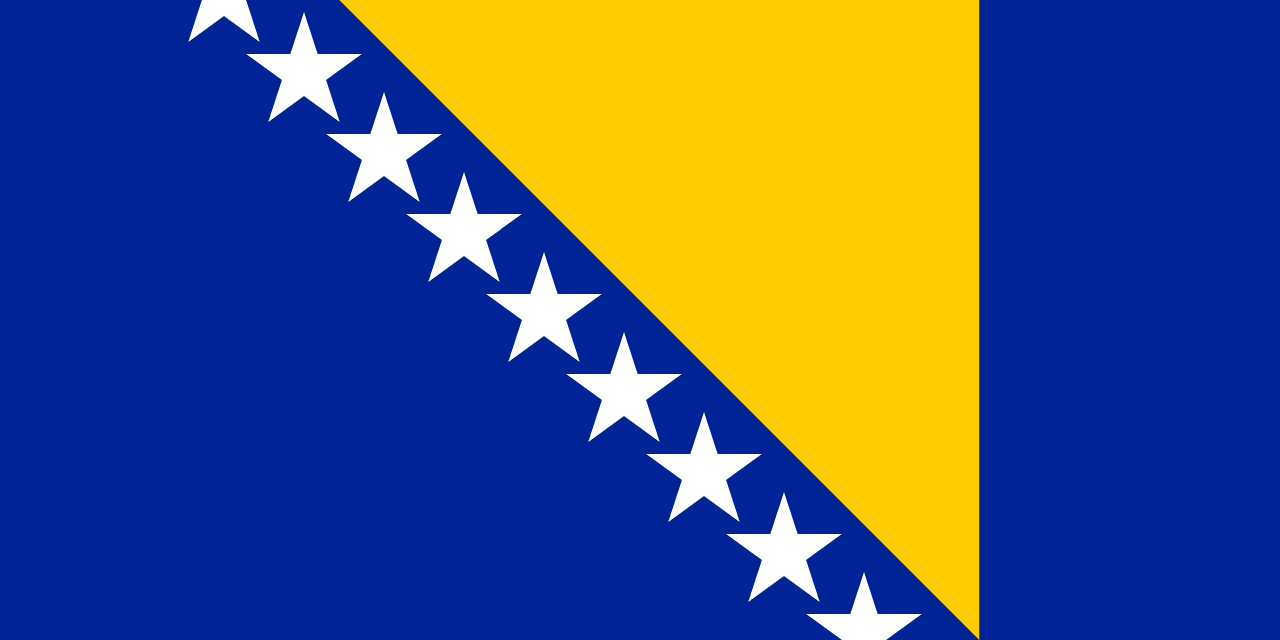
Few national flags carry their origin story quite as openly as the one flown over Sarajevo, Mostar, and Banja Luka. The flag of Bosnia and Herzegovina is a deliberately modern design: a deep blue field crossed by a bright yellow triangle, with a diagonal line of white stars running along its edge. There is no eagle, no crest, no historical heraldry. That blankness is intentional. Adopted in 1998, the flag was conceived as neutral ground in a country whose recent history made traditional symbols dangerous. It is, in a sense, a flag built to belong to everyone at once and to no single group in particular.
A Flag Designed by Committee, and by Crisis
The story behind this flag is unusual among the world's national emblems. In the years after the 1992–1995 war, Bosnia and Herzegovina struggled to agree on shared state symbols. The country is home to three constituent peoples, Bosniaks, Croats, and Serbs, and almost any flag drawing on the cultural traditions of one risked alienating the others. When the country's own parliament could not reach consensus, the design was ultimately imposed by the international community: it was put forward under the authority of the UN High Representative overseeing the peace settlement, and the current flag took effect in 1998.
Because of that, the flag was engineered to avoid the very symbolism that usually defines a nation. Instead of referencing any one ethnic or religious heritage, it reaches outward toward a shared European future. It is one of the clearest examples anywhere of a flag created not to celebrate a settled identity but to help build one.
Reading the Colors
The palette is restrained, just three colors, each doing real work. The blue field is the dominant tone, a color long associated with Europe and with the European Union, and it sets the flag apart from the red-heavy banners common across the Balkans. The yellow triangle provides warm, golden contrast and is sometimes read as a nod to the sun and to the natural wealth of the land. The white stars supply the third element, a cool, clean accent against the blue.
It is worth noting what these colors are not meant to do. They were chosen partly because they echo the broader European family of flags rather than the historical colors of any single Bosnian community. In a country where color itself can be politically loaded, this choice of blue, yellow, and white was its own kind of statement: a turn toward the continent rather than inward toward division.
The Geometry: Triangle and Stars
The design rewards a close look. A yellow triangle sits in the upper portion of the flag, with its three points carrying a layered meaning. Most directly, the three corners represent the three constituent peoples of Bosnia and Herzegovina. The triangle's slanted shape is also frequently read as an echo of the country's mountainous terrain, the land itself rendered in geometry.
Running alongside the long side of the triangle is a diagonal line of white, five-pointed stars. The stars stand for Europe, the same starry motif found across the continent's iconography. The most quietly clever detail is at the ends of that line: the stars at the top and bottom are partly cut off by the flag's edge, as though the row continues beyond what we can see. That deliberate cropping is meant to suggest infinity, an unbroken, endless sequence, hinting at continuity and a future without limits. It is a small visual trick, but once you notice it, the whole flag reads differently.
How It Compares to Its Neighbors and Look-Alikes
Set beside other Balkan flags, this one stands out immediately. Many flags in the region lean on red, on double-headed eagles, or on the pan-Slavic combination of red, white, and blue. The Bosnian flag's cool blue base and yellow geometry give it an entirely different feel, less like a traditional heraldic banner and more like a modern logo or emblem of a contemporary institution.
The closest visual cousins are not in the Balkans at all but in the symbolism of the European Union, whose blue field and golden stars the design clearly evokes. Some observers also see a faint resemblance to the flag of the United Nations in its institutional, deliberately neutral character, fitting, given the role international authorities played in its creation. Among national flags, the combination of a single triangle and a diagonal star line is genuinely rare, which makes the Bosnian flag easy to identify once you know it. Where a flag like that of the Czech Republic or Cuba uses a triangle pointing inward from the hoist, Bosnia's triangle sits across the top, an arrangement few others share. If you want the fuller context of the country behind the banner, the bosnia and herzegovina country guide covers its regions, cities, and culture in depth.
Identity, Acceptance, and Everyday Life
A flag imposed from outside is not automatically embraced, and the early years of this one were complicated. Because it did not emerge from a popular movement or a shared historical struggle, it took time for the design to settle into the national consciousness. Yet over the years since 1998 it has become the recognized face of the Bosnian state, flown at government buildings, displayed at international summits, and carried at the country's borders and embassies.
In sport, the flag travels widely. Bosnian fans wave it for the national football team and at the Olympic Games, where it identifies athletes competing under a single banner regardless of which community they come from, arguably the very unity the design was meant to encourage. On state holidays and civic occasions, the blue-and-yellow appears alongside the country's other official symbols, gradually accumulating the layers of memory and meaning that older flags acquire over generations. For a flag still well within living memory of its own birth, it has become a steady, familiar presence.
Quick Facts Worth Remembering
- The flag was adopted in 1998, making it one of Europe's more recently designed national flags.
- Bosnia and Herzegovina sits in Europe, specifically the Balkan Peninsula of southeastern Europe.
- The three points of the yellow triangle stand for the country's three constituent peoples.
- The white stars represent Europe, and they are intentionally cut off at the top and bottom edges to suggest infinity.
- The design was put forward under the UN High Representative rather than by a single named domestic designer.
- Its blue, yellow, and white palette was chosen partly to echo European symbolism and avoid any one community's traditional colors.
Frequently Asked Questions
When was the flag of Bosnia and Herzegovina adopted?
The current flag was adopted in 1998, in the years following the 1992–1995 war, after the country's own institutions could not agree on a design. It replaced earlier symbols and has served as the national flag ever since.
What do the colors and symbols mean?
The blue field and white stars evoke Europe, aligning the country with the wider continent. The yellow triangle's three corners represent the three constituent peoples, Bosniaks, Croats, and Serbs, and its shape is also linked to the country's mountainous landscape. The stars are cropped at the edges to imply an infinite, continuing line.
Who designed the flag?
Rather than a single celebrated artist, the flag was introduced under the authority of the UN High Representative overseeing the postwar settlement, after domestic political leaders failed to reach agreement. This international origin is one of the flag's defining and most unusual features.
What continent is Bosnia and Herzegovina on, and what flags is it similar to?
Bosnia and Herzegovina is in Europe, in the Balkan region of the southeast. Its flag most closely resembles the blue-and-gold-star symbolism of the European Union and carries the neutral, institutional feel sometimes associated with the United Nations, setting it apart from the red-dominated, eagle-bearing flags common elsewhere in the Balkans.
