

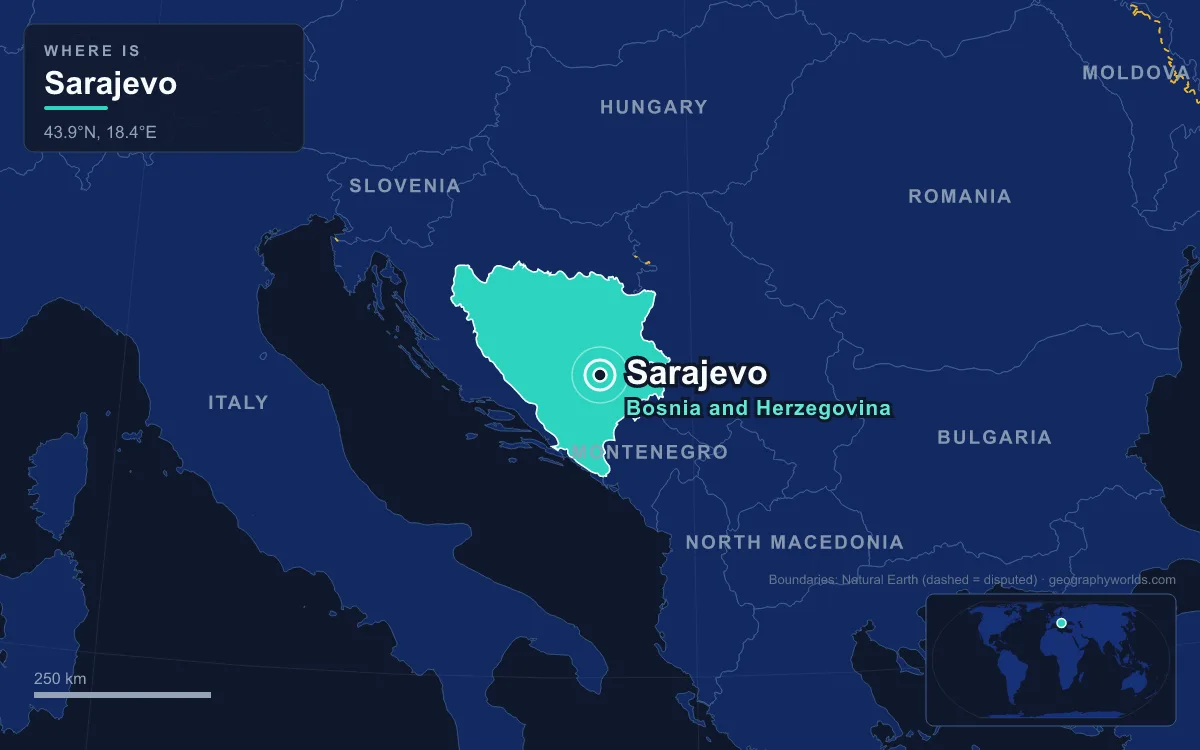
The capital of Bosnia and Herzegovina is Sarajevo, the country's largest city and its political, financial and cultural centre. It lies near the geometric middle of the triangular country, at about 518 metres above sea level in a valley of the Dinaric Alps, strung out for kilometres along the Miljacka river. The four municipalities that make up the city had 275,524 residents at the 2013 census, and the wider Sarajevo Canton had 413,593. Sarajevo is an Ottoman foundation, dated to 1461, and it has spent five centuries as the place where empires, faiths and markets met, which is why a mosque, a Catholic cathedral, an Orthodox church and a synagogue stand within a few minutes' walk of one another in its old centre. The city's story is easiest to follow through four things: who ruled it, how it traded, how it prayed, and how ordinary Sarajevans lived through its best and worst years.
Isa-Beg's Saray, the Latin Bridge and Five Centuries of Rulers
Sarajevo is named after a building of power. When the Ottomans conquered the region in the 1450s, the first Ottoman governor of Bosnia, Isa-Beg Ishaković, turned a cluster of villages on the Miljacka into a town. He built a mosque named for Sultan Mehmed II, the Careva Džamija or Emperor's Mosque, together with a covered market, a bathhouse, a caravanserai, a bridge and a governor's palace, the saray. The Turkish word saray, from Persian, means palace, and the Slavic ending -evo turned it into something like "the place of the palace". The first written mention of the name is in a letter of 1507. Throughout Ottoman rule the official name was Saraybosna, "Palace of Bosnia", which is still what the city is called in Turkish.
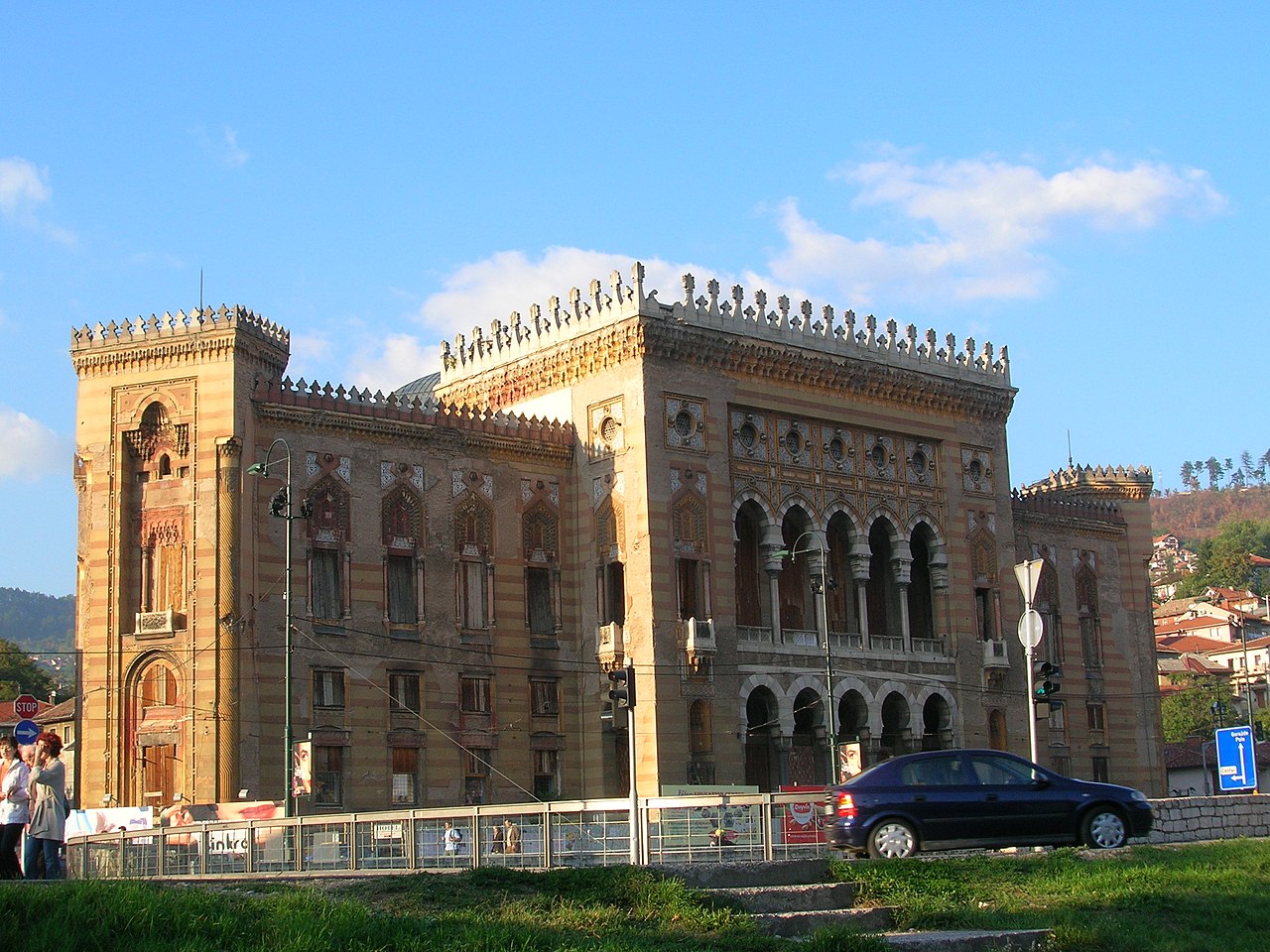
Power moved many times after that. In 1697, during the Great Turkish War, Prince Eugene of Savoy raided the city for the Habsburgs; his troops looted it and burned almost all of it in a single day. Austria-Hungary occupied Bosnia under the Treaty of Berlin in 1878 and annexed it outright in 1908, and it was under Austrian rule that the most consequential event in the city's history took place. On 28 June 1914 Archduke Franz Ferdinand and his wife Sophie attended a reception at the new City Hall, the Vijećnica, and were shot shortly afterwards near the northern end of the Latin Bridge by Gavrilo Princip, a Bosnian Serb member of the Young Bosnia movement. The assassination set off the July Crisis and the First World War.
The Latin Bridge itself is older than any of this. Its name comes from the Catholic quarter it served, which the Ottomans called Latinluk. A census of 1541 records a bridge on the spot, a stone bridge was built in 1565 by a leading citizen, Ali Ajni-Beg, and it was rebuilt after a flood in 1791. In the 20th century Sarajevo was the capital of a province within the Kingdom of Yugoslavia, was occupied by Axis forces from April 1941, and was liberated on 6 April 1945. It then became the capital of the Socialist Republic of Bosnia and Herzegovina, and it kept its role as the national capital when the country declared independence. The Dayton Agreement that ended the Bosnian War in 1995 drew the line between the Federation of Bosnia and Herzegovina and Republika Srpska through the old metropolitan area, and several suburban municipalities on the Republika Srpska side now form a separate city, Istočno Sarajevo.
Baščaršija and the Trade Waqf of Gazi Husrev-beg
If Isa-Beg founded the city, Gazi Husrev-beg, governor of Bosnia in the early 16th century, built most of what visitors now call the Old Town. Ottoman cities grew around the waqf, a charitable endowment in which a benefactor funded a mosque together with income-producing buildings whose rents paid for its upkeep. Husrev-beg's endowment included a school, a madrasa, a library, a bathhouse, a covered market (bezistan) and the Morića Han, a caravanserai that could hold about 300 travellers and 70 horses and is the only han still standing in Sarajevo.
These buildings stand in and around Baščaršija, the old bazaar on the north bank of the Miljacka. The name joins the Turkish baş, "head" or "main", and çarşı, "market". Isa-Beg laid out its first shops around his han in 1462, and the streets around it were soon divided into separate čaršije by trade, among them the Kazaz to the west and the Sedlar and Sarača to the north. At the peak of Ottoman power Sarajevo was the largest and most important Ottoman city in the Balkans after Istanbul. By 1660 its population was estimated at more than 80,000. For comparison, Zagreb had only about 14,000 people as late as 1851. The burning of 1697 ended that golden age, and by 1807 the city was down to about 60,000.
Trade in the modern city has moved west of the old bazaar, where the Avaz Twist Tower was, when it was built, the tallest skyscraper in the former Yugoslavia. Baščaršija remains the city's best-known district and its main draw for tourists, centred on the square that holds the Sebilj, a kiosk-shaped public fountain.
Gazi Husrev-beg Mosque, Sacred Heart Cathedral and the Sarajevo Haggadah
The centrepiece of the Husrev-beg endowment is his mosque, completed in 1530. It is the largest historical mosque in Bosnia and Herzegovina and the main congregational mosque for the country's Muslims. The architect is not known for certain; most scholars credit Acem Ali, an Ottoman builder of Persian descent, and masons from Ragusa (Dubrovnik) worked on it at Husrev-beg's request. In 1898, under Austro-Hungarian rule, it became the first mosque in the world to be lit by electricity. Husrev-beg is buried in a mausoleum beside it. By the middle of the 16th century Sarajevo had more than 100 mosques.

Christian and Jewish communities lived alongside. The Old Orthodox Church stands in Baščaršija, and an Orthodox church was among the handful of buildings left standing after the fire of 1697. The Catholic Sacred Heart Cathedral, the largest cathedral in the country and the seat of the Archbishop of Vrhbosna, was built between 1884 and 1887 in a Neo-Gothic style modelled on Notre-Dame in Dijon. After Spain expelled its Jews at the end of the 15th century, Sephardic families settled in Sarajevo at the Ottoman invitation, and the city became a centre of Sephardic culture and of the Ladino language, with a small Jewish quarter inside Baščaršija. This mix earned Sarajevo its nickname, the "Jerusalem of Europe".
The most famous object in the city belongs to that Jewish history. The Sarajevo Haggadah is an illuminated Passover manuscript made in northern Spain, probably Barcelona, around 1350; historians believe it left Iberia with Jews expelled in 1492, and it was sold to the National Museum in Sarajevo in 1894. During the Second World War, when the main Sephardic synagogue was looted and burned and most of the city's Jews were deported and murdered, the chief librarian of the National Museum, Derviš Korkut, smuggled it out of the city's reach. It is now kept in the National Museum of Bosnia and Herzegovina and was added to UNESCO's Memory of the World register in 2017. For how these communities are counted today, see our guide to religion in Bosnia and Herzegovina.
Sarajevo Daily Life: The 1885 Tram, the 1984 Olympics and 1,425 Days of Siege
Austria-Hungary treated Sarajevo as a testing ground. A horse-drawn tram line opened on New Year's Day 1885, making it the first city in this part of Europe with a tramway, and it served as a trial before trams were installed in Vienna. Trams still run the long east–west axis from Baščaršija to the suburb of Ilidža, on a single main route with seven lines as of 2026. The Austrians also built the Vijećnica, first designed in 1891 by Karel Pařík, taken over by Alexander Wittek and completed by Ćiril Iveković in the pseudo-Moorish style, and much of the Centar municipality, which is why the city switches from Ottoman lanes to Habsburg boulevards within a few hundred metres.
The post-war decades brought the biggest growth. Between 1945 and the end of Yugoslavia the population rose from about 115,000 to more than 600,000, housed in new blocks in Novi Grad and Novo Sarajevo. The peak was the XIV Olympic Winter Games, held from 8 to 19 February 1984, with 1,272 athletes from 49 countries. Sarajevo had beaten Sapporo and a Swedish bid from Falun and Gothenburg for them. Events were held on the mountains that ring the city: Bjelašnica at 2,067 metres, Jahorina at 1,913 metres, Trebević at 1,627 metres and Igman at 1,502 metres, still known locally as the Olympic mountains. The city's climate suits that role, with January averaging 0.6 °C and about 83 days a year below freezing.
Eight years later those same hills became firing positions. During the Bosnian War, Bosnian Serb forces of the Army of Republika Srpska and the Yugoslav People's Army besieged the city from 5 April 1992 to 29 February 1996, the longest siege of a capital city in modern warfare. Artillery, mortars and snipers in the surrounding hills targeted the city, and 11,541 people were killed, including more than 1,500 children. On 25 August 1992 shelling burned the Vijećnica, then the National and University Library, with about 1.5 million volumes inside. Trams stopped running on 15 April 1992 and, remarkably, restarted on 15 April 1994 while the siege was still going on. Where mortar shells scarred the pavement, the craters were later filled with red resin; the flower-like marks are called Sarajevo Roses, and several remain on the streets.
After the war, some 62,000 Serbs left the city and its suburbs in early 1996 following the Dayton division, and the city that was rebuilt is less mixed than before: in 1991 its population had been 49.2% Bosniak, 29.8% Serb, 10.7% Yugoslav and 6.6% Croat. The Vijećnica reopened on 17 July 2014 as the seat of the mayor and city council. Sarajevo has since been named a UNESCO Creative City of Film in 2019 and co-hosted the European Youth Olympic Winter Festival that same year. Its most persistent modern problem is air pollution, which a 2016 World Health Organization database put at about three times its recommended annual level for fine particles, based on 2010 estimates. To place the city in its wider setting, read our Bosnia and Herzegovina country guide and our explainer on what the Balkans are.
Quick Facts About Sarajevo
- Country: Bosnia And Herzegovina
- Continent: Europe (Southern Europe)
- Country population: approximately 3.1 million
- Capital city status: Sarajevo is the capital of Bosnia And Herzegovina, the seat of national government, and the location of foreign embassies, parliament, and the head of state's official residence.
Frequently Asked Questions
What is the capital of Bosnia And Herzegovina?
The capital of Bosnia And Herzegovina is Sarajevo. Sarajevo is the seat of national government, hosts most foreign embassies and consulates, and is typically where the head of state and parliament are located.
What continent is Sarajevo in?
Sarajevo, the capital of Bosnia And Herzegovina, is located in Europe, in the Southern Europe region. As Bosnia And Herzegovina's capital, Sarajevo serves as the country's primary connection to the broader Europen political, economic, and cultural sphere.
Why is Sarajevo the capital of Bosnia And Herzegovina?
Sarajevo was chosen as the capital of Bosnia And Herzegovina for reasons that typically combine geography, history, and politics. Capital city selections often reflect a desire for centrality (being accessible from across the country), historical importance (being a longstanding seat of government or culture), or neutrality (being acceptable to multiple regions or ethnic groups within the country). The specific reasons for Sarajevo's designation are detailed in the city's history above.
What is Sarajevo known for?
As the capital of Bosnia And Herzegovina, Sarajevo is best known for housing the country's central government institutions — parliament, presidential or royal residences, supreme court, and key ministries. It is also typically a major cultural and economic center within Bosnia And Herzegovina, hosting national museums, embassies, and signature monuments. The introduction and history sections above provide detailed coverage of the city's specific notable institutions and landmarks.
Related Pages
- Bosnia and Herzegovina Country Guide — full geography, climate, economy, and culture overview
- Flag of Bosnia and Herzegovina — meaning, history, and design of Bosnia and Herzegovina's national flag