

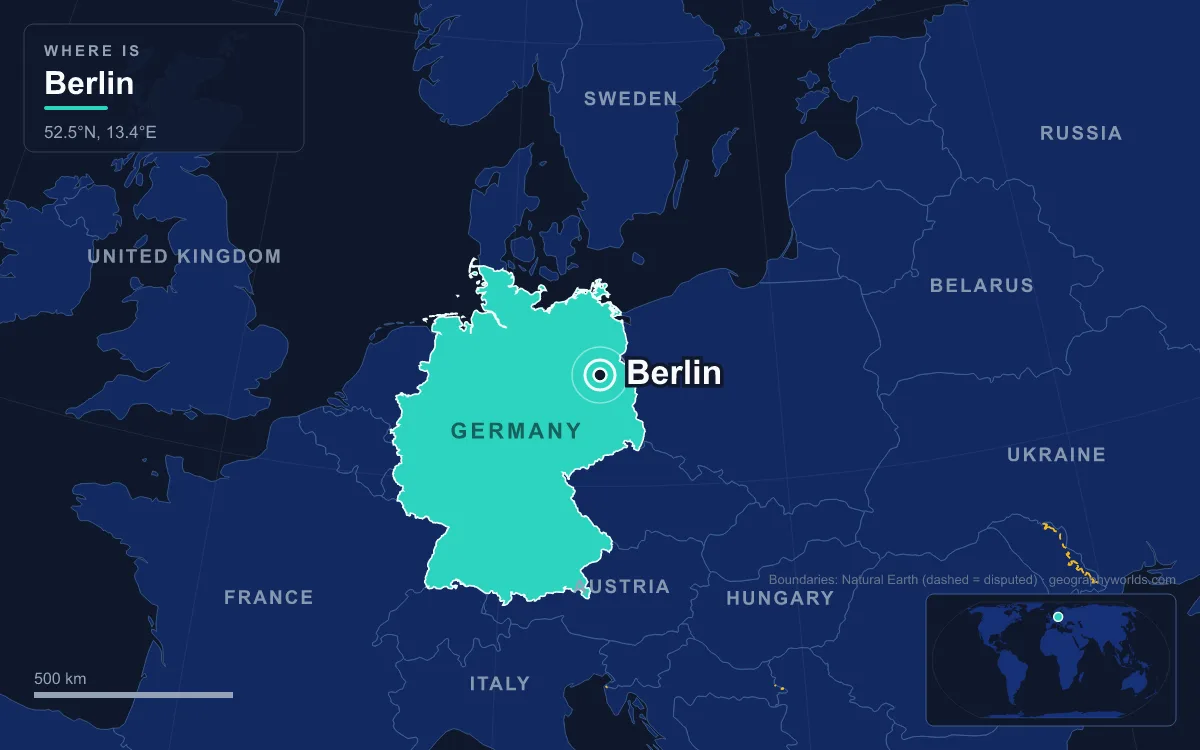
Germany's capital is Berlin, the country's largest city, which stands on the River Spree in the north-east of the country, surrounded by the state of Brandenburg. It had an official population of about 3.7 million at the end of 2025, the largest population within city limits of any city in the European Union, and it is also one of Germany's sixteen states. Berlin has been a capital, off and on, for more than 500 years, but its present role is recent: it became the capital of reunified Germany on 3 October 1990, and the Bundestag and chancellor only moved there from Bonn in 1999, after a close and emotional vote in the Bundestag.
Berlin and Cölln: Twin Trading Towns on the Spree
Berlin did not start as a seat of power. In the 12th century the area, settled until then by Slavic peoples such as the Hevelli and Sprevane, came under German rule as part of the Margraviate of Brandenburg, founded by Albert the Bear in 1157. The name Berlin itself probably comes from a Slavic root meaning swamp. German merchants founded two small towns facing each other across the Spree: Berlin, on the site of today's Nikolaiviertel, and Cölln, on the island in the Spree that also holds today's Museum Island. The year 1237, when Cölln is first recorded, is taken as the city's founding date.
The twin towns grew rich on trade. They sat on the route of the Via Imperii and on the road running from Bruges to Novgorod, and they held staple rights that forced passing merchants to offer their goods for sale. In 1307 they formed an alliance with a shared foreign policy, while keeping separate councils.
The turning point came with the Hohenzollern family, who ruled from Berlin until 1918. In 1443 the elector Frederick II began building a palace in Berlin-Cölln. The townspeople protested, and the dispute of 1448 is remembered as the Berliner Unwille, the "Berlin indignation". The elector won. In 1486, when John Cicero took power, the palace became the permanent residence of the electors of Brandenburg, and the city had to give up its status as a free member of the Hanseatic League. From then on, Berlin's fortunes followed those of its rulers.
From Hohenzollern Residence to Capital of Prussia in 1701
The Thirty Years' War of 1618 to 1648 wrecked the town. A third of its houses were damaged or destroyed and it lost half its people. The recovery was deliberate. Frederick William, the "Great Elector", encouraged immigration and religious tolerance, and with the Edict of Potsdam in 1685 he offered refuge to French Huguenots expelled from France. By 1700 about 30 per cent of Berlin's residents were French.
Since 1618 Brandenburg had been joined in personal union with the Duchy of Prussia, far to the east. In 1701 the elector Frederick III crowned himself Frederick I, King in Prussia, and Berlin became the capital of the new kingdom, replacing Königsberg. It was a deliberate move to centralise a far-flung state around its Brandenburg core. In 1709 and 1710 Berlin, Cölln and three newer districts, Friedrichswerder, Dorotheenstadt and Friedrichstadt, were merged into a single city. Between 1700 and 1750 its population nearly quadrupled, from about 30,000 to 113,000.
Under Frederick the Great, who reigned from 1740 to 1786, Berlin became a centre of the Enlightenment. Through the 19th century the Industrial Revolution turned it into Germany's main railway hub and industrial centre, and its population passed one million in 1877.
1871: Capital of the German Empire Because Prussia Led It
Before 1871 there was no German capital at all, because there was no German nation-state. The Holy Roman Empire had no fixed seat; kings were crowned at Aachen and later Frankfurt, and the Habsburg emperors ruled from Vienna. After 1815 the German Confederation's assembly met in Frankfurt, which also served briefly as the national capital during the revolutions of 1848.
When Germany was unified in 1871 under Prussian leadership, the choice was automatic. Berlin was the capital of Prussia, the dominant state of the new empire, so it became the capital of Germany as well. The Reichstag building, designed by Paul Wallot, was built on the Königsplatz between 1884 and 1894 to house the imperial parliament. On 9 November 1918, as the monarchy collapsed, Philipp Scheidemann proclaimed a republic from one of its balconies.
Even then Berlin's hold was not absolute. In 1919 the national assembly met in Weimar, away from the street fighting in the capital, and the new republic took that town's name. But the government stayed in Berlin. The Greater Berlin Act of 1920 absorbed dozens of surrounding towns, including Charlottenburg, Spandau and Köpenick, and made Berlin, with around four million people, the third-largest city in the world after London and New York. After 1933 the Nazi regime planned to rebuild it as a monumental "World Capital Germania", a scheme never carried out. Allied bombing and the Battle of Berlin in 1945 destroyed much of the centre.
Divided City, Two Capitals: East Berlin and "Provisional" Bonn
After the war the four Allied powers split Berlin into sectors. In 1948 the Soviet Union blockaded the western sectors, and the Western Allies supplied them by air from June 1948 to May 1949. When two German states were founded in 1949, East Germany proclaimed East Berlin, which held most of the historic centre, as its capital. The Western powers never recognised that claim, even after they opened embassies there in the 1970s.
West Germany faced a harder question. Frankfurt was the obvious candidate for its capital, but politicians feared that a large, important city would quietly become permanent and weaken the commitment to one day returning to Berlin. So the government settled in Bonn, a smaller university town on the Rhine, chosen as a plainly temporary solution. It helped that Bonn was close to Cologne, home of the first chancellor, Konrad Adenauer. In 1961 East Germany sealed West Berlin behind the Berlin Wall, which stood until 9 November 1989.
The 338-to-320 Vote of 20 June 1991
Germany was reunified on 3 October 1990, and the Unification Treaty named Berlin as the capital. It did not settle where the government would sit. Many politicians argued that parliament and the ministries should stay in Bonn, as The Hague serves as the seat of government while Amsterdam is the capital of the Netherlands. They pointed to Berlin's association with the Nazi state, to Bonn's closer position to Brussels, and to the fact that Bonn lay in Germany's wealthiest and most densely populated region, while the eastern states around Berlin were poor and thinly populated.
Supporters of Berlin, including Willy Brandt and Wolfgang Schäuble, introduced a cross-party motion titled "Completion of the Unity of Germany". On 20 June 1991, after more than ten hours of debate, the Bundestag passed it by 338 votes to 320. The first count gave 337, later corrected to 338. The vote split along regional lines, with members from the south and west mostly backing Bonn, and along generational lines, with older members more likely to choose Berlin. The votes of members from the former East Germany decided it.

The Reichstag Dome and the Spreebogen: Moving the Government in 1999
The move took most of a decade. The Berlin/Bonn Act of 26 April 1994 set out which ministries would go and which would stay. The Reichstag, badly damaged in an arson attack in February 1933 and later stranded in West Berlin beside the Wall, was rebuilt between 1995 and 1999 to designs by Norman Foster, topped by a walk-in glass dome above the debating chamber. Its keys were handed to the Bundestag president, Wolfgang Thierse, on 19 April 1999, and Berlin took on its full role as the seat of parliament and government in July 1999. The Bundesrat, which represents the states, followed in 2000.
The chancellor's office arrived in 1999, first in the former East German State Council building, then in 2001 in a new Chancellery by Axel Schultes and Charlotte Frank on the Spreebogen, a bend of the river beside the Reichstag. It is often described as the largest government headquarters building in the world.

Across the city, other capital projects filled the gaps left by division. Potsdamer Platz, a wasteland beside the Wall, became one of Europe's biggest building sites. The East German Palace of the Republic, built on the site of the Hohenzollern palace that East Germany had demolished in 1950, was itself torn down, and by 2020 the exterior of the old Berlin Palace had been rebuilt around the Humboldt Forum museum. A new main railway station opened in 2006, and Berlin Brandenburg Airport opened in 2020 after long delays.
What Being Capital Means Now: City-State, Bonn's Share and "Poor but Sexy"
Berlin's status today has three unusual features. First, the capital is shared in practice. The Berlin/Bonn Act gave Bonn the title of Federal City, and several ministries, including Defence, kept their main seat there with a second office in Berlin. Around 8,000 of the 18,000 officials in the federal ministries still work in Bonn, roughly 600 kilometres away. Only in 2006 was the Basic Law amended to say explicitly that Berlin is the capital.
Second, Berlin is a state as well as a city. It is one of three German city-states, with its own parliament, the Abgeordnetenhaus, and a governing mayor. It is entirely surrounded by the state of Brandenburg, whose capital, Potsdam, borders it to the south-west. In 1996 a plan to merge Berlin and Brandenburg was rejected in a referendum, so the two remain separate, though together they form a capital region of more than six million people.
Third, unlike Paris or London, Berlin is not the country's economic centre. Division drove many banks and corporate headquarters to West Germany, most banks settled in Frankfurt, and relatively few companies moved their headquarters back after reunification. In 2003 its mayor, Klaus Wowereit, described it as "poor, but sexy", a line that helped market its low rents and nightlife to artists and, later, start-up founders. Berlin's economy is now built on services, research, media and technology rather than heavy industry.
Berlin's path to capital status, from a palace forced on a trading town in the 1440s to a narrow parliamentary vote in 1991, explains much of how the city looks today. The story of the barrier that split it is told in our history of the Berlin Wall, and the gate that stood in its shadow has its own guide to the Brandenburg Gate. To see how Berlin fits among the other fifteen state capitals, from Munich to Kiel, read our list of Germany's state capitals.
Quick Facts About Berlin
- Country: Germany
- Continent: Europe (Western Europe)
- Country population: approximately 83.6 million
- Capital city status: Berlin is the capital of Germany, the seat of national government, and the location of foreign embassies, parliament, and the head of state's official residence.
Frequently Asked Questions
What is the capital of Germany?
The capital of Germany is Berlin. Berlin is the seat of national government, hosts most foreign embassies and consulates, and is typically where the head of state and parliament are located.
What continent is Berlin in?
Berlin, the capital of Germany, is located in Europe, in the Western Europe region. As Germany's capital, Berlin serves as the country's primary connection to the broader Europen political, economic, and cultural sphere.
Why is Berlin the capital of Germany?
Berlin was chosen as the capital of Germany for reasons that typically combine geography, history, and politics. Capital city selections often reflect a desire for centrality (being accessible from across the country), historical importance (being a longstanding seat of government or culture), or neutrality (being acceptable to multiple regions or ethnic groups within the country). The specific reasons for Berlin's designation are detailed in the city's history above.
What is Berlin known for?
As the capital of Germany, Berlin is best known for housing the country's central government institutions — parliament, presidential or royal residences, supreme court, and key ministries. It is also typically a major cultural and economic center within Germany, hosting national museums, embassies, and signature monuments. The introduction and history sections above provide detailed coverage of the city's specific notable institutions and landmarks.
Related Pages
- Germany Country Guide — full geography, climate, economy, and culture overview
- Flag of Germany — meaning, history, and design of Germany's national flag