

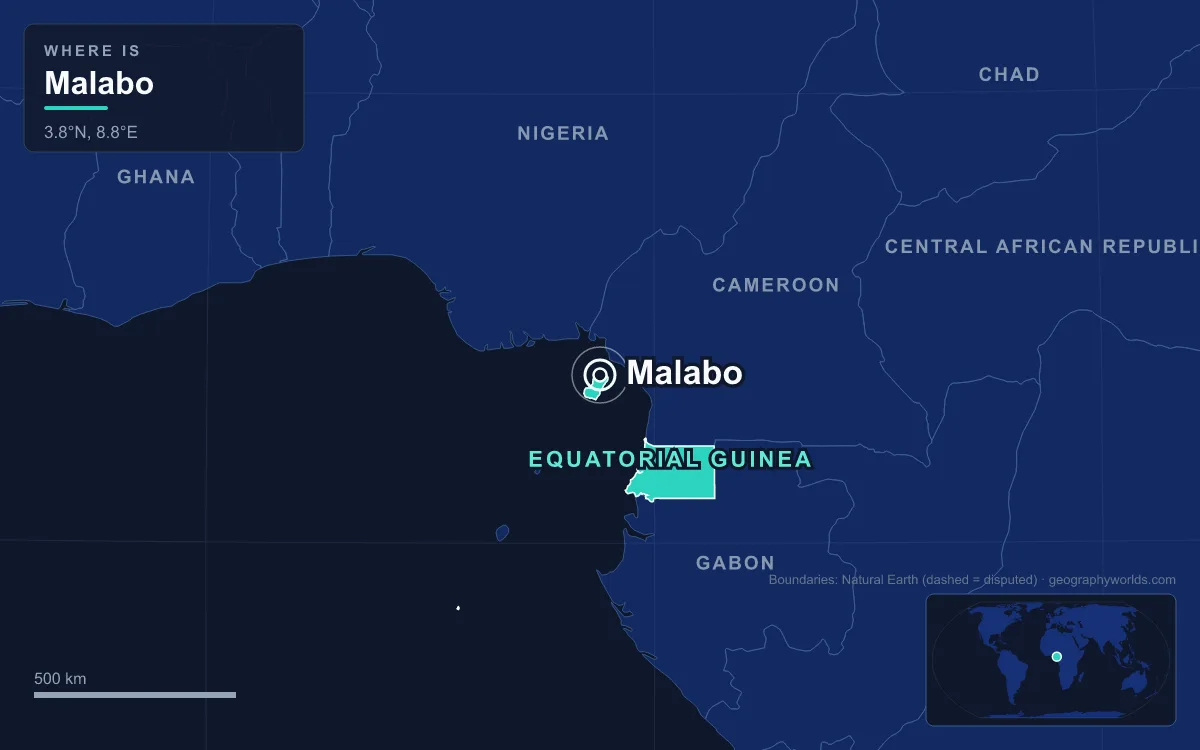
The capital of Equatorial Guinea is now Ciudad de la Paz, a planned city in the mainland region of Río Muni. A presidential decree of 2 January 2026 moved the title there from Malabo, which had been the capital since independence in 1968 and, as Santa Isabel, the seat of the Spanish colony before that. Malabo lies on the north coast of Bioko, a volcanic island in the Gulf of Guinea about 3°45′ north of the equator. It had roughly 297,000 inhabitants in 2018. Much of the country's commerce and a great deal of its recent history are still concentrated there, and so is its weather: as a capital, Malabo ranked among the cloudiest, wettest and most lightning-prone in the world.
Port Clarence, Santa Isabel, Malabo: Three Names and Three Rulers
Each of the city's three names records a change of master. The Portuguese navigator Fernão do Pó reached the island in 1472, and it carried a version of his name, Fernando Pó, for five centuries. Portugal handed the island, together with Annobón and trading rights on the mainland, to Spain through the treaties of San Ildefonso (1777) and El Pardo (1778). Spain did little with it. In 1827 it allowed Britain to use the island as a base against the Atlantic slave trade.
On 25 December 1827 the British captain William Fitzwilliam Owen founded Port Clarence on the ruins of an earlier Portuguese settlement, naming it after the Duke of Clarence, later King William IV. The indigenous Bubi called it Ripotó, "place of the foreigners". Royal Navy patrols landed Africans freed from slave ships there, The British consul doubled as governor, and one of them, John Beecroft, modernised the town. Spain reasserted control in 1855 and renamed it Santa Isabel after Queen Isabella II, and it went on to become the capital of Spanish Guinea.
The current name dates from 1973, when President Francisco Macías Nguema replaced European place names with African ones. The city was renamed for Malabo Löpèlo Mëlaka, the last Bubi king, who had surrendered to the Spanish. His uncle Sas Ebuera kept fighting until he was killed after open battle in 1898, and Spain did not complete its conquest of Bioko until 1912.
Black Beach and the 2026 Move to Ciudad de la Paz
Power in Malabo has always faced the water. The Governor's Palace and barracks stand near the bay, and behind them, at the mouth of the Cónsul River beside a strip of black sand, is Black Beach prison. During the rule of Macías Nguema, who took power at independence in 1968 and was overthrown in 1979 by his nephew Teodoro Obiang Nguema Mbasogo, and in the decades since, many opposition leaders were jailed and tortured there. They included Plácido Micó Abogo of the Convergence for Social Democracy and Martín Puye of the Movement for the Self-Determination of Bioko Island. The foreign mercenaries arrested after the failed 2004 coup attempt against Obiang were also held at Black Beach.
That coup attempt is part of the reason Malabo lost its status as capital. It raised fears in government about how easily a capital on an island could be reached from the sea, and planners chose an inland site in the rainforest of Río Muni, between Bata and Mongomo. The new city, first called Oyala, was designed by the Portuguese firm FAT – Future Architecture Thinking for 160,000 to 200,000 people on 8,150 hectares. Ministries began moving there in February 2017, and Obiang's decree of 2 January 2026 made Ciudad de la Paz the official capital. Opposition politicians have criticised the project, and much of the city is still under construction.
The Cathedral of Santa Isabel and Malabo's Churches
The two spires of the Cathedral of Santa Isabel, each about 40 metres high, dominate the old town. The Gothic Revival church was built between 1897 and 1916 to designs by the architect Luis Segarra Llairadó. It was paid for partly by the Spanish government and partly by donations from worshippers, and it is the seat of the Roman Catholic Archdiocese of Malabo. In January 2020 an electrical fault started a fire that burned part of the structure, and restoration work followed.

Catholicism came with Spain, but Protestant missions reached Port Clarence first and did well during the British years. Their success was one of the things that pushed Spain to take the island back. Christian churches still dominate the city, from Catholic parishes to Protestant and Assemblies of God congregations. The Malabo Mosque was established only in 2015. Faith is visible from the city too: on the summit of Pico Basilé, the highest mountain in Equatorial Guinea at over 3,000 metres and visible from all over Malabo, stand a church and a statue of Mother Bisila, made by the Spanish sculptor Modesto Gené Roig in 1968.
Cocoa, Pichi and Punta Europa Gas: Who Trades in Malabo
For its first century, Malabo's trade was built by people who came from elsewhere. Alongside the freed Africans landed by British patrols came free workers from Liberia, Sierra Leone, Ghana, Ivory Coast, Benin, Nigeria and Cameroon. Their descendants became the Creole community known as Fernandinos, and they supplied most of the labour that expanded cocoa farming on Fernando Pó in the 1880s and 1890s. They also brought a language. Pichinglis, or Pichi, grew out of the Krio of Freetown, which arrived with settlers from Sierra Leone in 1827. It is now the most widely spoken language in Malabo after Spanish and is probably the primary language of most of the city's people. At least 100,000 people across the country use it regularly. The indigenous Bubi, cut down over centuries by war and disease and now outnumbered on Bioko by Fang migrants from the mainland, mostly speak Bube.
Cocoa and coffee long remained the main exports, and fishing is still the city's main industry. Since the mid-1990s, though, oil and gas have remade the economy. Equatorial Guinea became one of sub-Saharan Africa's largest oil producers, though the wealth has been very unevenly shared. American companies working the offshore fields brought a wave of trade to Malabo. At Punta Europa, west of the city near the airport, the EG LNG plant shipped its first cargo of liquefied natural gas on 24 May 2007, and its first train has a capacity of 3.4 million tonnes a year. The port handles cargo for Bata and for Douala in the Gulf of Guinea, and Malabo International Airport, 7 to 9 kilometres west of the centre, has flights to Europe and other African capitals. The oil money also paid for the Sipopo resort, built for the 2011 African Union summit, and the 15,250-seat Estadio de Malabo, a venue for the 2012 Africa Cup of Nations.
Rain, Cloud and About 1,000 Hours of Sun a Year on Bioko
Daily life in Malabo is shaped by the weather. The city has a tropical monsoon climate with about 1,850 millimetres of rain a year. A short, slightly sunnier dry season runs from December to February, and January, the driest month, gets about 29 millimetres. From March to November it is wet and grey, and September and October together bring about 500 millimetres. Temperatures hardly change: nights average 20–21 °C in every month. The sun is what is missing. Malabo gets only about 1,000 hours of sunshine a year, and in July that works out to less than an hour and a half a day.
The city itself is compact. The Cónsul River marks its southern edge, with the hospital just across it to the south-west. To the east, the Punta de la Unidad Africana lies behind the government building and takes up the whole eastern side of the Bay of Malabo. To the west, Punta Europa holds the airport and the gas plant, so the old town, the government district and the industrial zone all line up along a few kilometres of coast.
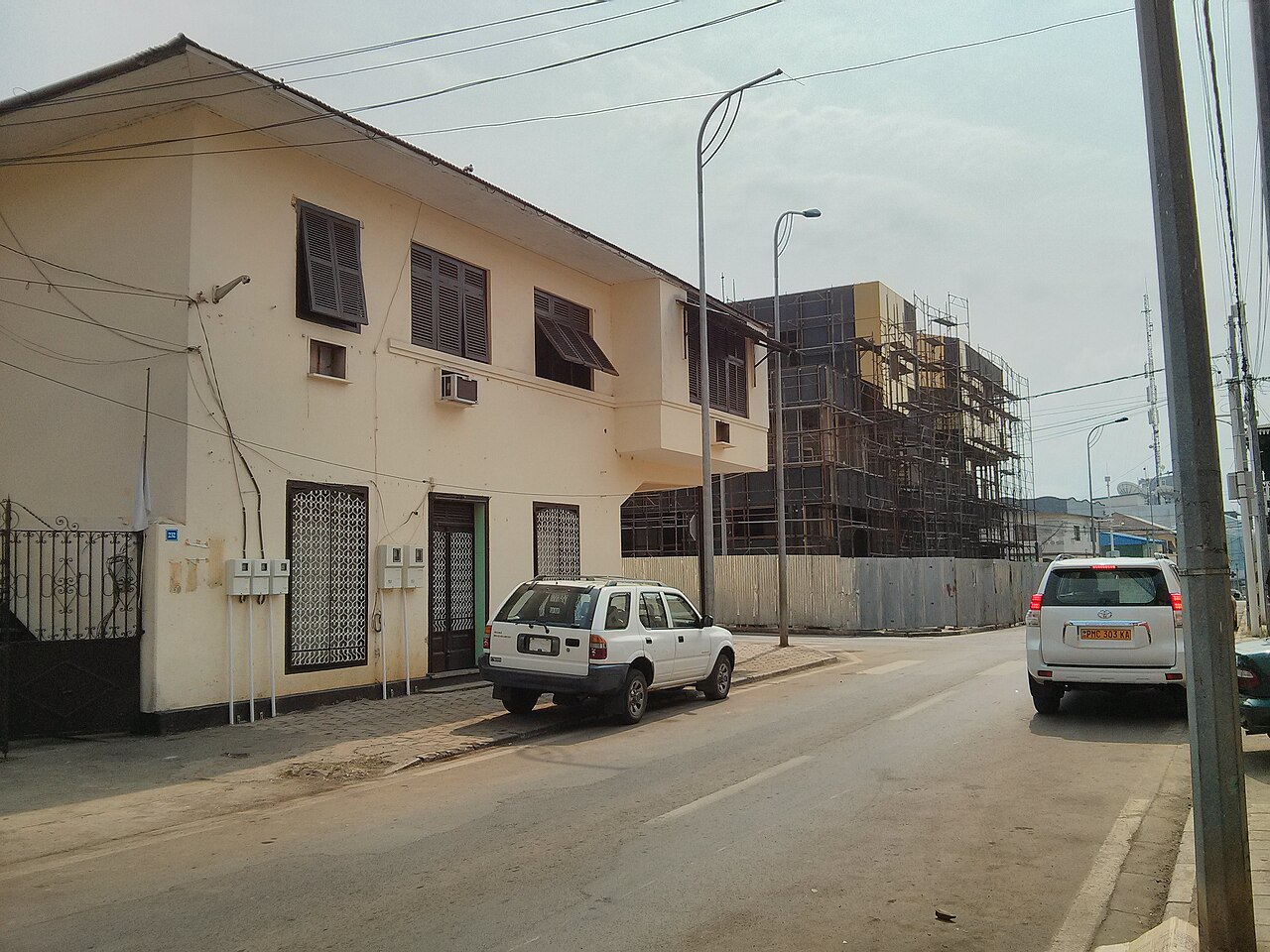
The population is young: about 45 percent of residents are under 15, and only about 4 percent are over 65. Public buses run between downtown and the Ela Nguema district, and taxis cover the rest of the city. In the older streets, wooden 19th-century houses still stand on Nigeria and Rey Boncoro streets, and the Casa Teodolita, built in 1902, is one of the oldest homes in the city, although many colonial buildings are worn. Cultural life centres on the Cultural Center of Spain in Malabo, founded in 2003, which hosts a travelling film festival and a hip hop festival. There is also the Equatorial Guinean Cultural Center, the Museum of Modern Art and the National Library, which dates from 1916. The National University of Equatorial Guinea has its headquarters in the city.
On weekends, the rest of Bioko is close at hand. The villages of the south coast around San Antonio de Ureca are known for primates and for leatherback turtles nesting between November and February, and the Iladyi falls near Moka drop more than 250 metres. Malabo is also the natural point of comparison for another island capital to the south-west, São Tomé. Although it is no longer the capital, it remains the country's oldest city, and our guide to Equatorial Guinea follows the story from Bioko to the mainland.
Quick Facts About Malabo
- Country: Equatorial Guinea
- Continent: Africa (Central Africa)
- Country population: approximately 2.0 million
- Capital city status: Malabo is the capital of Equatorial Guinea, the seat of national government, and the location of foreign embassies, parliament, and the head of state's official residence.
Frequently Asked Questions
What is the capital of Equatorial Guinea?
The capital of Equatorial Guinea is Malabo. Malabo is the seat of national government, hosts most foreign embassies and consulates, and is typically where the head of state and parliament are located.
What continent is Malabo in?
Malabo, the capital of Equatorial Guinea, is located in Africa, in the Central Africa region. As Equatorial Guinea's capital, Malabo serves as the country's primary connection to the broader African political, economic, and cultural sphere.
Why is Malabo the capital of Equatorial Guinea?
Malabo was chosen as the capital of Equatorial Guinea for reasons that typically combine geography, history, and politics. Capital city selections often reflect a desire for centrality (being accessible from across the country), historical importance (being a longstanding seat of government or culture), or neutrality (being acceptable to multiple regions or ethnic groups within the country). The specific reasons for Malabo's designation are detailed in the city's history above.
What is Malabo known for?
As the capital of Equatorial Guinea, Malabo is best known for housing the country's central government institutions — parliament, presidential or royal residences, supreme court, and key ministries. It is also typically a major cultural and economic center within Equatorial Guinea, hosting national museums, embassies, and signature monuments. The introduction and history sections above provide detailed coverage of the city's specific notable institutions and landmarks.
Related Pages
- Equatorial Guinea Country Guide — full geography, climate, economy, and culture overview
- Flag of Equatorial Guinea — meaning, history, and design of Equatorial Guinea's national flag