

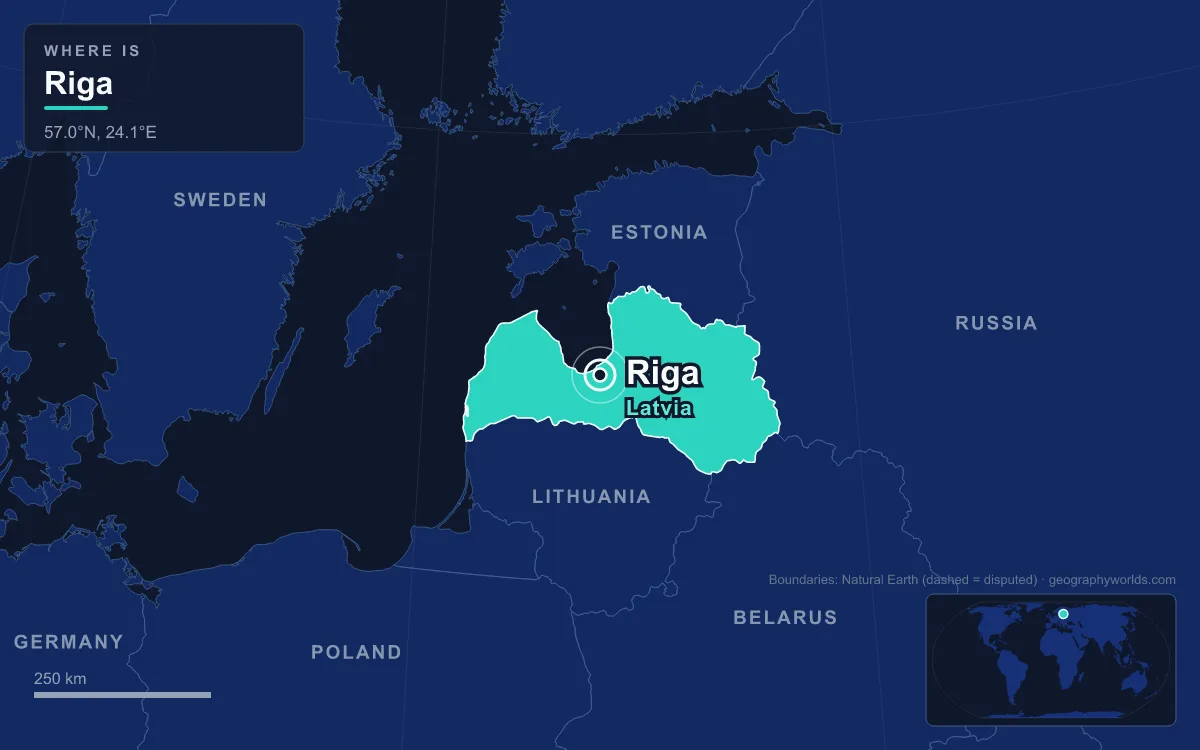
One in three people in Latvia lives in Riga, the country's capital and largest city, on less than half of one percent of its land. Riga sits on the Gulf of Riga near the mouth of the Daugava river, its centre about 15 kilometres upstream from where the river meets the sea, and had 588,911 inhabitants in 2026, with about 847,000 in the wider metropolitan area. Founded in 1201 and once a Hanseatic port, it is known above all for its medieval Old Town and for at least 800 Art Nouveau buildings, one of the largest collections anywhere, which together form a UNESCO World Heritage Site. Riga is easiest to understand through its numbers, and through the comparisons that make them meaningful.
One Latvian in Three: Riga Against the Rest of Latvia
Latvia covers 64,573 square kilometres and has about 1.83 million people. Riga's territory is just 307.17 square kilometres, a flat, sandy plain lying 1 to 10 metres above sea level, yet it holds a third of the national population. Its economic weight is heavier still: roughly half of all jobs in Latvia are in Riga, and the city produces more than half of the country's GDP and around half of its exports, led by wood products, IT, food and drink, pharmaceuticals, transport and metalworking.
Inside the city the contrasts are just as sharp. Riga is divided into six administrative units: the Central District covers only 3 square kilometres, while the Kurzeme District covers 79. Three of the six were created on 1 September 1941 and the other three in October 1969, and their current names were confirmed on 28 December 1990. The city council's development agency has drawn up a plan to divide Riga into 58 neighbourhoods.
No other Latvian city comes close. Daugavpils, the second-largest, lies about 230 kilometres to the south-east on the same river, 25 kilometres from Lithuania and 33 from Belarus. At the 1897 Russian census it had 69,700 people, 44 percent of them Jewish, and since the Second World War it has been overwhelmingly Russian-speaking. The gap in scale is why Riga is described as Latvia's primate city: it is the country's political, financial and cultural centre, and its main port, and Riga International Airport is the busiest in all three Baltic states.
The city's ethnic mix also differs from the country's. In 2017 ethnic Latvians made up 44 percent of Riga's population and Russians 38 percent, against 62.7 and 24.5 percent nationally. In 1989 Latvians were only 36.5 percent of the capital; by 2022 the figure had risen to 47.4 percent, while the Russian share fell from 47.3 to 35.7 percent.
From About 900,000 in 1991 to 588,911 in 2026
Riga has been shrinking for a generation. In 1991, when Latvia restored its independence, the city had just over 900,000 residents. Emigration and low birth rates have since removed more than a third of them. The same curve has happened before. In 1897 Riga was the sixth-largest city of the Russian Empire, soon afterwards it was the empire's largest timber-exporting port, and by 1913 it had swelled to 472,100 people. Then came the First World War, the German capture of the city in September 1917 and the fight for independence, and the 1935 census counted only 385,063 inhabitants.
The Soviet peak was built on migration. After the Red Army retook Riga on 13 October 1944, workers, administrators and soldiers arrived from Russia and other Soviet republics, and large microdistricts of multi-storey blocks were built to house them. Those arrivals and their children born before 1991 were not automatically given Latvian citizenship, which is why, in 2022, 15.3 percent of Riga's residents were still classed as non-citizens.
Riga Versus Vilnius and Tallinn
For most of the 20th century Riga was the unquestioned metropolis of the Baltic states, and it still holds about a tenth of the three countries' combined population. That lead is gone. Vilnius has recently overtaken it and is now the most populous city in the Baltics, while Tallinn, 300 kilometres to the north, is smaller than either.
The three capitals also chose different paths after 1991. Tallinn built its reputation on start-ups, Vilnius on financial technology. Riga has leaned on its port, its airport and tourism, which grew 22 percent in 2011 alone and brought more than 1.4 million foreign visitors in 2019 and over 1.1 million international tourists in 2024. It was also meant to become the financial centre of the former Soviet Union; one bank promoted its secrecy with the Russian-language slogan "We are closer than Switzerland!" Riga does keep some regional records: its radio and TV tower, built between 1979 and 1989, reaches 368.5 metres, the tallest tower in the European Union and the third-tallest in Europe after Moscow's Ostankino and the Kyiv TV Tower.
Riga has also been the Baltic region's preferred stage for big events. It hosted the Eurovision Song Contest in 2003, the NATO summit in 2006 and the men's ice hockey world championships in 2006, 2021 and 2023, and it shared the title of European Capital of Culture with Umeå in Sweden in 2014. Vilnius was a Capital of Culture in 2009 and Tallinn in 2011, so all three capitals held the title within six years. Riga is also home to BEREC, the European Union's body of telecoms regulators, and in 2017 it was named European Region of Gastronomy.
The Daugava: 1,020 Kilometres of River, 15 Kilometres to the Sea
The Daugava rises in the Valdai Hills of Russia, close to the source of the Volga, and runs 1,020 kilometres through Russia, Belarus and Latvia; only 352 kilometres are in Latvia. Riga crosses it with five bridges, the newest being the Southern Bridge, opened in 2008. A sheltered natural harbour on the site of today's Riga, recorded as Duna Urbs as early as the 2nd century, was settled by the Livs, a Finnic people, and the river was part of the Viking route to Byzantium via the Dnieper.

The port is Riga's economic engine and its most volatile number. The Freeport of Riga handled a record 41.8 million tonnes of cargo in 2014 and in 2018 completed a new development on Krievu Sala to move traffic away from the centre. By 2024 cargo turnover had fallen by half, largely because trade with Russia collapsed after the invasion of Ukraine and the sanctions that followed. The next bet is Rail Baltica, the planned railway meant to tie Riga into the European network.
1201 Versus 1918: Seven German Centuries
Riga's founding date is exact because it was imposed from outside. Bishop Albert landed in 1200 with 23 ships and 500 Westphalian crusaders and in 1201 moved the seat of the Livonian bishopric to Riga. He founded the Livonian Brothers of the Sword in 1202 and began fortifying the town in 1207; in 1211 Riga minted its first coins and Albert laid the cornerstone of the cathedral, and obtained papal bulls requiring German merchants to route their Baltic trade through Riga. The city joined the Hanseatic League in 1282, accepted the Reformation in 1522 and passed from Polish-Lithuanian to Swedish rule in 1621 and to Russia in 1710.
Across all of that, the Baltic German elite kept its grip. In 1867 Germans still made up 42.9 percent of the population, and German remained the language of administration until Russian replaced it in 1891. Latvians only began moving into the city in large numbers in the mid-19th century; they founded the Riga Latvian Association in 1868 and held the first national song festival in 1873. Latvia declared independence on 18 November 1918, and by the 1935 census Latvians were 63 percent of the capital, alongside Jews at 11.3 percent and Germans at 10 percent. Most Baltic Germans were resettled in late 1939. In the Rumbula massacre of 30 November and 8 December 1941, about 24,000 Latvian Jews from the Riga Ghetto and about 1,000 Jews deported from Germany were murdered in a forest outside the city.
800 Art Nouveau Buildings Versus a Medieval Core
Riga's architecture is really two cities. The medieval Old Town, Vecrīga, was once walled on three sides; when the walls came down, water from the Daugava was diverted into the line of the former wall to make the City Canal. The war left much of it in ruins. St Peter's Church lost its wooden tower to fire and was restored in 1954, and the House of the Blackheads was destroyed, its ruins demolished, and a copy completed only in 1995.
Beyond the canal lies the boom city. Between 1910 and 1913 Riga added 300 to 500 new buildings a year, many in Art Nouveau style and most outside the Old Town. Most of their architects were locals, many trained at the architecture faculty of the Riga Polytechnic Institute (now Riga Technical University), opened in 1869; the most famous facades, on Alberta iela, are largely the work of Mikhail Eisenstein. At least 800 survive. Between the two sits the Central Market, built from 1924 to 1930 by reusing five German Zeppelin hangars as pavilions. It covers 72,300 square metres with more than 3,000 stalls and is Europe's largest market.

Minus 25 °C to Plus 30 °C: Riga's Climate in Numbers
Riga has a humid continental climate. January and February are the coldest months, averaging −2.1 °C, and temperatures of −20 to −25 °C are recorded almost every year on the coldest days. Snow cover can last 80 days. Summers average about 18 °C and are often rainy, though the hottest days can pass 30 °C, and the nearby sea brings frequent autumn rain and fog. For the country beyond the capital, read our Latvia country guide; for how the three Baltic states fit together, see what are the Baltic states; and for the city that has just overtaken Riga in size, our profile of Vilnius.
Quick Facts About Riga
- Country: Latvia
- Continent: Europe (Northern Europe)
- Country population: approximately 1.8 million
- Capital city status: Riga is the capital of Latvia, the seat of national government, and the location of foreign embassies, parliament, and the head of state's official residence.
Frequently Asked Questions
What is the capital of Latvia?
The capital of Latvia is Riga. Riga is the seat of national government, hosts most foreign embassies and consulates, and is typically where the head of state and parliament are located.
What continent is Riga in?
Riga, the capital of Latvia, is located in Europe, in the Northern Europe region. As Latvia's capital, Riga serves as the country's primary connection to the broader Europen political, economic, and cultural sphere.
Why is Riga the capital of Latvia?
Riga was chosen as the capital of Latvia for reasons that typically combine geography, history, and politics. Capital city selections often reflect a desire for centrality (being accessible from across the country), historical importance (being a longstanding seat of government or culture), or neutrality (being acceptable to multiple regions or ethnic groups within the country). The specific reasons for Riga's designation are detailed in the city's history above.
What is Riga known for?
As the capital of Latvia, Riga is best known for housing the country's central government institutions — parliament, presidential or royal residences, supreme court, and key ministries. It is also typically a major cultural and economic center within Latvia, hosting national museums, embassies, and signature monuments. The introduction and history sections above provide detailed coverage of the city's specific notable institutions and landmarks.
Related Pages
- Latvia Country Guide — full geography, climate, economy, and culture overview
- Flag of Latvia — meaning, history, and design of Latvia's national flag