

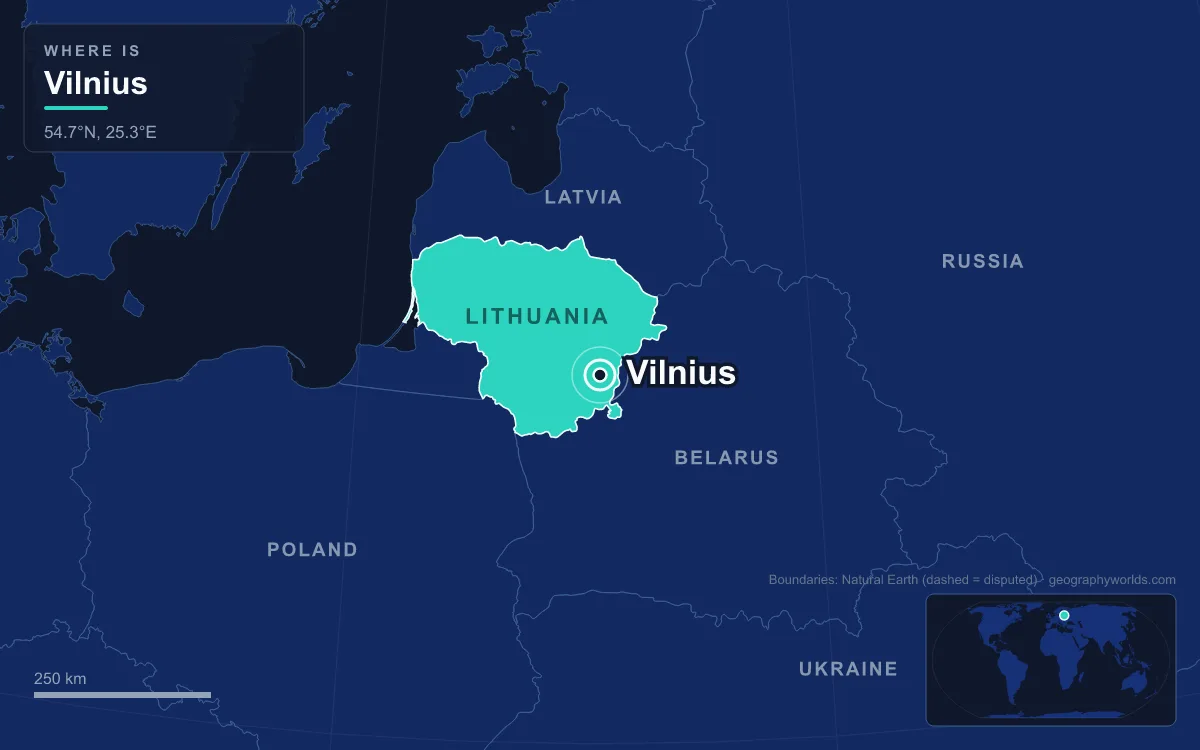
In 1323 Grand Duke Gediminas signed letters from "our royal city called Vilna", inviting German merchants and craftsmen, and Jews, to settle there. That city, Vilnius, is still the capital and largest city of Lithuania. It stands where the Vilnia river flows into the Neris in the south-east of the country, 312 kilometres from the Baltic coast, and with an estimated 619,405 residents in July 2026 it is now the most populous city in the three Baltic states. Its baroque Old Town, one of the largest in Europe, has been on the UNESCO World Heritage List since 1994. But what really defines Vilnius is the succession of peoples who have made it their own, which is why the same city appears in older books as Wilno, Vilna and Vilne.
Gediminas's Letters of 1323: Lithuanians, Ruthenians, Germans and Jews
Long before Gediminas, the confluence of the Neris and the Vilnia was the most densely settled spot in the area, dotted with fortified homesteads. The city's name comes from the Vilnia, an old Lithuanian word meaning "ripple", and the Latin form Vilna in Gediminas's letters is the first time it appears in writing. A legend recorded around the 1530s says that the duke, after hunting near the river mouth, dreamed of an iron wolf howling on a hill, and that the priest Lizdeika told him to build a castle and a capital there.
From the start it was a city of two halves. Fourteenth-century sources describe a Great, Lithuanian, city and a Ruthenian one, home to Orthodox East Slavs whose written language, Ruthenian, became the main chancery language of the Grand Duchy of Lithuania in the 14th and 15th centuries. Vilnius received city rights in 1387, the year Lithuania formally converted to Christianity, and craftsmen and merchants of many nations moved in. By the 16th century German merchants and artisans, Jews and Tatars had all settled.
The Tatars came by invitation. Late in the 14th century Grand Duke Vytautas brought Muslim Tatars into the Grand Duchy, and the 1397 settlement of Khan Tokhtamysh's clan is recorded by the chronicler Jan Długosz. Their light cavalry fought in every major Lithuanian and Polish campaign from the Battle of Grunwald onward, and in Vilnius they had their own quarter, Totorių Lukiškės. The Karaites, a small Jewish sect from Crimea, also settled in Lithuania, and they have restored their prayer house, the Vilnius Kenesa, since independence.
The Babylon of Europe: Italians, Poles and Vilnius University
The 16th century brought an Italian court. Bona Sforza, an Italian princess, married Grand Duke Sigismund I the Old in 1517, and she and their son Sigismund II Augustus drew Italian architects and artists to the city. Italian and Swiss craftsmen lived there in numbers, and their influence runs through the Renaissance and Baroque buildings of the Old Town. So many languages were in use that in 1552 Sigismund Augustus ordered decrees of the city magistrate to be read out in Lithuanian, Polish and Ruthenian.
In 1579 Stephen Báthory founded a Jesuit academy that became Vilnius University, the only university in the Grand Duchy and the third in the Polish-Lithuanian Commonwealth after Kraków and Königsberg. Its professors and students came from France, Spain, Sweden and even Croatia. In 1600 an English book on university cities by Samuel Lewkenor listed the city's Catholics, Orthodox, Calvinists, Lutherans, Jews and "Tartar" Muslims, and Western writers of the 16th to 18th centuries nicknamed Vilnius the "Babylon of Europe". Only Amsterdam, one English geographer suggested, could match it for the number of its churches and temples.
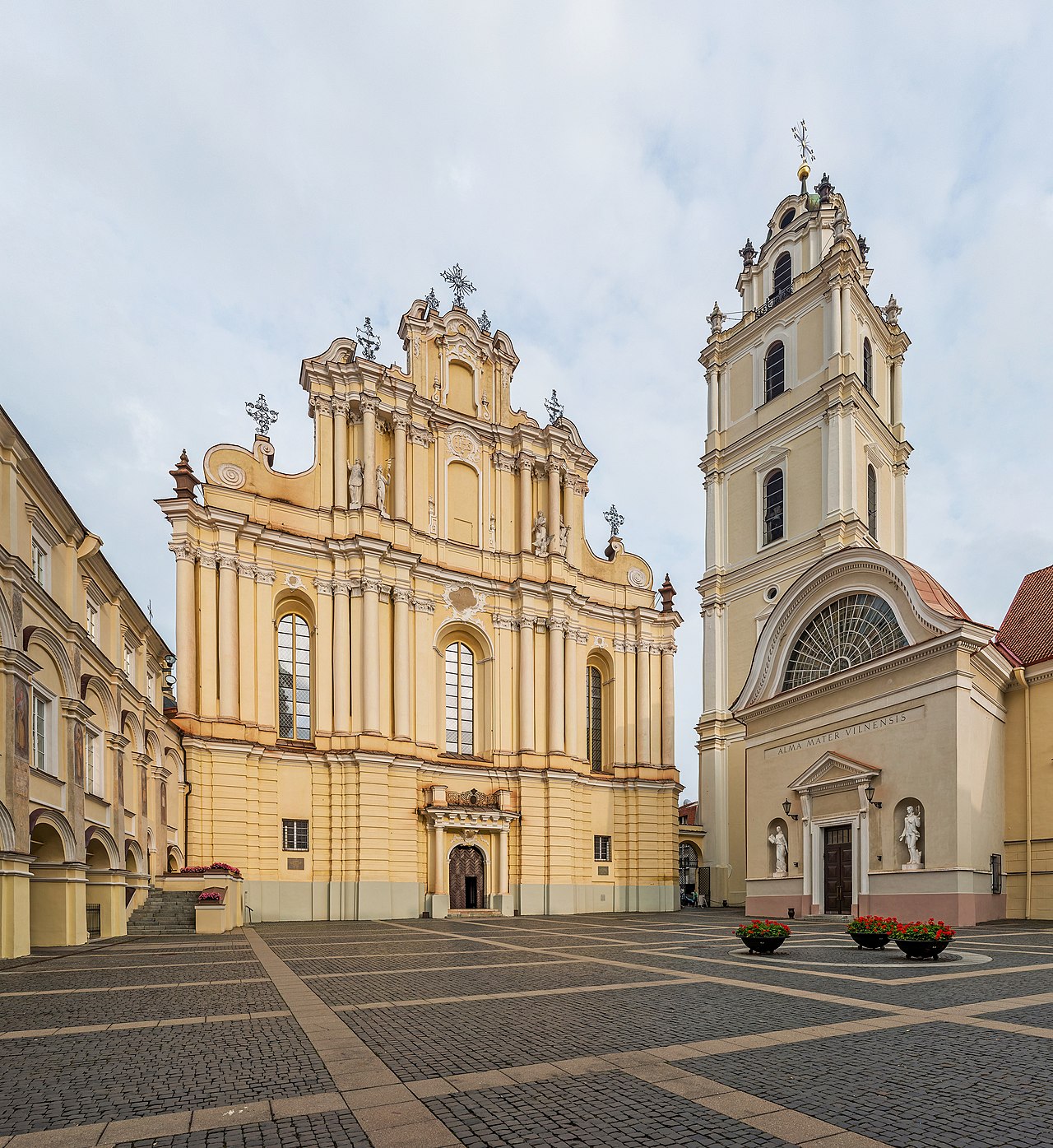
Over the same period the city's written language shifted. In the 15th and 16th centuries only 5 percent of townspeople's legal records were in Polish; by the middle of the 17th century 53 percent were. Polish replaced Ruthenian in written sources and Lithuanian in public use, and the Polish-speaking population kept growing through the Reformation and Counter-Reformation. The Orthodox did not vanish. At St Paraskeva's Church in the Old Town, Peter the Great had Abram Gannibal baptised in 1705; Gannibal was the great-grandfather of Alexander Pushkin. Old Believers who broke with the Russian Orthodox Church in 1667 settled in Lithuania; their Supreme Council is still based in Vilnius. The university itself was shut by the Russian Empire after the failed November Uprising of 1830 to 1831 and did not reopen until 1919.
Yerushalayim d'Lita: the Vilna Gaon, the Vilna Shas and Ponary
For Jews the city was Vilne, and from the 18th century it was a world centre of Torah study, known as Yerushalayim d'Lita, the Jerusalem of Lithuania. When Napoleon passed through in 1812 he is said to have called it "the Jerusalem of the North". Its best-known scholar was Elijah ben Solomon Zalman, the Vilna Gaon, born in 1720 and died in Vilnius in 1797, the leading figure of the misnagdim, the Jews who opposed Hasidism. The Vilna Shas, the edition of the Talmud most widely used today, was printed in the city in 1886. Its Great Synagogue had stood since the early 1630s.

That world was destroyed in three years. On the eve of the German invasion the city's Jewish population was at least 60,000 and perhaps 80,000, swollen by refugees from German-occupied Poland. German troops entered on 26 June 1941, and that summer German units and Lithuanian collaborators killed more than 21,000 of the city's Jews. The survivors were forced into the Vilna Ghetto, whose population of around 40,000 was reduced by starvation, disease, shootings and deportations. Many were murdered at Ponary (Paneriai), near a railway station on the edge of the city, where between July 1941 and August 1944 up to 100,000 people were shot, about 70,000 of them Jews, along with Poles and Soviet prisoners of war. The historian Timothy Snyder estimates that of 70,000 Jews in Vilna, only about 7,000 survived the war.
The Great Synagogue was wrecked during the occupation and its remains demolished by the Soviet authorities. In June 2015 ground-penetrating radar located its foundations, and archaeologists have been excavating the site since 2016. A memorial stone on present-day Mėsinių Street marks the centre of the former ghetto, and the Vilna Gaon Museum of Jewish History tells the story of Lithuanian Jewry.
Wilno, 1920 to 1945: A Polish City and the Great Exchange
By the late Russian Empire, Lithuanians had lost their majority even in the surrounding region: the 1897 census recorded only 17.6 percent Lithuanians across the Vilnius Governorate, and a German count in 1916 found Poles to be the largest group in the city itself, at 50.2 percent of 140,840 residents. After the First World War Poland and Lithuania both claimed the city. Polish forces took it in October 1920, and after the short-lived Republic of Central Lithuania it was annexed by Poland as Wilno, capital of the Wilno Voivodeship. The border was confirmed by international agreement in 1923, while Lithuania continued to regard the city as its capital under Polish occupation. The 1931 Polish census counted 65.9 percent Poles and just 0.8 percent Lithuanians, and by 1938 Wilno had about 208,000 people and was Poland's fifth-largest city. Under Russian rule it had been a centre of Jewish, Polish, Lithuanian and Belarusian cultural revivals alike.
The Second World War reversed the picture. After the Soviet invasion of Poland, Stalin handed the city to Lithuania in October 1939 under the Soviet-Lithuanian Mutual Assistance Treaty, and the Soviet Union annexed Lithuania itself in June 1940, making Vilnius capital of the Lithuanian SSR. After 1945 a population exchange between Poland and Soviet Lithuania sent a large part of the city's Poles, especially the educated, west to Poland, while Poles from neighbouring Soviet Belarus moved into Vilnius and the region around it. Lithuanians returned in growing numbers, though Sovietisation soon brought Russian speakers too. The city's Polish community today is concentrated in the surrounding districts: Poles are 46 percent of the population of Vilnius District Municipality and 76 percent in Šalčininkai.
Belarusians, Ukrainians and New Arrivals Since 2020
On 11 March 1990 Lithuania declared that it was restoring its independence. On 13 January 1991 Soviet troops attacked the State Radio and Television Building and the Vilnius TV Tower, killing 14 civilians, and the Soviet Union recognised Lithuanian independence that September. For the first time in modern history Lithuanians became a clear majority of their capital: 63.2 percent in 2011 and 67.4 percent in 2021. The 2021 census counted 85,438 Poles, 15.4 percent of the city.
The newest chapter has come from the east. After the 2020 to 2021 protests in Belarus, the number of Vilnius residents born in Belarus rose from about 25,000 to 37,000 between 2021 and 2023, and after Russia's full-scale invasion of Ukraine the number born in Ukraine rose from 10,000 to 29,000. Economic migrants from Uzbekistan, Kyrgyzstan, Tajikistan and India followed in 2023 and 2024, most of them settling in the capital. By late 2023 some 73,000 foreigners lived in Vilnius, up from 38,000 eighteen months earlier, and the city's own count reached 643,513 in April 2026. Vilnius hosted the NATO summit in 2023 and was European Green Capital in 2025. For the country around the city, see our Lithuania country guide and our explainer on where Lithuania is, and for how its capital compares with Riga and Tallinn, our guide to the Baltic states.
Quick Facts About Vilnius
- Country: Lithuania
- Continent: Europe (Northern Europe)
- Country population: approximately 2.8 million
- Capital city status: Vilnius is the capital of Lithuania, the seat of national government, and the location of foreign embassies, parliament, and the head of state's official residence.
Frequently Asked Questions
What is the capital of Lithuania?
The capital of Lithuania is Vilnius. Vilnius is the seat of national government, hosts most foreign embassies and consulates, and is typically where the head of state and parliament are located.
What continent is Vilnius in?
Vilnius, the capital of Lithuania, is located in Europe, in the Northern Europe region. As Lithuania's capital, Vilnius serves as the country's primary connection to the broader Europen political, economic, and cultural sphere.
Why is Vilnius the capital of Lithuania?
Vilnius was chosen as the capital of Lithuania for reasons that typically combine geography, history, and politics. Capital city selections often reflect a desire for centrality (being accessible from across the country), historical importance (being a longstanding seat of government or culture), or neutrality (being acceptable to multiple regions or ethnic groups within the country). The specific reasons for Vilnius's designation are detailed in the city's history above.
What is Vilnius known for?
As the capital of Lithuania, Vilnius is best known for housing the country's central government institutions — parliament, presidential or royal residences, supreme court, and key ministries. It is also typically a major cultural and economic center within Lithuania, hosting national museums, embassies, and signature monuments. The introduction and history sections above provide detailed coverage of the city's specific notable institutions and landmarks.
Related Pages
- Lithuania Country Guide — full geography, climate, economy, and culture overview
- Flag of Lithuania — meaning, history, and design of Lithuania's national flag