

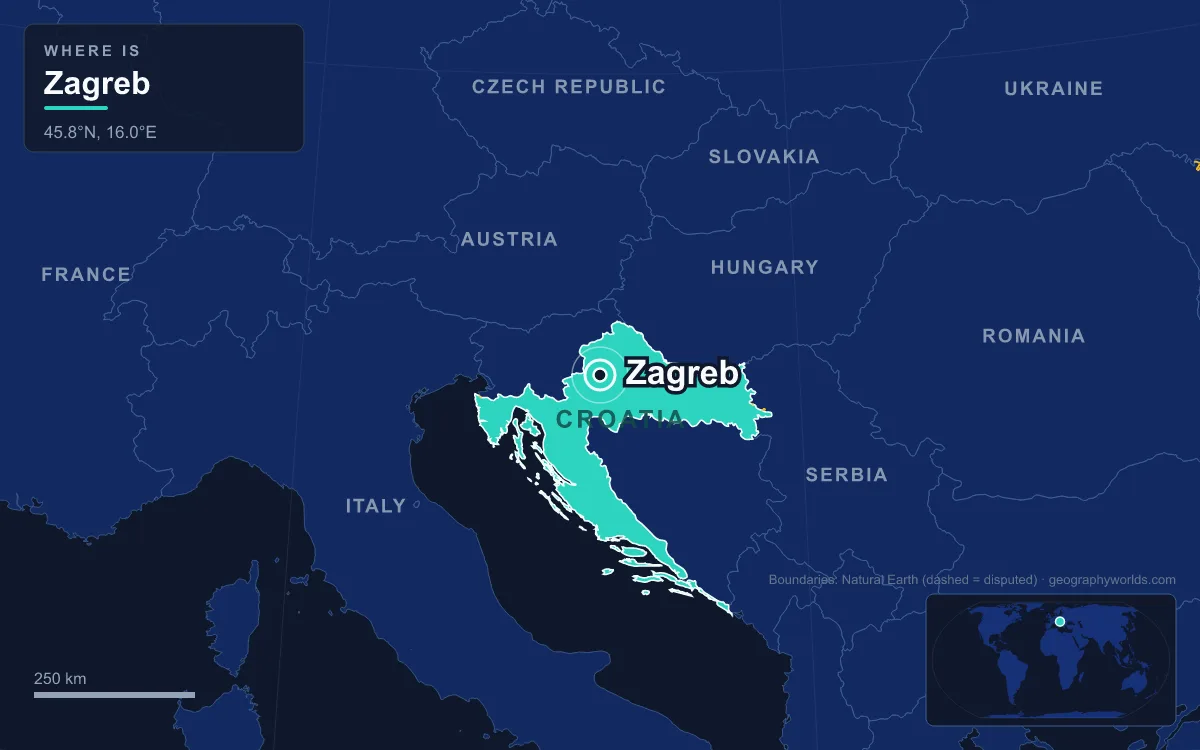
Zagreb is the capital and largest city of Croatia. It sits in the north of the country on the Sava River, at the southern foot of Medvednica mountain and close to the Slovenian border, and at the 2021 census it had 767,131 inhabitants, with 1,086,528 in the metropolitan area, around a quarter of all Croatians. What sets Zagreb apart is that it began as two rival towns on neighbouring hills, the bishop's Kaptol and the royal Gradec, which fought each other on and off for four centuries before they were merged into one city in 1850. The story below runs era by era, from that double beginning to the earthquake-damaged capital of today.
Andautonia and the Founding of Kaptol, to 1242
People lived in the Zagreb area long before the city. The Veternica cave on its outskirts held Neanderthal remains dated to 50,000 to 100,000 years ago, and the nearest Roman town, Andautonia, stood at today's Ščitarjevo from the 1st to the 5th century AD. Neither became Zagreb. The city's recorded story starts in 1094, when King Ladislaus I of Hungary founded a diocese on the eastern of two low hills above the Medveščak stream.
That hill became Kaptol, named after the capitulum, the body of canons who governed it. Its cathedral was consecrated in 1217, only to be wrecked when the Mongols swept through Hungary and Croatia in 1242. The western hill, Grič, grew into a separate settlement of craftsmen and merchants called Gradec. The name Zagreb itself is usually traced to a Proto-Slavic root meaning a hill or rise, though some linguists read it as a word for a riverbank, and the city's old German name, Agram, preserves an older form of it.
Gradec's Golden Bull and the Feud Between the Hills, 1242–1526
The Mongol raid changed Gradec's fortunes. In 1242 King Béla IV issued a Golden Bull making it a free royal city, answerable directly to the crown, with the right to elect its own judge and govern itself. Its citizens spent the next two decades, from 1242 to 1261, enclosing the hill in a triangle of walls with four gates. Only one of them, the Stone Gate on the eastern side, still stands.
Kaptol and Gradec were a few hundred metres apart, and they did not get along. They quarrelled over who could collect rents and over disputed properties, and those disputes turned violent in the 14th century. On Christmas Eve 1391 the bishop fired bombards at Gradec from Popov toranj, the Priest's Tower; in January 1397 he excommunicated the town, and King Sigismund later forced him to lift the curse in St Mark's Church. Fighting flared again in 1421 over the boundary along the Medveščak and did not die down until 1469. The last major quarrel, in 1667, was over a bridge across that same stream. The canons walled Kaptol between 1469 and 1473, and the bishop added the towers that still ring the cathedral between 1512 and 1520, this time against the Ottomans.

A Frontier Capital Under Ottoman Threat, 1526–1850
The Hungarian defeat at Mohács in 1526 put Zagreb close to the Ottoman frontier for more than a century. Gradec had sent 40 armed infantrymen to that battle. In the succession war that followed, the two hills again took opposite sides, Gradec backing Ferdinand of Habsburg and Kaptol, under Bishop Šimun Erdődy, backing John Zápolya. Even so, the town's standing rose. At an assembly on 7 March 1577 Zagreb was called the capital of Croatia-Slavonia for the first time.
The 17th century brought the Baroque. The Jesuits arrived in 1606 and built St Catherine's Church between 1620 and 1632, the earliest Baroque religious building in the city, followed by the Capuchins in 1618 and the Poor Clares around 1650. The more important change happened below the hills. In 1641 the town turned gardens on the plain near the Manduševac spring into a marketplace. That square, later called Harmica and then Ban Jelačić Square, pulled trade and houses downhill, and Ilica and Long Street (today's Radićeva) grew out from it. The Medveščak remained a hazard: in July 1651 it burst its banks and killed 52 people in the houses along today's Tkalčićeva Street.
Gradec kept its political weight. From 1734 the Croatian Parliament met on the east side of St Mark's Square, where it still sits, and Banski dvori across the square, the former residence of the ban (viceroy), is used by the Croatian government today. In 1845 Zagreb was formally made the capital of Croatia.
Jelačić's Merger and the 1880 Earthquake, 1850–1918
In 1850 Ban Josip Jelačić united Gradec, Kaptol and the surrounding settlements into one city, ending the old two-town arrangement, and in 1851 Zagreb elected its first mayor, Janko Kamauf. The main square below the hills now carries Jelačić's name. Modern infrastructure followed quickly: a railway to Zidani Most and Sisak in 1862, a gasworks the next year, waterworks in 1878, and the first horse-drawn tram on 5 September 1891. The whole tram network was electrified by 1911.
At 7:33 on the morning of 9 November 1880, a magnitude 6.3 earthquake with its epicentre in Medvednica struck the city. Only one person died, but a city commission counted 1,758 damaged buildings, 485 of them heavily. The cathedral was the most prominent casualty, and Hermann Bollé's reconstruction gave it the neo-Gothic twin spires, about 108 m high, that now dominate the skyline. The rebuilding also set the plan of the lower town. In 1882 the planner Milan Lenuci conceived a U-shaped chain of park squares for Donji Grad; the parks were laid out between 1883 and 1887, and the Lenuci Horseshoe was completed in 1889 when the Botanical Garden joined its two ends. The Croatian National Theatre and the Croatian Academy of Sciences and Arts both stand on it. In 1892 a steel bridge replaced the wooden crossing of the Sava.

Yugoslavia's Second City, 1918–1991
From 1918 Croatia was part of Yugoslavia, and Zagreb became that state's second-largest city and a leading economic centre. Its population grew by 70 percent in the 1920s, the biggest boom in its history, and the region's first radio station went on air from Zagreb in 1926. Between 1941 and 1945 the city was the capital of the Independent State of Croatia, an Axis puppet state backed by Nazi Germany and Italy, whose Ustaša regime executed thousands of people in and around Zagreb. Partisans took the city at the end of the war, and from 1945 until 1990 it was the capital of the Socialist Republic of Croatia inside federal Yugoslavia.
Post-war Zagreb jumped the river. Working-class districts had already filled the land between the railway and the Sava; from the mid-1950s the city built Novi Zagreb, a new town of housing estates on the south bank. Pleso airport and the Žitnjak industrial zone followed, along with landmarks of the period such as the Zagreb TV Tower on Sljeme (1973) and the Mamutica apartment block in Travno (1974). The Sava flood of 1964 killed 17 people and left 40,000 homeless. The 1987 Summer Universiade gave the centre its first pedestrian-only streets and new sports grounds.
Capital of Independent Croatia, 1991 to Today
After Croatia declared independence from Yugoslavia in 1991, the Croatian Parliament proclaimed Zagreb the capital of the new republic. The city escaped major damage in the 1991–1995 war, though there was sporadic fighting around the Yugoslav army barracks, and in May 1995 two Serb rocket attacks killed seven civilians. In 1997 the City of Zagreb was given the status of a county in its own right, separate from the surrounding Zagreb County, though it remains the administrative seat of both; since 1999 it has been divided into 17 city districts, from Donji Grad in the centre to Sesvete and Podsljeme on the Medvednica foothills.
Old fault lines still matter. Zagreb sits beside the Medvednica fault zone and records around 400 earthquakes a year, almost all too small to feel. At about 6:24 on 22 March 2020, in the middle of the COVID-19 pandemic, a quake of magnitude 5.3 (5.5 on the Croatian local scale) struck with its epicentre 7 km north of the centre. It was the strongest since 1880: more than 1,900 buildings were declared uninhabitable, the tip of the cathedral's southern spire broke off, and a teenage girl died of her injuries. Much of the historic core has been under scaffolding since, and as of 2026 the cathedral is still being repaired.
Day-to-day Zagreb still follows the lines of its eras. The hill towns hold the Parliament, the government and the cathedral. The 19th-century grid of Donji Grad holds the theatres, museums and the main railway station. Novi Zagreb, across the Sava, is where most of the post-war population lives. Trams have served the city since 1891 and today run on 15 day lines and 4 night lines, averaging only about 13 km/h, among the slowest in Europe. The population peaked at 790,017 in 2011 and dipped slightly by 2021. For the country around the capital, from the Adriatic islands to the Pannonian plain, see our Croatia country guide; for how Zagreb's 1991 promotion fit into the wider collapse of the federation, read the historical geography of Yugoslavia's breakup, and for Croatia's five land neighbours, from Slovenia a short drive west of the capital to Montenegro in the far south, see the countries that border Croatia.
Quick Facts About Zagreb
- Country: Croatia
- Continent: Europe (Southern Europe)
- Country population: approximately 3.8 million
- Capital city status: Zagreb is the capital of Croatia, the seat of national government, and the location of foreign embassies, parliament, and the head of state's official residence.
Frequently Asked Questions
What is the capital of Croatia?
The capital of Croatia is Zagreb. Zagreb is the seat of national government, hosts most foreign embassies and consulates, and is typically where the head of state and parliament are located.
What continent is Zagreb in?
Zagreb, the capital of Croatia, is located in Europe, in the Southern Europe region. As Croatia's capital, Zagreb serves as the country's primary connection to the broader Europen political, economic, and cultural sphere.
Why is Zagreb the capital of Croatia?
Zagreb was chosen as the capital of Croatia for reasons that typically combine geography, history, and politics. Capital city selections often reflect a desire for centrality (being accessible from across the country), historical importance (being a longstanding seat of government or culture), or neutrality (being acceptable to multiple regions or ethnic groups within the country). The specific reasons for Zagreb's designation are detailed in the city's history above.
What is Zagreb known for?
As the capital of Croatia, Zagreb is best known for housing the country's central government institutions — parliament, presidential or royal residences, supreme court, and key ministries. It is also typically a major cultural and economic center within Croatia, hosting national museums, embassies, and signature monuments. The introduction and history sections above provide detailed coverage of the city's specific notable institutions and landmarks.
Related Pages
- Croatia Country Guide — full geography, climate, economy, and culture overview
- Flag of Croatia — meaning, history, and design of Croatia's national flag