

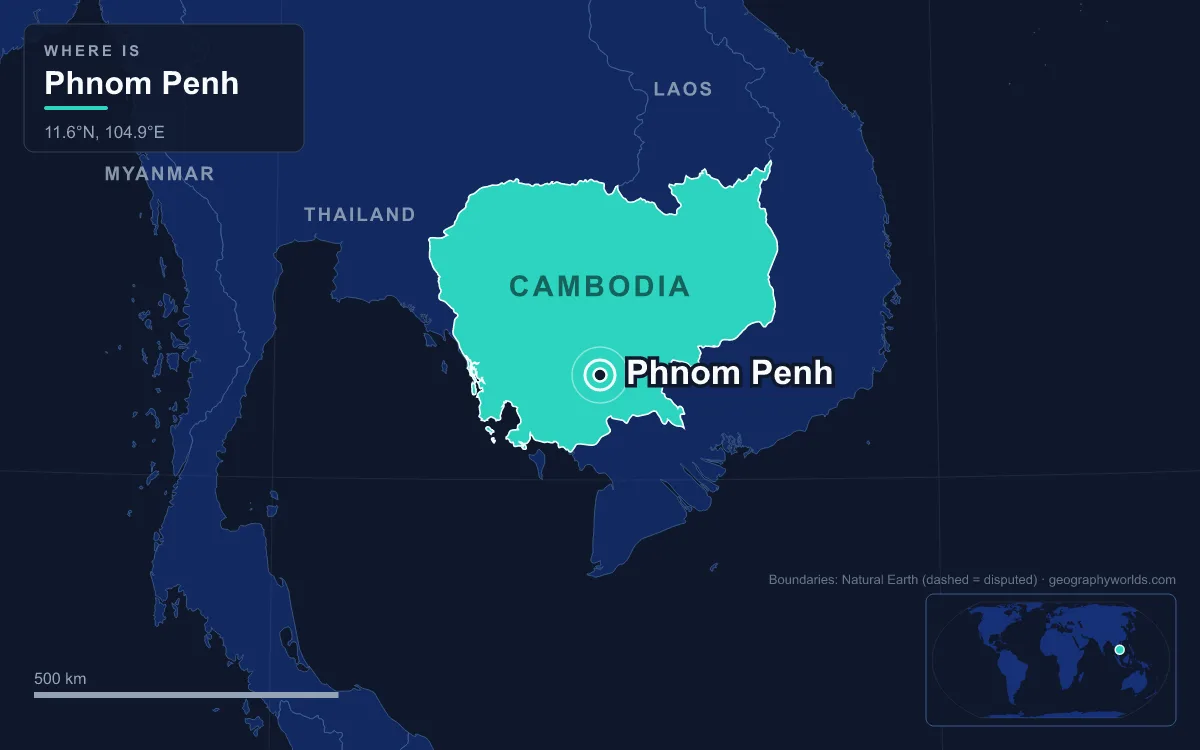
Phnom Penh is the capital of Cambodia, at Chaktomuk, where the Tonlé Sap meets the Mekong and the Bassac River begins. The autonomous municipality covers about 679 square kilometres and had 2,129,371 residents in 2019. A 2017 survey by the National Institute of Statistics found the city was 95.3 percent Khmer, 4 percent Cham and 0.7 percent other groups, mostly Chinese and Vietnamese. That near-uniform figure is misleading, though. For most of its modern history Phnom Penh was a city of minorities: Chinese merchants, Vietnamese clerks and fishermen, Cham Muslims, and at times Portuguese, Japanese and French residents, around a Khmer royal court.
Lady Penh, King Ponhea Yat and the Khmer Court at Chaktomuk
The city's founding story is about one woman. According to the legend, in 1372 a wealthy widow called Penh found a koki tree floating down the Tonlé Sap after a storm. Inside it were four Buddha statues and one of Vishnu. She had a hill built on the west bank to house them, with a shrine on top. The shrine became Wat Phnom, and the settlement became Phnom Penh, "Penh's hill". Wat Phnom is 46 metres high, and a small shrine to Lady Penh at its south-west corner still receives offerings of food and prayers.

People lived here long before the legend. Archaeologists at Choeung Ek, in Dangkao district, have found kilns that made ceremonial kendi vessels from the 5th to the 13th century. They also found an earthwork ring 740 metres across, built in the 11th century. The Khmer court arrived in the 15th century, when King Ponhea Yat left Angkor after Siamese forces captured it. He named his new city Krong Chaktomuk, "city of four faces", after the four waterways that meet there. His stupa stands on top of Wat Phnom. The court moved away again by about 1500, to Longvek, Oudong and other sites, and did not return for roughly 360 years. In the mid-1860s King Norodom moved the court from Oudong to Phnom Penh, and the Royal Palace was built on the riverfront between 1866 and 1870. Norodom had already signed a treaty placing Cambodia under French protection in 1863, which lodged a French resident general in Phnom Penh, and the city's population became steadily more mixed.
Teochew, Cantonese, Hokkien, Hakka and Hainanese Merchants
The Chinese were Phnom Penh's largest and most enduring minority. Portuguese sailors recorded a small Chinese settlement in the early 17th century. After the Ming dynasty fell in 1644, refugees from Fujian and Guangdong arrived in larger numbers. Most were men who married Khmer women, and their descendants often came to identify as Cambodian. By the Sihanouk years (1953 to 1970), some 135,000 Phnom Penh residents, roughly a third of the city, were of Chinese ancestry. The Canadian sinologist William Willmott, who studied the community in the early 1960s, put the Chinese population of the whole country at about 425,000.
Each dialect group had its own trades. The Teochew were the largest group, and in the city they worked as import-export traders, pharmacists and street peddlers. Cantonese builders won contracts from the French in the 1880s and 1890s to put up the brick-and-concrete shophouses that still line the older streets. About 70 percent of Cambodia's Hakka lived in the capital, where they worked in traditional medicine and as folk dentists and shoemakers. The Hokkien worked in shipping and banking. Hainanese arrivals of the 1950s had taken over the city's hotel and restaurant business by the late 1960s. The community's recognised leadership was the board of the Chinese Hospital Committee, and its constitution divided the fifteen seats by dialect: six Teochew, three Cantonese, two Hokkien, two Hakka and two Hainanese.
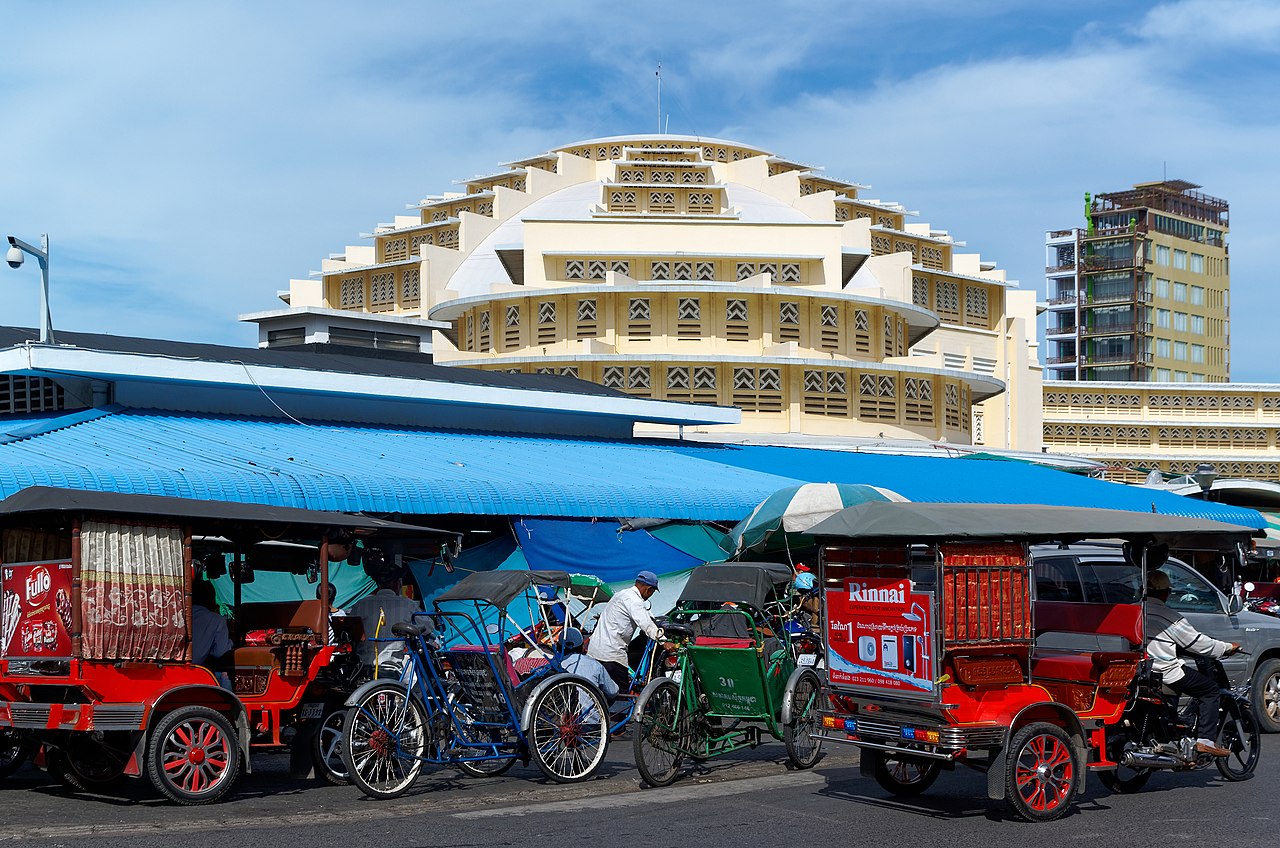
The Central Market (Phsar Thmei) stands at the centre of the old Chinatown. In the late 1920s the city had about 90,000 inhabitants, and the French decided it needed a new covered market. The site was a drained marsh. Work began in August 1935 to a design by the city architect Jean Desbois. King Sisowath Monivong opened the building in September 1937. Its central dome is 26 metres high, with four long arms reaching out diagonally, and at its opening it was said to be the largest market in Asia. A US$4.2 million renovation funded by the French Development Agency restored its concrete structure between 2009 and 2011. It still works as a market, with gold and jewellery stalls under the dome.
Vietnamese Clerks, Cham Muslims and the River Settlements
Vietnamese influence came first through armies and then through the colonial civil service. In 1813 the Nguyễn court at Huế sent 10,000 troops to Phnom Penh, and under Emperor Minh Mạng it went on to rule Cambodia directly, reducing the Cambodian court to a minor role. Under the French, educated Vietnamese were hired as secretaries, clerks and officials in the protectorate's offices. After independence in 1953, Sihanouk's government replaced most of them with Cambodians, and many moved into banks and trading firms. In the 1960s Vietnamese mechanics worked in car-repair shops owned by Chinese businessmen, and Vietnamese fishermen settled along the Mekong and Tonlé Sap. In 1962 the census counted Vietnamese as Cambodia's largest minority, at 3.8 percent of the population.
That community was nearly destroyed in the 1970s. After Lon Nol took power in 1970, about 30,000 Vietnamese were killed and tens of thousands fled. The Khmer Rouge expelled or killed most of the rest. After 1979 the Vietnamese-backed government encouraged former residents to return, and a 1983 policy allowed new migrants in too. Many are still stateless, and because they cannot legally buy land without citizenship, many live in floating settlements on the rivers. The 2019 census recorded only 78,090 people nationwide who speak Vietnamese as their mother tongue. Scholars estimate the true number of ethnic Vietnamese at between 400,000 and a million. During the 2013–2014 opposition protests, Vietnamese-owned shops in Phnom Penh were ransacked.
The Cham, the 4 percent in the 2017 survey, are the city's Muslims. Their ancestors came from the kingdom of Champa on the coast of present-day Vietnam. When the last Cham king, Pô Chien, lost his lands to Vietnamese expansion, he led his people into Cambodia, where they settled in communities along the Mekong. A small part of the Cambodian community still keeps the Western Cham script alive, and Cambodian Cham have long had ties with Kelantan in Malaysia; 9,704 Cham refugees, most of them from Cambodia, were allowed to stay in Malaysia after 1975. Before any of these groups, Phnom Penh had a Portuguese community that traded and ran missions until the 17th century, and Japanese settlers who lived on the outskirts in the same period.
Vann Molyvann's Generation and the Emptying of 17 April 1975
After independence, Cambodians themselves began to shape the city's buildings. Vann Molyvann was born in Kampot province in 1926, studied architecture in Paris and returned in 1956 as one of only a handful of trained Cambodian architects. Norodom Sihanouk made him head of public works and state architect. He designed more than 100 structures, among them the Independence Monument, the Chaktomuk Conference Hall and the National Sports Complex. His style, New Khmer Architecture, combined modernism with forms taken from Angkor. The city's heritage of French colonial, New Khmer and Art Deco buildings earned it the nickname "Pearl of Asia".
That period ended in war. As fighting and American bombing spread through the countryside, refugees poured into the city, and by 1975 Phnom Penh held two to three million people. The Khmer Rouge took the city on 17 April 1975 and forced every resident out, including hospital patients, and sent them to rural labour. The evacuated townspeople, rich and educated included, were classed as "new people". The Tuol Svay Prey High School was turned into Security Prison 21 (S-21), where an estimated 20,000 people were imprisoned between 1976 and 1979. Many were then killed at Choeung Ek, a former orchard 17 kilometres south of the centre, where the remains of 8,895 victims were later exhumed. Chinese, Vietnamese and Cham residents were all targeted. The number of ethnic Chinese in Cambodia fell from about 425,000 in the 1960s to 61,400 by 1984. Molyvann survived in exile in Switzerland and did not return until 1991.
Vietnamese forces drove the Khmer Rouge out of Phnom Penh in 1979, and people slowly returned. The 1998 census counted about 862,000 residents. Aid from France, Australia and Japan and loans from the Asian Development Bank and the World Bank paid to rebuild the water supply and roads. The water utility, which had been bankrupt, went on to win the Ramon Magsaysay Award in 2006. The population reached 1.3 million in 2008 and more than 2.1 million in 2019. Khmer is the official language, and English and French are also used. Chinese-language schools teach Cantonese, Mandarin or both, because Chinese is increasingly seen as a language of business. The skyline is now led by the 188-metre Vattanac Capital Tower. Slums remain, though: 105,771 people lived in them at the end of 2012.
The Water Festival, the city's largest, brings people from across Cambodia into the capital for three days of boat races and fireworks. It celebrates the reversal of the Tonlé Sap's flow. The race boats recall the naval forces of Angkor, an empire traced in our guide to the geography of the Khmer Empire. The city's pagodas and mosques belong to a longer religious history, set out in our guide to religion in Cambodia. The river that brought Lady Penh her koki tree also brought most of the city's later arrivals, and its full course is followed in the complete guide to the Mekong.
Quick Facts About Phnom Penh
- Country: Cambodia
- Continent: Asia (Southeast Asia)
- Country population: approximately 18.1 million
- Capital city status: Phnom Penh is the capital of Cambodia, the seat of national government, and the location of foreign embassies, parliament, and the head of state's official residence.
Frequently Asked Questions
What is the capital of Cambodia?
The capital of Cambodia is Phnom Penh. Phnom Penh is the seat of national government, hosts most foreign embassies and consulates, and is typically where the head of state and parliament are located.
What continent is Phnom Penh in?
Phnom Penh, the capital of Cambodia, is located in Asia, in the Southeast Asia region. As Cambodia's capital, Phnom Penh serves as the country's primary connection to the broader Asian political, economic, and cultural sphere.
Why is Phnom Penh the capital of Cambodia?
Phnom Penh was chosen as the capital of Cambodia for reasons that typically combine geography, history, and politics. Capital city selections often reflect a desire for centrality (being accessible from across the country), historical importance (being a longstanding seat of government or culture), or neutrality (being acceptable to multiple regions or ethnic groups within the country). The specific reasons for Phnom Penh's designation are detailed in the city's history above.
What is Phnom Penh known for?
As the capital of Cambodia, Phnom Penh is best known for housing the country's central government institutions — parliament, presidential or royal residences, supreme court, and key ministries. It is also typically a major cultural and economic center within Cambodia, hosting national museums, embassies, and signature monuments. The introduction and history sections above provide detailed coverage of the city's specific notable institutions and landmarks.
Related Pages
- Cambodia Country Guide — full geography, climate, economy, and culture overview
- Flag of Cambodia — meaning, history, and design of Cambodia's national flag