

Caracas is the capital and largest city of Venezuela, set in a narrow valley about 900 metres above sea level in the Central Range, separated from the Caribbean coast by the 15-kilometre-wide mass of El Ávila. The Metropolitan District of Caracas had an estimated 3.24 million people in 2022, and Greater Caracas, including satellite towns in Miranda and La Guaira, about 5.3 million. It was not Venezuela’s first capital: the Spanish governed the province from the coastal town of Coro until 1578, and for most of the 19th century rival cities contested the title. Caracas won because its mountain-guarded valley was safer from pirates and gentler in climate than the coast, and apart from the Gran Colombia years and two brief spells when Valencia held the title, it has been the seat of government ever since.
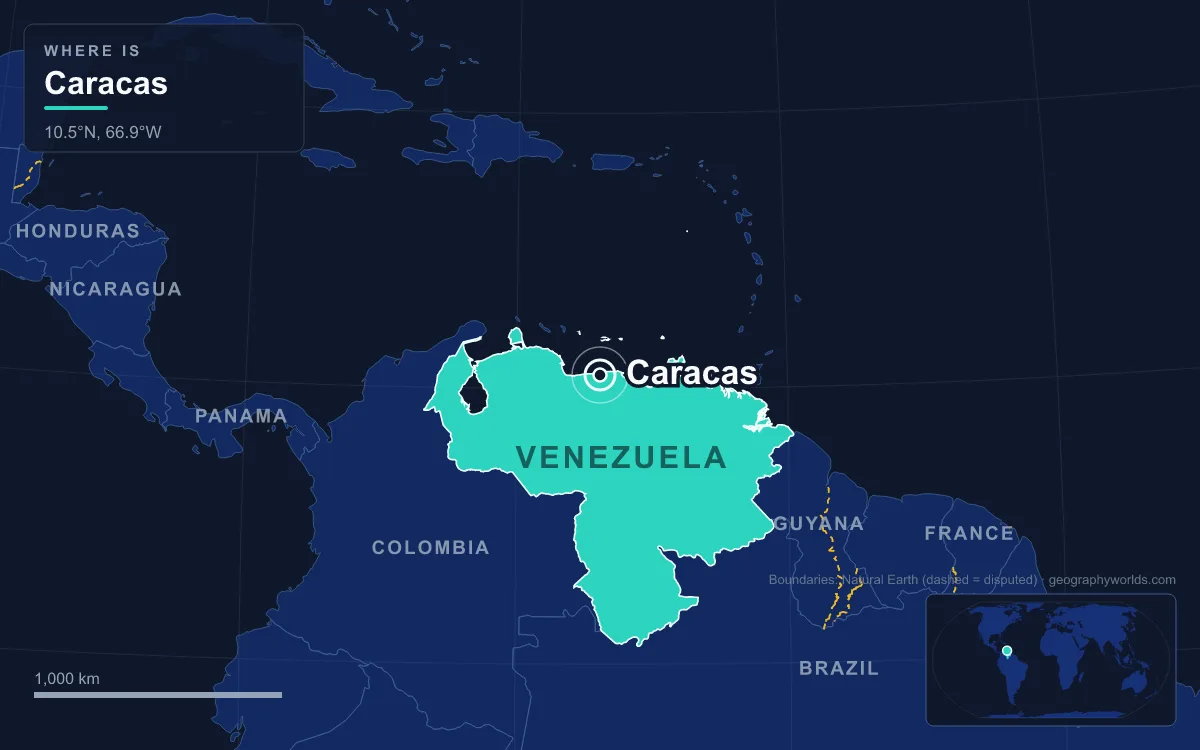
From Coro to Caracas: How the Capital Moved Inland in 1578
Spanish Venezuela began on the dry north-western coast. Santa Ana de Coro was founded on 26 July 1527 by Juan de Ampíes, and from 1528 to 1546 the province was leased to the Welser banking family of Augsburg, who ran it as the colony of Klein-Venedig. Coro served as the capital of the Province of Venezuela and was the seat of its first bishop. Settlers spread east from it, founding inland towns such as Barquisimeto and Valencia before they reached the valley of the Caracas people.
That valley resisted them for years. Francisco Fajardo, the son of a Spanish captain and a Guaiquerí cacica (chief) who came from Margarita Island, tried to settle it between 1555 and 1562; his Hato de San Francisco of 1560 and Juan Rodríguez de Suárez’s Villa de San Francisco of 1561 were both destroyed by warriors under the chiefs Guaicaipuro and Terepaima. Captain Diego de Losada finally succeeded, defeating the local groups one by one, and on 25 July 1567 he founded Santiago de León de Caracas.
The new town was the closest of the Spanish settlements to the central coast, and its valley had good land for both crops and livestock. Coro, by contrast, was exposed to raiders and to a harsh, arid climate. Governor Juan de Pimentel, who took office in 1576, moved the seat of the provincial government to Caracas, and by 1578 Coro had lost the capital; it lost the bishopric too in 1636. In the 1580s Caracas farmers were already shipping food to the Spanish garrison at Cartagena and selling wheat into imperial trade, which tied the young capital into the empire’s supply routes.
The Ávila Wall, the 1595 Raid and the Cacao Fortune
What made Caracas a better capital than a port was the mountain between it and the sea. The coast of Venezuela was raided repeatedly by pirates in the 16th and 17th centuries, and the Cordillera de la Costa, a wall more than 2,000 metres high, left the city relatively safe from seaborne raids. The protection was not absolute. In 1595 the Preston–Somers expedition landed about 200 English privateers under Amyas Preston and George Somers, who crossed the mountains by a little-used pass while the defenders guarded the main road. After a failed ransom negotiation they sacked and burned the town. It was rebuilt with the proceeds of the wheat trade.
The money that turned Caracas into a real colonial centre came from cacao. In the 1620s local planters found a market for their beans, first in Mexico and then across the Caribbean, and the city came to rely on the labour of enslaved Africans. Blight, the persecution of its Portuguese traders by the Mexican Inquisition, competition from Guayaquil and the earthquake of 1641 brought a slump from the 1650s, and by the 1670s much of the trade ran illegally through Dutch Curaçao. The Crown answered in 1728 by chartering the Guipuzcoan Company of Caracas, a Basque trading monopoly under which the cacao business grew in importance.
1777 to 1858: Captaincy General, Independence and Valencia’s Challenge
Caracas became the unquestioned centre of the region in 1777, when Luis de Unzaga created the Captaincy General of Venezuela with Caracas as its capital. The decree of 8 September 1777 detached Cumaná, Guayana, Maracaibo, Trinidad and Margarita from New Granada and joined them to Caracas in government and military matters, so for the first time the scattered provinces of the coast and plains answered to one city.
The same concentration of power made Caracas the focus of revolt. The Gual and España conspiracy of 1797 was planned there, and in 1799 José María España was executed and quartered in the main square, now Plaza Bolívar. On 19 April 1810 a popular rising in that square began the break with the Spanish Crown, and on 5 July 1811 seven of the ten provinces of the captaincy declared independence. Simón Bolívar, born in Caracas on 24 July 1783, rose to lead the struggle.

Geography then turned against the revolutionaries. At 4:37 in the afternoon of 26 March 1812, a Maundy Thursday, a magnitude 7.7 earthquake destroyed much of Caracas and other republican towns; an estimated 15,000 to 20,000 people died across the region. Because it fell on the liturgical anniversary of the 1810 rising, many read it as divine judgement, and support for the First Republic collapsed. On 25 July 1812 the republican commander Francisco de Miranda capitulated to the royalist Domingo Monteverde, and in 1814 about a quarter of the city’s population left. Independence was secured only after Bolívar’s victory at Carabobo on 24 June 1821.
Independence did not settle where the country would be run from. From 1819 to 1830 Venezuela was a department of Gran Colombia, and the Constitution of Cúcuta of 1821 placed the federal capital in Bogotá, leaving Caracas as only a regional seat. When Venezuela broke away in 1830, Valencia, not Caracas, became the capital of the new republic. Valencia ceased to be the capital soon afterward, and the government returned to Caracas.
Valencia tried again after the March Revolution of 1858 toppled the Monagas brothers, when it once more became the seat of the national government. Valencia had a real claim: founded on 25 March 1555, twelve years before Caracas, it was the first Spanish settlement in north-central Venezuela and is today the country’s third-largest city. Each time, though, the seat of government returned to Caracas, where the institutions of the colonial captaincy had been concentrated since 1777.
Guzmán Blanco’s Capitol and the Oil-Boom Capital
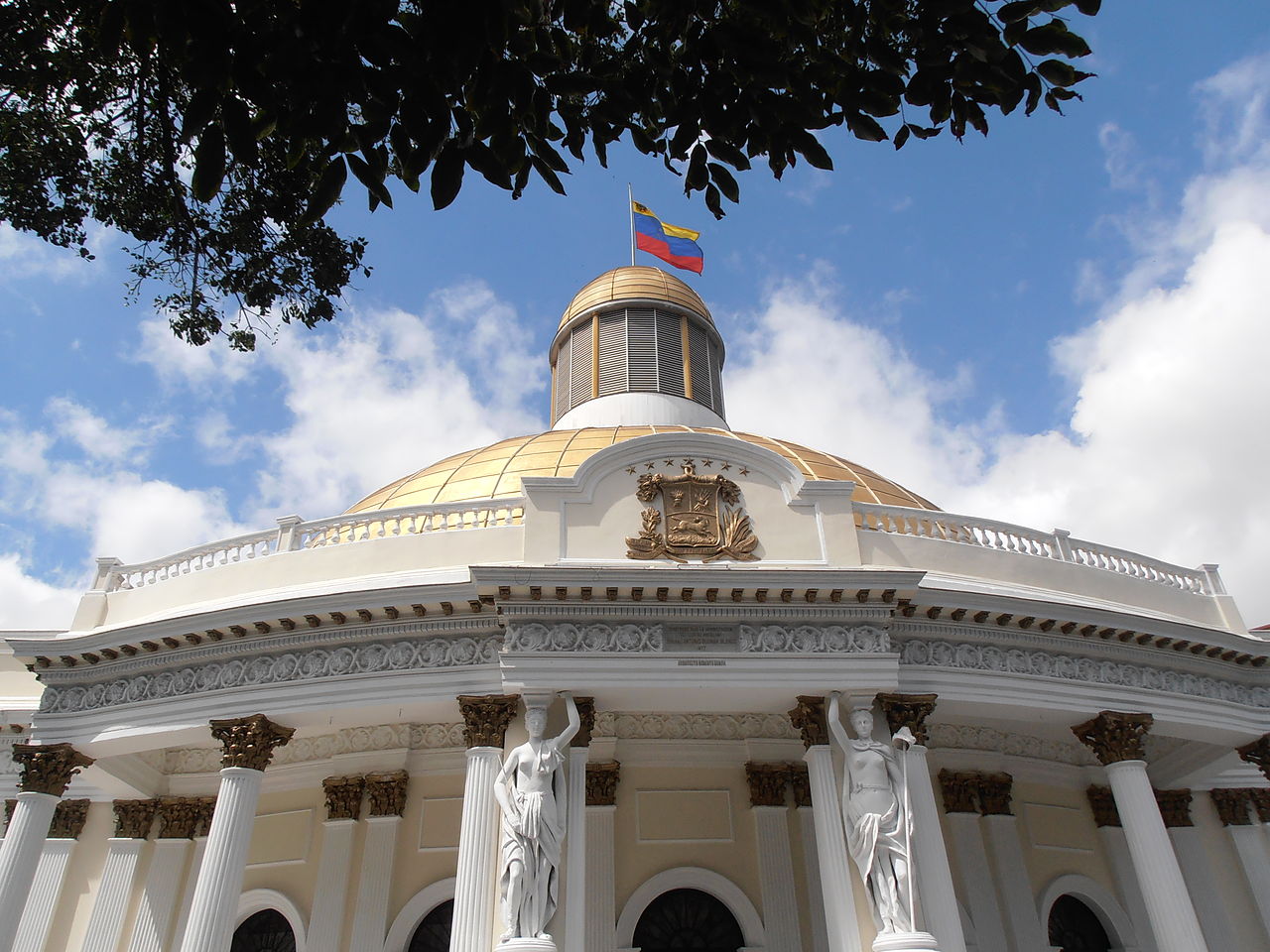
The Caracas that looks like a national capital was largely built by Antonio Guzmán Blanco, who dominated Venezuelan politics in the 1870s and 1880s. Between 1872 and 1877 he built the Palacio Federal Legislativo, the gold-domed Capitol designed by Luciano Urdaneta Vargas, which still houses the National Assembly. He turned the ruined Santísima Trinidad church into the National Pantheon, whose central nave is given over to Bolívar’s bronze sarcophagus, and his governments added the Municipal Theatre, inaugurated in 1881, the La Guaira and Caracas Railway and, in 1879, the bolívar currency. From 1874 the city’s streams were also channelled into the Guaire River as sewers, a decision whose pollution the river still carries.
Even so, the city stayed recognisably colonial until the 1930s. What changed it was oil. Revenue from the petroleum boom of the early 20th century funded an intensive modernisation programme that began in the 1950s and continued through the 1960s and early 1970s: the University City designed by Carlos Raúl Villanueva, a UNESCO World Heritage Site since 2000; the Teresa Carreño Cultural Complex; the Museum of Contemporary Art; motorways; and a metro that opened on 2 January 1983 with 11.5 kilometres of line and now runs to 106.5 kilometres. The presidency itself works from Miraflores Palace, begun on 27 April 1884 as the family residence of Joaquín Crespo and used as a presidential residence from the time of Cipriano Castro.
The boom also filled the valley. Rural Venezuelans moved to the capital in search of work faster than planned housing could be built, and self-built ranchos climbed the hillsides. Today about 45% of the city’s population lives in these settlements, which cover about a quarter of its urban area. The collapse of oil prices in the 1980s, the Caracazo riots of 1989 and the long economic crisis that followed left much of the mid-century infrastructure poorly maintained.
Libertador, Chacao and a Capital Governed in Pieces
Being the capital has shaped how Caracas is run as much as how it looks. The city is split between two jurisdictions. Its western half forms the Libertador municipality, the only municipality of the 433-square-kilometre Capital District, whose head of government has been appointed by the president since a 2009 law. The eastern half lies in the state of Miranda, in the separate municipalities of Baruta, Chacao, El Hatillo and Sucre. A Metropolitan District created on 8 March 2000 tried to unite them under one elected mayor, but it was abolished by the Constituent National Assembly on 20 December 2017.
The capital’s role has also made it the stage for national crises. On 3 January 2026 United States forces struck targets in northern Venezuela and seized President Nicolás Maduro at his compound in Caracas, flying him to New York to face drug-trafficking charges, to which he pleaded not guilty. Venezuela’s government condemned the operation as a kidnapping, and Delcy Rodríguez was sworn in as acting president on 5 January. By February the United States embassy in Caracas had reopened for the first time since 2019.
For all the changes of regime, the geography that won Caracas the capital in the 1570s still holds. The Ávila, now protected as Waraira Repano National Park, divides the city from the coast at La Guaira, and the valley remains the country’s administrative, financial and cultural centre, home to the headquarters of the state oil company PDVSA and the Caracas Stock Exchange. How it compares with Maracaibo, Valencia and the other big cities is set out in our list of the largest cities in Venezuela, and the oil that paid for modern Caracas is covered in our guide to Venezuela’s natural resources; for the country as a whole, start with the Venezuela country guide.
Quick Facts About Caracas
- Country: Venezuela
- Continent: South America
- Country population: approximately 28.6 million
- Capital city status: Caracas is the capital of Venezuela, the seat of national government, and the location of foreign embassies, parliament, and the head of state's official residence.
Frequently Asked Questions
What is the capital of Venezuela?
The capital of Venezuela is Caracas. Caracas is the seat of national government, hosts most foreign embassies and consulates, and is typically where the head of state and parliament are located.
What continent is Caracas in?
Caracas, the capital of Venezuela, is located in South America. As Venezuela's capital, Caracas serves as the country's primary connection to the broader South American political, economic, and cultural sphere.
Why is Caracas the capital of Venezuela?
Caracas was chosen as the capital of Venezuela for reasons that typically combine geography, history, and politics. Capital city selections often reflect a desire for centrality (being accessible from across the country), historical importance (being a longstanding seat of government or culture), or neutrality (being acceptable to multiple regions or ethnic groups within the country). The specific reasons for Caracas's designation are detailed in the city's history above.
What is Caracas known for?
As the capital of Venezuela, Caracas is best known for housing the country's central government institutions — parliament, presidential or royal residences, supreme court, and key ministries. It is also typically a major cultural and economic center within Venezuela, hosting national museums, embassies, and signature monuments. The introduction and history sections above provide detailed coverage of the city's specific notable institutions and landmarks.
Related Pages
- Venezuela Country Guide — full geography, climate, economy, and culture overview
- Flag of Venezuela — meaning, history, and design of Venezuela's national flag