

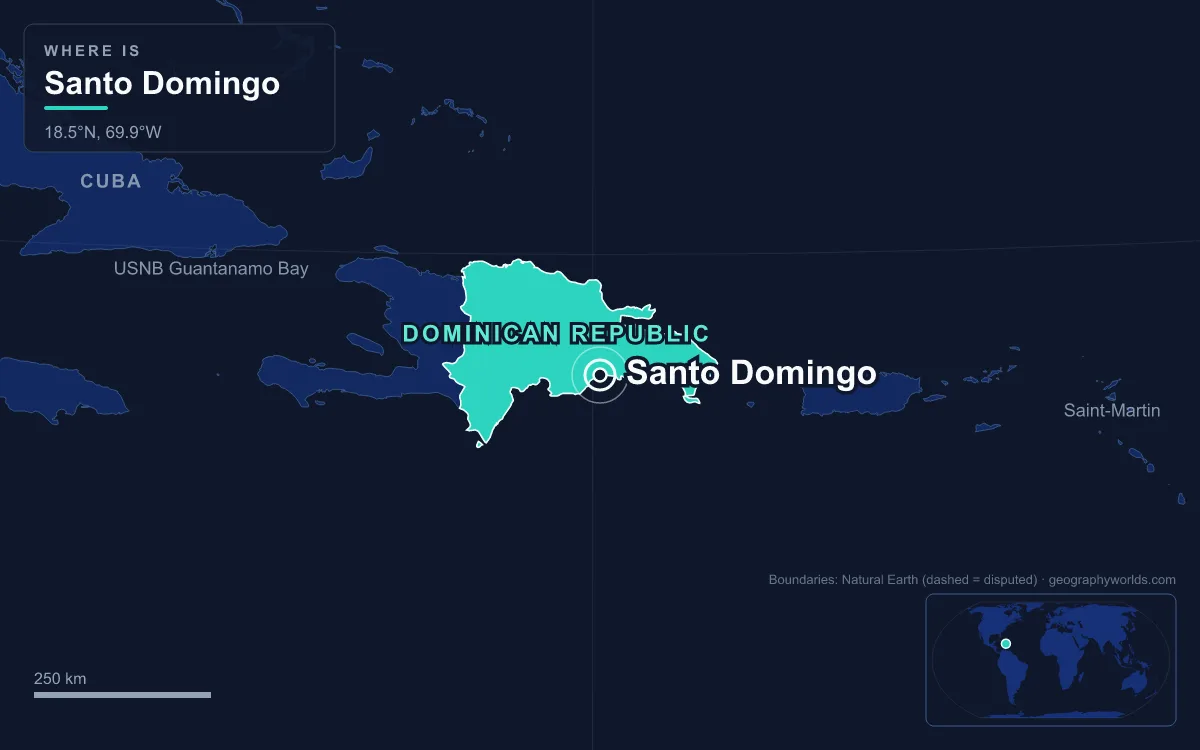
Santo Domingo is the capital and largest city of the Dominican Republic. It sits on the southern coast of Hispaniola, where the Ozama River meets the Caribbean Sea. The city proper, the Distrito Nacional, had 1,029,110 residents in 2022, and Greater Santo Domingo had 4,274,651. That makes it the largest metropolitan area in the Caribbean. It is also the oldest continuously inhabited European settlement in the Americas. Bartholomew Columbus founded it in the late 1490s: the city counts from 1496, and its official founding date is 5 August 1498. Its walled Colonial Zone has been a UNESCO World Heritage Site since 1990. The easiest way to understand the city is through the buildings that have survived its five centuries, so this guide takes six of them in turn, starting at the river mouth and ending on the far bank.
Fortaleza Ozama: The Tower Nicolás de Ovando Began in 1502
The first Santo Domingo stood on the east bank of the Ozama. In June 1502 a major hurricane destroyed it. The new governor, Nicolás de Ovando, rebuilt the town on the west bank, and one of his first projects was a fortress at the river mouth to guard the harbour. Building ran from 1502 to 1508 under the Spanish architect Gómez García de Varela. Black and Taíno slaves did the labour, cutting coral stone from the sea. The central Torre del Homenaje, or Tower of Homage, is 18 metres high with walls 2 metres thick. Through the 16th century it was the tallest European-built structure in the Americas. UNESCO describes the Fortaleza, as part of the city walls, as the oldest military construction of European origin in the Americas.
The fortress failed at its main job more than once. Sir Francis Drake seized it in 1586 when he took the city and held it for ransom. It served as a prison for centuries, holding pirates and politicians. Former presidents Jacinto Peynado and Horacio Vásquez were both held there. The present entrance on Calle Las Damas, the Carlos III gate, dates from 1787. In 1938 Rafael Trujillo's port works enclosed the riverside in a concrete wall styled to look colonial. The prison closed in 1965, during the civil war of that year. Colonel Francisco Caamaño's constitutionalist government turned the compound into a public square, and bullet holes from that fighting are still visible in the doors. A statue out front shows Gonzalo Fernández de Oviedo, who governed the fortress from 1533 to 1557 and wrote the Historia general y natural de las Indias.

Catedral Primada de América, Consecrated on 31 August 1541
A few blocks west, beside Parque Colón, stands the oldest cathedral still standing in the Americas. Pope Julius II ordered it in 1504, and building began in 1512 to plans by Alonso de Rodríguez. The first bishop, García Padilla, never actually reached the island. Work stopped and restarted with a new design by Luis de Moya and Rodrigo de Liendo in 1522. The church was consecrated on 31 August 1541 under Bishop Alonso de Fuenmayor. In 1546 Pope Paul III raised it to a metropolitan cathedral at the request of Charles V. That is why the Archbishop of Santo Domingo still carries the honorary title Primate of the Indies. Alonso González, taking his lead from Seville Cathedral, had partially completed the church by 1550.
The façade is golden coral limestone, and the interior has ribbed Gothic vaults. That makes it one of the few examples of true Gothic building outside Europe. The bell tower was never finished. In 1547 work stopped because the tower was starting to rise above the Fortaleza's Tower of Homage, and that bothered the sentries. Drake's men used the cathedral as their headquarters in 1586 and looted it. Remains believed to be those of Christopher Columbus lay here until 1795, when they went to Havana. Between 1898 and 1899 they moved on to Seville. The cathedral also holds a panel of the Virgin of Altagracia dated 1523, a Plateresque archbishop's throne from 1540, and 14 chapels. For the wider picture of Catholic and Protestant life in the country, see our guide to religion in the Dominican Republic.
Alcázar de Colón, Diego Columbus’s Palace on the Ozama
Christopher Columbus's eldest son Diego arrived in 1509 as governor. King Ferdinand II of Aragon granted him a plot on a rocky rise above the Ozama, and between about 1511 and 1514 he built a fortified palace there. It was modelled on an existing building at Mancera de Abajo, in the Spanish province of Salamanca, and the name of its architect is unknown. The building is mostly Gothic, with Renaissance arcades, and it is made of coral-stone masonry. It is the first fortified European palace in the Americas. It is also the only known New World home of any member of the Columbus family. Diego's children Juana, Isabel, Luis and Cristóbal were born there. After Diego died in Spain in 1526, his widow, María Álvarez de Toledo, stayed on until her own death in 1549.
Hernán Cortés and Pedro de Alvarado both passed through, and expeditions of conquest were planned in its rooms. Drake looted it in 1586. As Santo Domingo lost importance, the house fell apart. By the mid-18th century it was abandoned, and in 1776 there was a plan to turn it into a prison. Of the original 55 rooms, 22 survive. The palace was declared a National Monument in 1870 and restored between 1955 and 1957. It reopened as a museum of period furniture and late-medieval and Renaissance European art, including Flemish tapestries from the 15th to 17th centuries. It is the most visited museum in Santo Domingo. In front of it, Plaza de España runs down to Las Atarazanas, the old naval yards. This was the first European commercial district in the Americas.

Puerta del Conde and the Night of 27 February 1844
The western gate of the walled city started in 1543 as Fort San Genaro. It takes its present name from a siege in 1655. That spring an English force under General Robert Venables and Admiral William Penn, sent by Oliver Cromwell, attacked Santo Domingo. The governor, Bernardino de Meneses Bracamonte y Zapata, Count of Peñalva, drove them off with a smaller force of local militia. The city lost only 25 dead. The rebuilt bastion was named El Baluarte del Conde after him, and its archway became La Puerta del Conde.
The gate's second fame is political. Spain ceded its side of the island to France in 1795. Over the next few decades the city changed hands several times. In 1821 José Núñez de Cáceres declared the Republic of Spanish Haiti, but Haiti annexed it just two months later. On 27 February 1844, the independence movement founded by Juan Pablo Duarte struck at last. At the Puerta del Conde, Francisco del Rosario Sánchez proclaimed Dominican independence from Haiti and raised the first Dominican flag. The battles that followed, such as 19 March, 30 March and Las Carreras, gave their names to city streets. How the two nations of Hispaniola grew apart afterwards is traced in our Haiti vs Dominican Republic comparison.
Behind the gate lies Parque Independencia, redesigned by the architect Antonin Nechodoma in 1912. At its centre is the Altar de la Patria, a white marble mausoleum from 1976. It holds the remains of the three founding fathers: Duarte, Sánchez and Matías Ramón Mella. The Latin line over the arch comes from Horace: it is sweet and fitting to die for one's country.

Palacio Nacional: Trujillo’s Seat of Government, Opened 1947
Santo Domingo's modern shape comes largely from one man. Hurricane San Zenón struck in 1930 and killed up to 8,000 people. Rafael Trujillo, in power from that year, rebuilt the capital, and in 1936 he renamed it Ciudad Trujillo after himself. The name lasted until he was assassinated in 1961. His most lasting building is the Palacio Nacional. It stands on the site of the Presidential Mansion built during the United States occupation of 1916 to 1924. Construction began on 27 February 1944, the centenary of independence, to a restrained neoclassical design by the Italian architect Guido D'Alessandro. The palace opened on 16 August 1947 and covers about 18,000 square metres. It still houses the offices of the president and vice president. Its Hall of the Caryatids stood in for Havana in the New Year's scene of The Godfather Part II.
The streets around the palace saw the city's worst modern fighting. President Juan Bosch, elected in 1962, was overthrown after seven months, and in April 1965 civil war broke out in the capital. The United States invaded for a second time. On 15 and 16 June paratroopers of the 82nd Airborne fought their way into Caamaño's stronghold around Calle El Conde. By the time the fighting ended on 31 August 1965, 2,850 Dominicans and 44 American servicemen were dead.
Faro a Colón, the 1992 Monument Across the River
The last landmark stands on the east bank, the side of the river where the first town stood before the 1502 hurricane. It is in the municipality of Santo Domingo Este, inside Mirador del Este park. The Columbus Lighthouse was more than a century in the making. The Dominican historian Antonio Delmonte y Tejada suggested a Columbus monument in 1852. The idea was taken up at the Fifth International Conference of American States in Chile in 1923. In 1931 the Scottish architect Joseph Lea Gleave won a design competition held in Brazil. It drew 455 entries from 48 countries, and Frank Lloyd Wright and Eliel Saarinen sat on the jury. The foundations were dug in 1948, but work then stalled until 1986. It was finally finished under President Joaquín Balaguer in 1992, in time for the 500th anniversary of Columbus's first voyage, at a cost of about US$70 million.
The building is a reinforced-concrete cross, 210 metres long and 59 metres wide. It has 157 beams of light that point skyward and project a cross of light into the night sky. Dominican authorities say it holds remains of Christopher Columbus. Spanish researchers have used DNA tests to show that remains in Seville Cathedral are his, though that result does not exclude some bones in Santo Domingo also being his. Dominican authorities have not allowed the same tests on the lighthouse remains. Inside, national exhibits from countries across the Americas and beyond fill the halls.
Between the Fortaleza and the Faro lie about 490 years and the full width of the Ozama. The river runs 148 kilometres to the sea, and the country's busiest port still sits at its mouth. For the land around the city, from the Cordillera Central to the Enriquillo basin, read our overview of Dominican Republic geography.
Quick Facts About Santo Domingo
- Country: Dominican Republic
- Continent: North America (Caribbean)
- Country population: approximately 11.6 million
- Capital city status: Santo Domingo is the capital of Dominican Republic, the seat of national government, and the location of foreign embassies, parliament, and the head of state's official residence.
Frequently Asked Questions
What is the capital of Dominican Republic?
The capital of Dominican Republic is Santo Domingo. Santo Domingo is the seat of national government, hosts most foreign embassies and consulates, and is typically where the head of state and parliament are located.
What continent is Santo Domingo in?
Santo Domingo, the capital of Dominican Republic, is located in North America, in the Caribbean region. As Dominican Republic's capital, Santo Domingo serves as the country's primary connection to the broader North American political, economic, and cultural sphere.
Why is Santo Domingo the capital of Dominican Republic?
Santo Domingo was chosen as the capital of Dominican Republic for reasons that typically combine geography, history, and politics. Capital city selections often reflect a desire for centrality (being accessible from across the country), historical importance (being a longstanding seat of government or culture), or neutrality (being acceptable to multiple regions or ethnic groups within the country). The specific reasons for Santo Domingo's designation are detailed in the city's history above.
What is Santo Domingo known for?
As the capital of Dominican Republic, Santo Domingo is best known for housing the country's central government institutions — parliament, presidential or royal residences, supreme court, and key ministries. It is also typically a major cultural and economic center within Dominican Republic, hosting national museums, embassies, and signature monuments. The introduction and history sections above provide detailed coverage of the city's specific notable institutions and landmarks.
Related Pages
- Dominican Republic Country Guide — full geography, climate, economy, and culture overview
- Flag of Dominican Republic — meaning, history, and design of Dominican Republic's national flag