

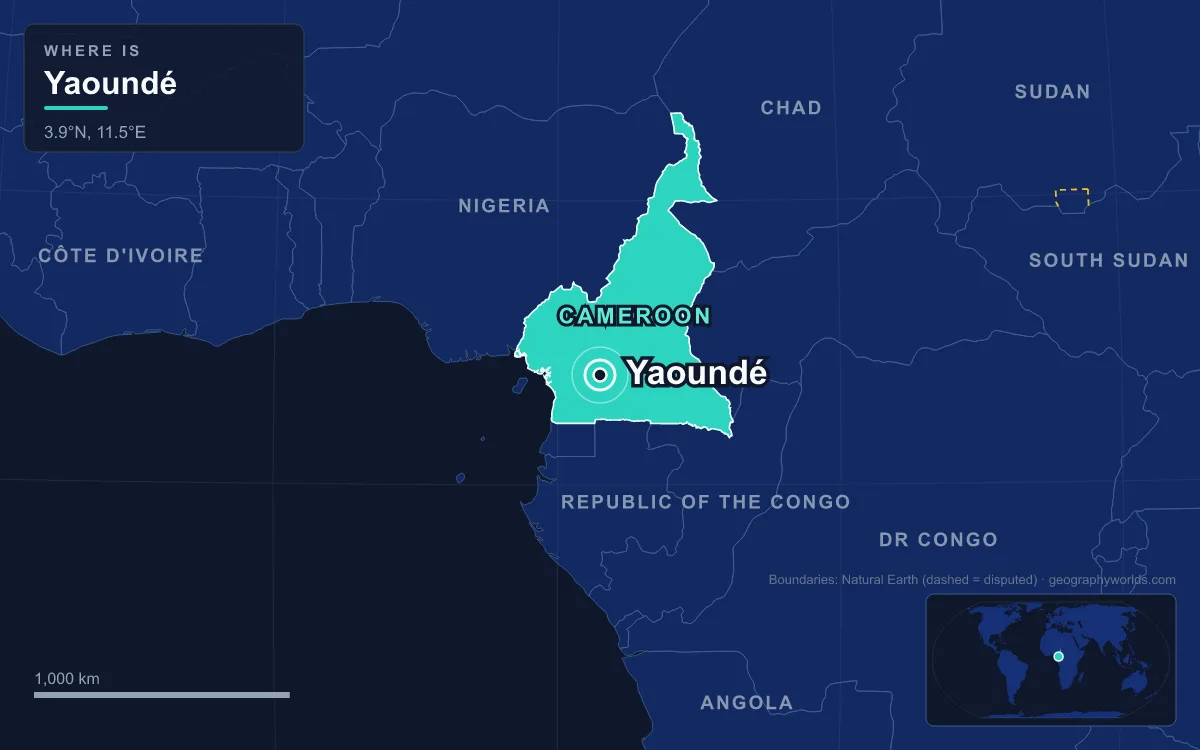
Yaoundé is the capital of Cameroon. It stands on hills about 750 metres above sea level in the Centre Region, roughly 210 kilometres inland from the Atlantic port of Douala. A 2025 estimate puts its population at about 3.76 million, which makes it the country's second city, just behind Douala. The key to understanding Yaoundé is that it was chosen as a capital rather than growing into one. French administrators picked this forest-edge German outpost to run their Cameroon mandate in 1922. For almost all of the century since, it has held the government while Douala has held the money. Most of what sets Yaoundé apart shows up when the two cities are set side by side.
Yaoundé and Douala by the Numbers
Cameroon covers 475,442 square kilometres and has close to 31 million people, but two cities dominate its urban life. They are almost the same size, and very different in almost everything else.
| Yaoundé | Douala | |
|---|---|---|
| Role | Political capital, seat of government | Economic capital, main seaport |
| Population (2025 est.) | about 3.76 million | about 3.82 million (city proper) |
| Setting | Forested hills, about 750 m up | Wouri River estuary on the Atlantic |
| Annual rainfall | about 1,510 mm | about 3,600 mm |
| First European presence | German station, late 1880s | Portuguese visitors, about 1472 |
| Main airport | Nsimalen, opened 1991 | Douala International, the country's main airport |
Population figures for both cities vary a lot from source to source, and some estimates put Yaoundé nearer 3 million. The direction of travel is clear, though. The 2005 census gave the Mfoundi department, which is effectively greater Yaoundé on 297 square kilometres, 1,881,876 people. On the 2025 estimate, the capital has roughly doubled since then.
A Research Station of 1889 Against a Port of 1472
Douala is centuries older as a place Europeans knew. Portuguese sailors reached the Wouri estuary in about 1472. They called it the Rio dos Camarões, the "river of shrimps", and that name eventually became "Cameroon". By 1650 a Duala-speaking town stood on the river. In the 18th century it was a centre of the Atlantic slave trade, and later it served as the capital of German Kamerun until 1902, when the seat moved to Buea.
Yaoundé, by comparison, is a latecomer. German explorers Richard Kund and Hans Tappenbeck set up an outpost called Epsumb or Jeundo between the Nyong and Sanaga rivers, on the northern edge of the forest. Sources date it to 1887, 1888 or February 1889, and the local Ela Esono chiefs agreed to it. From December 1889 to May 1895 the botanist Georg August Zenker ran it as an agricultural research station named Jaunde, after the local Yaunde (Ewondo) people. It bought rubber and ivory in exchange for imported cloth and iron. In 1895 Major Dominik set up a military garrison there, which allowed a Pallottine mission and school to open at nearby Mvolyé, now a suburb. Belgian troops from the Congo occupied Jaunde during the First World War. After Germany's defeat, France took eastern Cameroon as a League of Nations mandate and in 1922 made Yaoundé its capital. Douala got one more turn as capital, from 1940 to 1946, before power settled inland for good.
1,510 Millimetres of Rain and Two Wet Seasons
The climate difference between the two cities is striking. Douala gets about 3,600 millimetres of rain a year, and more than 680 millimetres falls in each of July and August. Yaoundé gets less than half as much. Its elevation also keeps it cooler than you would expect this close to the equator. Average highs run from about 27 °C in July and August to about 32 °C in February, and nights stay close to 19 °C all year.
The timing of the rain is where the two cities differ most. Douala has a single long wet season that peaks in the middle of the year. Yaoundé's wet season runs for ten months, from March to November, but it has a clear dip in July, when rainfall falls to about 60 millimetres. That gives the city what are effectively two rainy seasons, peaking in May and in October, with October the wettest month at about 294 millimetres. Because of the July lull, climatologists classify Yaoundé as tropical wet-and-dry (Köppen Aw) rather than tropical monsoon. December to February is the dry season. It is also the sunniest part of the year, with around 180 to 190 hours of sunshine a month, about double July's total. Our guide to the best time to visit Cameroon turns these patterns into travel advice.
From the 1957 Cocoa Crisis to a City of Millions
For most of the colonial era Douala was the bigger and busier city. It had about 100,000 people by 1955 and around 500,000 by 1972. Yaoundé's growth took off after 1957, when a crisis in the cocoa economy and unrest along the coast pushed people inland. Independence in 1960 and the federation with the former British Southern Cameroons in 1961 confirmed Yaoundé as the seat of government. The ministries, embassies and civil servants that followed kept the city growing.
Growth came with problems. City council figures record more than 130 floods between 1980 and 2014. At their worst, floods hit the city 15 to 20 times a year and affected up to 100,000 people each time. In 2010 Mayor Jean Claude Adjessa Melingui launched the Yaoundé City Sanitation Master Plan. Within four years the number of floods had fallen to about three a year, and cases of water-borne diseases such as typhoid had dropped by almost half. Further work followed under a $152 million plan financed largely by the African Development Bank and the French Development Agency. The city is also partly farmland: residents keep an estimated 50,000 pigs and more than a million chickens.

Ministries in Yaoundé, Factories in Douala and Bonabéri
The two cities share out Cameroon's economy very unevenly. More than 75 percent of the country's industrial capacity is in Douala and Bonabéri, across the Wouri. Douala's port handles most of the national exports, including oil, cocoa, coffee, timber and fruit, and the city is the commercial capital of the whole CEMAC economic bloc, from Gabon to Chad. Since its first container terminal opened in March 2018, the new deep-water port at Kribi has been taking some of that traffic.
Yaoundé runs on the state instead. The civil service and the diplomatic corps are its main employers, and this concentration gives it a higher standard of living and more security than most of Cameroon. The centre holds government offices, hotels and the central market. The Bastos district is home to the embassies and most expatriate residents, and the presidential palace is in Etoudi. Local industries include tobacco, dairy products, beer, clay, glass and timber. The city is also a distribution hub for coffee, cocoa, copra, sugar cane and rubber grown in the surrounding Centre Region. Culture follows the state as well. The Cameroon National Museum occupies the former presidential palace, and the Cameroon Art Museum is in a former Benedictine monastery. There is also a zoo and botanical park at Mvog-Betsi.

Baccalauréat and GCE: Capital of a Bilingual Country
Yaoundé is the capital of a country with two official languages, French and English. The Centre Region around the capital is French-speaking, while the English-speaking areas lie in the Northwest and Southwest regions. Even so, Yaoundé runs both school systems side by side. French-system schools lead to the Baccalauréat, and English-system schools lead to GCE Advanced Levels. Universities in the city include the University of Yaoundé II, the Catholic University of Central Africa and the Protestant University of Central Africa. On the street, many people speak Ewondo Populaire, a pidgin based on the Beti languages.
The Reunification Monument was built in the 1970s to commemorate the 1961 union of French and British Cameroon, and it was designed by Gédéon Mpando and Engelbert Mveng. Its message has grown more complicated since then. On 20 May 1972 a referendum ended the federation and centralised power in Yaoundé, and that date is now National Day. From November 2016 protesters in the Northwest and Southwest regions campaigned for the continued use of English in their courts and schools. In 2017 the dispute turned into an armed conflict between government forces and separatists, and by June 2020 about 740,000 people had been displaced. For the regional make-up of the country, see our largest cities in Cameroon list.
Nsimalen, Ngaoundéré and the Three-Hour Road to the Coast
Yaoundé Nsimalen International Airport opened in 1991, 27 kilometres south of the city. It replaced the old airport, which the growing city had surrounded and which sat too close to a fuel depot. That older airfield is now a Cameroon Air Force base. Nsimalen's 3,400-metre runway can take a Boeing 747, but it is still only the second-busiest airport in the country. It handled 190,487 passengers in 2004, while Douala remains the main international gateway.
On the ground, the Douala road takes about three hours and has a record of fatal crashes. Trains run west to Douala and north to Ngaoundéré on the Adamawa Plateau, and two trans-African highways, Lagos–Mombasa and Tripoli–Cape Town, pass through the city. Match days show the capital at its loudest. The Ahmadou Ahidjo Stadium, built in 1972, seats 42,500 and was a venue for the 2021 Africa Cup of Nations. It once drew 120,000 people to a national-team match in the 1980s, far more than it can seat today. The city is also the start and finish of the Grand Prix Chantal Biya, a road cycling race on the UCI Africa Tour. Our Cameroon country guide shows how the inland capital and the coastal port fit into the country around them.
Quick Facts About Yaounde
- Country: Cameroon
- Continent: Africa (Central Africa)
- Country population: approximately 30.6 million
- Capital city status: Yaounde is the capital of Cameroon, the seat of national government, and the location of foreign embassies, parliament, and the head of state's official residence.
Frequently Asked Questions
What is the capital of Cameroon?
The capital of Cameroon is Yaounde. Yaounde is the seat of national government, hosts most foreign embassies and consulates, and is typically where the head of state and parliament are located.
What continent is Yaounde in?
Yaounde, the capital of Cameroon, is located in Africa, in the Central Africa region. As Cameroon's capital, Yaounde serves as the country's primary connection to the broader African political, economic, and cultural sphere.
Why is Yaounde the capital of Cameroon?
Yaounde was chosen as the capital of Cameroon for reasons that typically combine geography, history, and politics. Capital city selections often reflect a desire for centrality (being accessible from across the country), historical importance (being a longstanding seat of government or culture), or neutrality (being acceptable to multiple regions or ethnic groups within the country). The specific reasons for Yaounde's designation are detailed in the city's history above.
What is Yaounde known for?
As the capital of Cameroon, Yaounde is best known for housing the country's central government institutions — parliament, presidential or royal residences, supreme court, and key ministries. It is also typically a major cultural and economic center within Cameroon, hosting national museums, embassies, and signature monuments. The introduction and history sections above provide detailed coverage of the city's specific notable institutions and landmarks.
Related Pages
- Cameroon Country Guide — full geography, climate, economy, and culture overview
- Flag of Cameroon — meaning, history, and design of Cameroon's national flag