

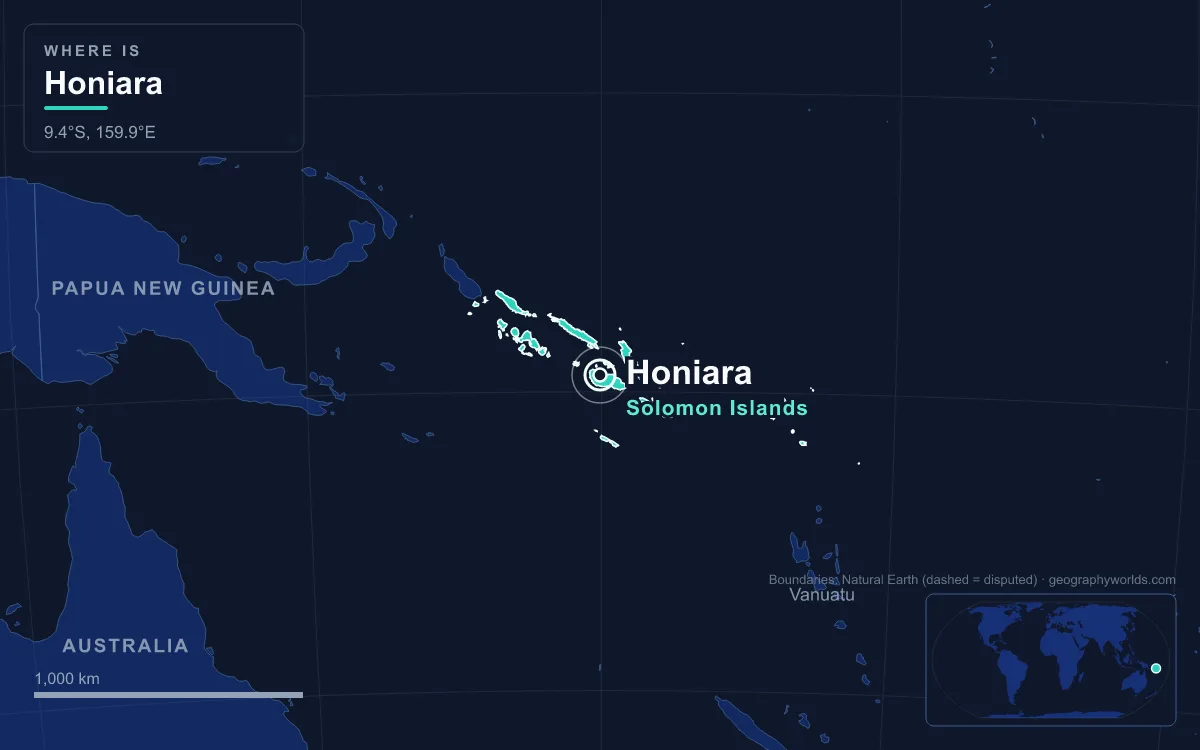
Honiara is the capital and largest city of Solomon Islands. It lies on the northwestern coast of Guadalcanal and faces Iron Bottom Sound, and at the 2019 census it had 129,569 residents, or 169,721 across the wider urban area. The city was built on the ruins of the Second World War. The British moved the protectorate's capital here in 1952 because the Americans had left behind roads, wharves and an airfield after the Guadalcanal Campaign. Today the Honiara capital territory covers about 22 square kilometres. Its history reads most clearly through seven places: a peninsula, an airfield, a ridge-top memorial, a parliament, a Chinatown, a market and a cathedral.
Point Cruz, Where the Name Began
Point Cruz is a small peninsula in the middle of the city. Along with the streets around it, it forms Honiara's central business district. The city's name comes from the Ghari language of Guadalcanal. Naho-ni-ara, often written nagho ni ara, means roughly "facing the east and southeast trade winds", and it originally applied to the land just west of the point.
Honiara was not the first capital. From 1896 to 1942 the British Solomon Islands Protectorate was run from Tulagi, a small island across the sound that officials considered healthier and better isolated than the larger islands. Japan occupied Tulagi in May 1942, and US Marines took it back in heavy fighting that August. After the war the Protectorate Government first set up at Lungga Plantation, then moved to Point Cruz, where a long-leaf secretariat building held the post office and telecommunications office opposite today's Central Police Station. Government buildings began opening in Honiara in January 1952, and the capital move became official that year. In March 1959 the royal yacht Britannia tied up at the Point Cruz wharf for a visit by Prince Philip.
Today Point Cruz holds the seaport, government and business offices, the Central Police Station and the Point Cruz Yacht Club, whose clubhouse was opened in August 1964. The National Museum stands opposite the Mendana Hotel on Mendana Avenue, the city's main thoroughfare. It opened officially in June 1969 but grew from collections started in 1951, and it was looted during the unrest of 1999 to 2003.
Henderson Field and the Lunga Plain
Roughly 8 to 11 kilometres east of the centre, depending on where you measure from, across the Lunga River, is Honiara International Airport. It was built as Henderson Field, and it is the reason Honiara exists. In May 1942 Japanese engineers surveyed the flat land at Lunga Point for an airfield, and construction units arrived on 6 July. From there, aircraft could patrol the shipping lanes to Australia. Allied coastwatchers reported the work. On 7 August 1942 US Marines landed on Guadalcanal, Tulagi and Florida Island and captured the nearly finished strip.
The Americans named the airfield after Major Lofton Henderson, a Marine aviator killed leading his squadron at the Battle of Midway. For six months the Japanese tried to take it back. The Battle for Henderson Field in October 1942 was the last of three major Japanese land offensives. The Guadalcanal Campaign ran from 7 August 1942 until the Japanese evacuated from Cape Esperance in February 1943. It was one of the turning points of the Pacific War. American engineers left behind a network of roads, camps and wharves along the coast. That infrastructure is what persuaded the British to build their new capital beside the airfield rather than return to Tulagi.
The airfield is still the country's main international gateway, with Munda in Western Province as its alternate. Its terminal ceiling was damaged by a magnitude 7.0 earthquake centred 57 kilometres southwest of Honiara on 22 November 2022. The Kukum Highway links the airport to the city and forms Honiara's main east–west spine.
Skyway Drive and the Guadalcanal American Memorial
On a hillock off Skyway Drive, with Honiara spread out to its north, the Guadalcanal American Memorial looks out over Iron Bottom Sound, which Allied sailors named for the many ships and planes that sank there. It was dedicated on 7 August 1992, the 50th anniversary of the Red Beach landings. The memorial was a joint project of the American Battle Monuments Commission and the Guadalcanal–Solomon Islands Memorial Commission. Red marble tablets inside the compound describe the campaign. A ceremony is held there every 7 August.

Honiara remembers the war from more than one side. Japanese veterans built the Solomons Peace Memorial Park in memory of everyone killed in the war, and another Japanese monument stands on Mount Austen. A memorial in town honours Sergeant Major Jacob Vouza, a Solomon Islander who was tortured by Japanese soldiers, escaped, and lived to tell his story. Between the National Museum and the police station stands "Pistol Pete", a 155-millimetre Japanese howitzer that once shelled Henderson Field. Wrecks of a Japanese ship sunk on 23 October 1942 still lie in the shallows east of the Mataniko River mouth.
The Cone-Shaped Parliament Above Hibiscus Avenue
The Parliament of Solomon Islands meets in a cone-shaped concrete building on the hill above Hibiscus Avenue, about a quarter of a mile south of Point Cruz. It was built with American aid, although a Japanese firm did the construction, and it was inaugurated in 1993. Inside, the dome is decorated with tapestry, frescoes and traditional artwork. The chamber holds 50 members elected for four-year terms in single-seat constituencies. Three of those seats belong to the city: East, Central and West Honiara. They are among only six constituencies in the country with more than 10,000 voters.
In 2021 the building became the focus of the country's political anger. In 2019 the government of Manasseh Sogavare switched diplomatic recognition from Taiwan to the People's Republic of China. On 24 November 2021 a protest by the group Malaita for Democracy turned violent, and protesters tried to storm Parliament to force him out. Buildings next to the parliament were burned to the ground, and the city was placed under a 36-hour lockdown. Australia, Papua New Guinea, Fiji and New Zealand sent police and troops. Sogavare survived a no-confidence vote on 6 December 2021.
Chinatown on the Mataniko River
The Mataniko River runs through the city past Chinatown, whose high porches have been said to make it look like an "Asian Wild West". The district has been at the centre of Honiara's worst days. From the late 1990s, fighting between the Malaita Eagle Force and Guadalcanal's Isatabu Freedom Movement turned the city into a battleground, and a coup attempt came in June 2000. Two New Zealand diplomats were among those murdered in March 2002. In July 2003 the Regional Assistance Mission to Solomon Islands (RAMSI), an Australian-led mission backed by the Pacific Islands Forum, arrived to restore order.
In April 2006 riots followed the election of Snyder Rini as prime minister. They destroyed much of Chinatown, left more than 1,000 Chinese residents homeless and gutted the Pacific Casino Hotel. Three MPs were arrested, and Rini resigned on 26 April 2006, just before he was due to face a no-confidence motion. Rebuilding took years. In November 2021, during the protests over the switch to China, Chinatown was looted and burned again, fifteen years after the first time.
Honiara Central Market on Iron Bottom Sound
If Parliament is where the country is governed, the Central Market is where it comes together. The market has dominated the Solomon Islands' internal trade since the 1950s. The Honiara City Council runs it, along with a second market at Kukum. It has its own frontage on Iron Bottom Sound, so fishermen can bring their catch straight up a boat ramp to the stalls. Produce arrives from across the country: fish, fruit and vegetables, fresh coconut water, flowers, and shell money and other crafts.

In 2014 the market had around a thousand vendors, and about 80 per cent of them were women. Some of them travel to Honiara for a while just to sell. The market is seen as a meeting place for the country's many ethnic groups. Honiara is also where Pijin took hold: it became the city's principal language in the 1960s and spread from the capital to become the main language spoken across the islands. Waste has been a long-running problem. About 94 per cent of the market's rubbish is compostable, and all of it goes to the Ranadi landfill.
Holy Cross Cathedral and the Mendaña Cross
On a ridge east of the centre, known as Vavaya Ridge or Cathedral Hill, stands Holy Cross Cathedral, the seat of the Catholic Archdiocese of Honiara. The site was chosen because it was believed to be where Mendaña's expedition set up the first Christian cross in the Solomons in 1568, and where one of his friars said the first Mass in the islands. A Quonset hut left over from the war served as the first pro-cathedral from 1957. A brick from the first Catholic mission in the Solomons, founded in 1845, was set into its façade. The permanent cathedral's foundation stone was laid in 1976, and the building was consecrated in 1978. That was the same year Pope John Paul II made Honiara a metropolitan archdiocese and, in July, Honiara became the capital of an independent Solomon Islands.

Its style has been called Pacific architecture, and the carving on the altar and lectern draws on local traditions. The cathedral is one of several major churches in a predominantly Christian city. The Anglican Cathedral Church of St Barnabas, consecrated in 1969, seats about nine hundred people, and Honiara is also the headquarters of the South Seas Evangelical Church, the United Church and the Seventh-day Adventists. In November 2023 the city hosted the Pacific Games for the first time, and the host nation won 78 medals, its best result.
For wider context, the Solomon Islands country guide covers the archipelago beyond Guadalcanal. The comparison with Papua New Guinea sets the country against its much larger Melanesian neighbour. If you are planning a trip to see these sites, the rainy season from November to April matters, and our guide to the best time to visit Solomon Islands will help you decide when to go.
Quick Facts About Honiara
- Country: Solomon Islands
- Continent: Oceania
- Country population: approximately 858 thousand
- Capital city status: Honiara is the capital of Solomon Islands, the seat of national government, and the location of foreign embassies, parliament, and the head of state's official residence.
Frequently Asked Questions
What is the capital of Solomon Islands?
The capital of Solomon Islands is Honiara. Honiara is the seat of national government, hosts most foreign embassies and consulates, and is typically where the head of state and parliament are located.
What continent is Honiara in?
Honiara, the capital of Solomon Islands, is located in Oceania. As Solomon Islands's capital, Honiara serves as the country's primary connection to the broader Oceanian political, economic, and cultural sphere.
Why is Honiara the capital of Solomon Islands?
Honiara was chosen as the capital of Solomon Islands for reasons that typically combine geography, history, and politics. Capital city selections often reflect a desire for centrality (being accessible from across the country), historical importance (being a longstanding seat of government or culture), or neutrality (being acceptable to multiple regions or ethnic groups within the country). The specific reasons for Honiara's designation are detailed in the city's history above.
What is Honiara known for?
As the capital of Solomon Islands, Honiara is best known for housing the country's central government institutions — parliament, presidential or royal residences, supreme court, and key ministries. It is also typically a major cultural and economic center within Solomon Islands, hosting national museums, embassies, and signature monuments. The introduction and history sections above provide detailed coverage of the city's specific notable institutions and landmarks.
Related Pages
- Solomon Islands Country Guide — full geography, climate, economy, and culture overview
- Flag of Solomon Islands — meaning, history, and design of Solomon Islands's national flag