

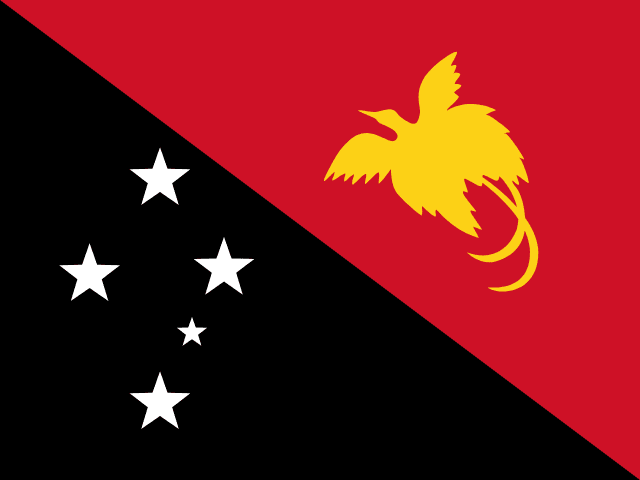
Few national flags carry a story as charming as Papua New Guinea's. Split corner to corner into bold halves of red and black, it pairs a golden bird of paradise in flight with the five white stars of the Southern Cross. It is striking, instantly recognisable, and unusually personal: the winning design came from the hand of a teenage schoolgirl rather than a committee of officials. Adopted in 1971, four years before the nation gained full independence, the flag has become one of the most beloved emblems in the Pacific and a quiet point of national pride for a country of staggering cultural diversity.
A Flag Divided Diagonally
The first thing the eye registers is the diagonal split. A line runs from the upper hoist corner down to the lower fly corner, carving the rectangle into two triangles. The upper triangle, nearest the flagpole, is black; the lower triangle is a deep, vivid red. This diagonal arrangement is what vexillologists call a per bend division, and it gives the flag a sense of movement and energy that a simple horizontal stripe could never match.
Each half then carries its own emblem. On the black upper triangle, the five stars of the Southern Cross appear in white, arranged just as they sit in the southern night sky. On the red lower triangle, a stylised yellow bird of paradise soars with its tail feathers streaming behind it. The contrast of warm gold against deep red, and crisp white against black, makes the whole composition feel balanced despite its asymmetry.
What the Colours and Symbols Mean
The four colours of the flag, red, black, yellow and white, were not chosen at random. Red is widely understood to represent the blood of the people and the sacrifices made for the nation. Black stands for the people of Papua New Guinea themselves, an acknowledgement of the Melanesian population who have inhabited these islands for tens of thousands of years.
The yellow bird of paradise is the soul of the design. The bird of paradise is Papua New Guinea's national bird, found in the dense rainforests of the highlands and lowlands, and prized across the country for its dazzling plumage. Its presence on the flag links the young nation to its natural heritage and to the cultural traditions in which the bird's feathers feature in ceremonial dress. The white of the Southern Cross, meanwhile, ties the country to the wider southern hemisphere and the seas of the South Pacific, while the constellation itself is a symbol of guidance and shared geography with neighbouring nations.
How the Flag Came to Be
The flag's origin is the detail people remember most. In the lead-up to self-government, a national competition was held to choose a design. The winning entry came from Susan Karike, a fifteen-year-old student whose composition married the Southern Cross with the bird of paradise on a red-and-black field. Her design was adopted as the national flag in 1971, ahead of Papua New Guinea's independence from Australian administration in 1975.
What makes the choice so enduring is that it sidestepped the colonial palette. Rather than borrowing the blues, the Union Jacks or the geometric patterns common to flags shaped by European powers, Karike's design reached for symbols rooted in the land itself. The red and black were already meaningful colours in local artistic and ceremonial traditions, and the bird of paradise was an unmistakably home-grown emblem. The flag has remained essentially unchanged since adoption, a rare continuity for a nation that became independent in the turbulent decolonisation years of the mid-twentieth century.
How It Compares to Other Pacific Flags
Papua New Guinea sits within Oceania, and its flag invites comparison with its neighbours, though it stands distinctly apart from them. Many nearby nations, including Australia and New Zealand, also display the Southern Cross, reflecting the constellation that dominates the southern sky across the region. Yet where those flags retain a blue field and a Union Jack in the canton, signalling their British heritage, Papua New Guinea's flag abandons that template entirely.
The red-and-black diagonal split is unusual among world flags, and the soaring bird of paradise is unique to Papua New Guinea, with no other national flag featuring this creature. Compared with the flags of fellow Melanesian nations such as Vanuatu, Fiji or the Solomon Islands, which each take very different colour and layout approaches, Papua New Guinea's design is among the most pictorial and the most immediately legible. The combination of a recognisable animal and a real constellation gives it a storytelling quality that a purely geometric flag lacks.
A Symbol of Unity in a Diverse Nation
Papua New Guinea is one of the most linguistically and culturally diverse countries on Earth, home to hundreds of distinct languages and an extraordinary patchwork of communities spread across rugged highlands, dense forests and scattered islands. In a place where local identity runs deep, the flag offers a shared symbol that belongs to everyone. The bird of paradise and the Southern Cross are emblems no single group can claim above another, which is part of why the design has been embraced so warmly. If you want to understand the country behind the flag, our papua new guinea country guide explores its geography and culture in greater depth.
The flag appears on government buildings, school grounds and official documents, and the bird of paradise motif has spilled well beyond the flag itself, appearing on currency, the national coat of arms and the badges of national institutions. It has become shorthand for the country as a whole.
The Flag in Modern Life
Today the flag is woven into the rhythm of national life. It is raised with particular pride on Independence Day, celebrated each September, when streets, vehicles and clothing across the country bloom with red, black and gold. Sporting events are another stage for the flag: Papua New Guinea is passionate about rugby league, and supporters of the national team, often nicknamed in connection with the bird of paradise, wave the colours fervently at matches at home and abroad.
The flag also travels with the country onto the international stage, flying at regional Pacific gatherings, at the Olympic Games and Commonwealth Games, and outside Papua New Guinea's diplomatic missions around the world. For citizens living overseas, the soaring golden bird is an instant reminder of home.
Interesting Facts About the Flag
- The design was created by Susan Karike, a fifteen-year-old student, making it one of the few national flags credited to a teenager.
- It was officially adopted in 1971, four years before Papua New Guinea's full independence in 1975.
- The bird of paradise is the country's national bird and appears nowhere else on a national flag.
- The five white stars depict the Southern Cross, a constellation shared with several southern-hemisphere flags.
- The diagonal red-and-black division reflects colours long used in the region's ceremonial and artistic traditions.
- The flag has remained unchanged since its adoption, an unusual continuity for a modern nation.
Frequently Asked Questions
When was the flag of Papua New Guinea adopted?
The flag was officially adopted in 1971. This was during the period of self-government, ahead of the country gaining full independence from Australian administration in 1975. It has remained unchanged ever since.
What do the colours and symbols of the flag mean?
The flag uses red, black, yellow and white. Red represents the blood and sacrifice of the people, black stands for the people of Papua New Guinea, the yellow bird of paradise is the national bird and a symbol of natural heritage, and the white Southern Cross links the country to the southern sky and the wider Pacific.
Who designed the Papua New Guinea flag?
The flag was designed by Susan Karike, who was a fifteen-year-old student at the time. Her entry won a national design competition, making the flag a rare example of a national emblem created by a teenager rather than an official body.
What continent is Papua New Guinea on, and how does its flag compare to similar ones?
Papua New Guinea is part of Oceania, in the southwest Pacific. Like Australia and New Zealand, its flag features the Southern Cross, but unlike those flags it has no Union Jack and no blue field. Its diagonal red-and-black layout and unique bird of paradise emblem set it firmly apart from its regional neighbours.