
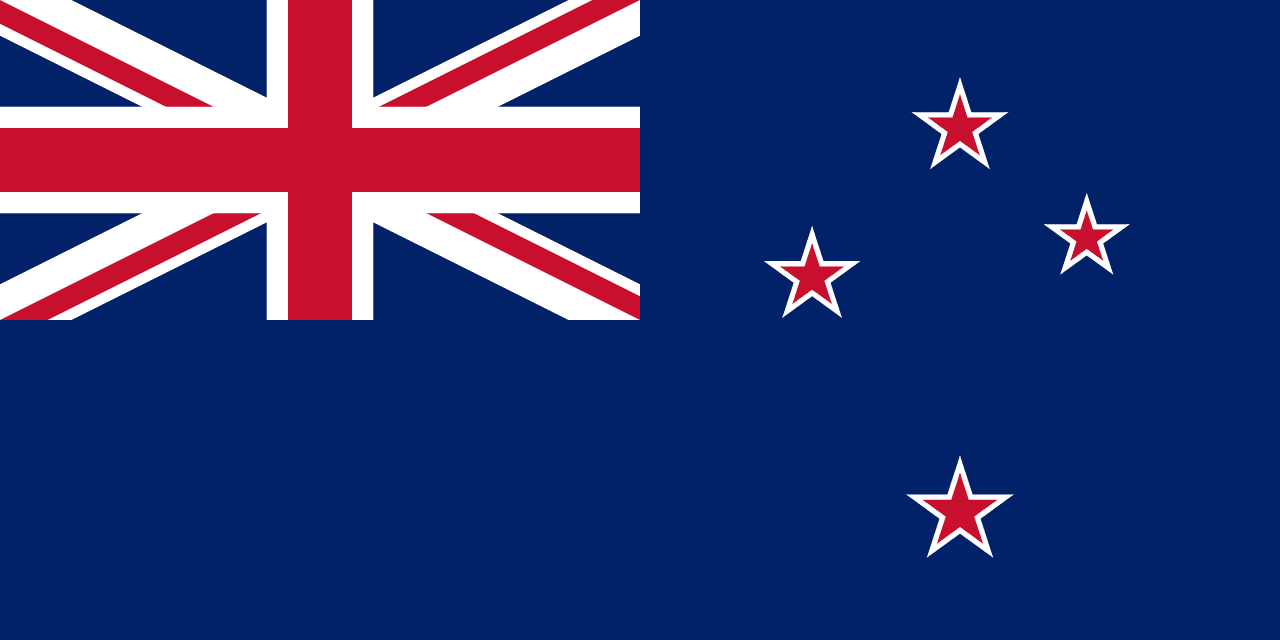
Flutter a New Zealand flag in a stiff Pacific breeze and you are looking at a small piece of imperial history stitched onto a deep blue field. In the upper corner sits the Union Jack; off to the right, four red stars trace the constellation that Southern Hemisphere sailors have navigated by for centuries. It is a quiet, restrained design, easy to overlook on first glance, yet it carries layers of meaning about where the country came from, the seas that surround it, and the long conversation New Zealanders have had with themselves about what their national emblem should be. Officially adopted in 1902, this blue ensign remains the recognised flag of New Zealand today.
A Field of Blue, the Union Jack, and Four Red Stars
The flag uses just three colours, but each one does deliberate work. The background is a rich royal blue, evoking the wide ocean that frames the islands and the sky above them. In the canton, the top-left quarter, sits the Union Jack, rendered in its own red, white, and blue, marking New Zealand's historical ties to Britain and its origins as a Crown colony. To the fly side, the four stars are red outlined in white, a colour pairing that keeps them crisp and legible against the dark blue ground. Blue, red, and white together give the flag a maritime, ensign-like character that was deliberate from the start, since the design grew out of naval signalling traditions rather than land-based heraldry.
How the Pieces Fit Together
Understanding the layout helps explain why the flag reads the way it does. It is a blue ensign, a standard British template in which a plain blue field carries the Union Jack in the canton and a distinguishing badge in the fly. New Zealand's distinguishing badge is the cluster of four stars representing the Southern Cross, the small but unmistakable constellation visible across the southern night sky. Crucially, New Zealand shows four stars rather than five, and the four are sized slightly differently to mirror the relative brightness of the actual stars. The stars sit grouped toward the right half of the flag, balancing the visual weight of the Union Jack in the opposite corner so the whole design feels settled rather than lopsided.
From Colonial Ensign to National Flag
The flag did not appear fully formed. It descended from the colonial blue ensigns that British territories flew in the nineteenth century, each customised with a local badge. New Zealand experimented with several versions of that badge before the Southern Cross was settled upon, and for a time the stars were accompanied by letters or other markings. The familiar arrangement of four red stars on the blue ensign was given formal standing in 1902, when legislation confirmed it as the national flag. What began as a maritime and official ensign gradually became the everyday symbol flown over public buildings, schools, and ceremonies, its colonial roots slowly absorbed into a broader sense of national belonging.
Cousins and Look-Alikes Across the Southern Seas
New Zealand's flag is famously easy to confuse with Australia's, and the resemblance is not accidental. Both are blue ensigns born of the same British template, both place the Union Jack in the canton, and both feature the Southern Cross. The reliable way to tell them apart is to study the stars. New Zealand shows four red stars edged in white, each with five points. Australia shows six white stars, including a large seven-pointed Commonwealth Star beneath the Union Jack and a Southern Cross of differing point counts. So Australia's flag is busier and entirely white-starred, while New Zealand's is sparer and uses red. Other ensign-style flags, such as those of Fiji or various former British territories, share the same canton-and-badge logic, which is why so many flags of the region rhyme visually while remaining distinct in their details.
What the Flag Says About National Identity
For many New Zealanders the flag is bound up with the country's story as a Pacific nation with deep British institutional roots, a country that took the Westminster system and the English language but planted them in islands shaped by Maori culture and a unique natural world. The Southern Cross stars locate the nation firmly in the Southern Hemisphere and on the map of the wider Pacific, while the Union Jack acknowledges the constitutional heritage of the Crown. That dual character has made the flag a subject of genuine national debate, since some feel it speaks more to colonial origins than to a fully independent modern identity. Anyone curious about the islands, their landscapes, and their layered cultural makeup can explore more in our new zealand country guide.
The Flag in Modern Life and the 2016 Referendum
Today the flag appears wherever the nation represents itself: on government buildings, at international sporting fixtures, on naval and merchant vessels, and at ceremonies of remembrance such as Anzac Day. Its most dramatic recent moment came in the mid-2010s, when the country held a two-stage referendum on whether to replace it. Alternative designs were proposed, several of them featuring the silver fern, a beloved national emblem long associated with New Zealand sport. After a spirited public conversation, voters chose to keep the existing blue ensign in 2016, deciding that continuity and recognition outweighed the appeal of a fresh design. The episode left the flag unchanged but sharpened public awareness of what it symbolises.
Interesting Facts About New Zealand's Flag
- It is a blue ensign, a British naval template adapted with a local badge rather than an entirely original design.
- The four stars depict the Southern Cross, and they are deliberately sized to reflect the relative brightness of the real stars.
- New Zealand uses four stars, while neighbouring Australia uses six, the most reliable way to tell the two flags apart.
- The stars are red with white edging, a detail that keeps them sharp against the deep blue field.
- A 2016 referendum gave voters the chance to change the flag, but the historic design was retained.
- New Zealand lies in Oceania, in the southwestern Pacific, which is why a southern constellation sits at the heart of its emblem.
Frequently Asked Questions
When was the New Zealand flag adopted?
The current design was formally adopted in 1902, when legislation confirmed the blue ensign with the Union Jack and four red Southern Cross stars as the national flag. Its components, however, evolved earlier from the colonial blue ensigns that British territories flew during the nineteenth century.
What do the colours and stars on the flag mean?
The blue field evokes the surrounding ocean and sky, the Union Jack represents New Zealand's British heritage and constitutional ties to the Crown, and the four red stars form the Southern Cross, the constellation that anchors the country in the Southern Hemisphere.
Who designed the New Zealand flag?
The flag was not the creation of a single celebrated designer but grew out of the standard British blue ensign system, which territories customised with their own badges. New Zealand's contribution was the four-star Southern Cross badge, refined over time before being fixed in law in 1902.
What continent is New Zealand on, and how does its flag compare to similar ones?
New Zealand sits in Oceania, in the southwestern Pacific Ocean. Its flag closely resembles Australia's because both are blue ensigns showing the Union Jack and the Southern Cross. The clearest difference is the stars: New Zealand has four red stars edged in white, while Australia has six white stars including a large Commonwealth Star.