
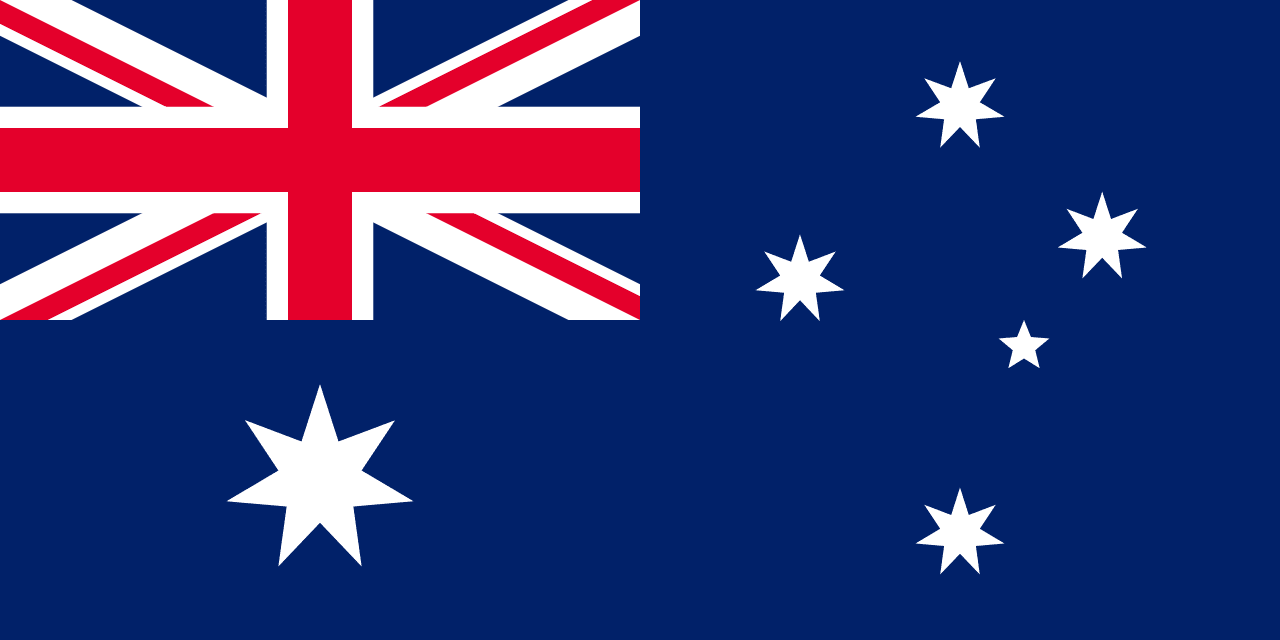
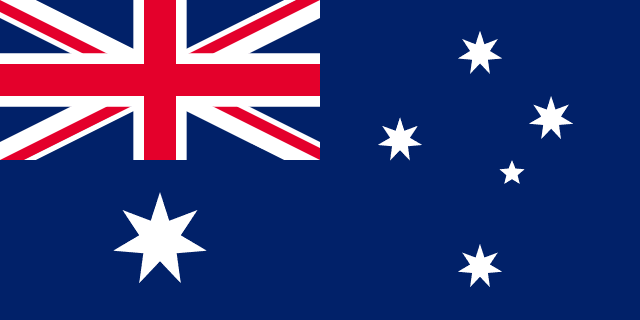
Few national flags pack as much narrative into a single rectangle as the flag of Australia. Glance at it and you see three distinct stories stitched together: a British Union Jack tucked into the upper hoist, a large seven-pointed star floating beneath it, and the unmistakable Southern Cross constellation strung across the fly. It is a deep blue ensign in a 1:2 proportion, decorated entirely in white and the red, white and blue of the Union Jack. Understanding why those elements sit where they do reveals a great deal about how Australia sees its past, its geography and its place in the wider world.
A Banner Born From a Competition
The flag's origins are unusually democratic for a national emblem. In 1901, the year the Australian colonies federated into a single Commonwealth, a public design competition was announced. It drew an extraordinary response: more than 32,000 entries arrived from across the country, including submissions from schoolchildren and amateur artists. Rather than crown a single winner, the judges found that five different people had independently arrived at strikingly similar designs, and the prize was shared among them.
The chosen design was first flown on September 3, 1901, in Melbourne, then the seat of the new federal government. The flag did not stay frozen, though. Early versions of the central star had only six points. In 1908 a seventh point was added so the star could represent the territories alongside the six states. For decades the blue ensign coexisted with other versions and was used in various official contexts, and it was only formalised as the national flag with the Flags Act of 1953, which took effect in 1954. That date, rather than 1901, marks the flag's legal birth as Australia's official symbol.
Reading the Colors
The palette is restrained and deliberate: blue, white and red. The dominant blue field gives the flag its character as an ensign, a maritime tradition Australia inherited from Britain, where blue ensigns were flown by government and naval vessels. The red, white and blue of the Union Jack carry their own British heritage, while the white of the stars stands out cleanly against the dark background.
It is worth noting that the colors here are not assigned the kind of one-to-one symbolic meanings you find in some flags, where a particular hue stands for blood or peace or sunshine. Instead the meaning lives in the symbols themselves: the constellation, the federation star and the inherited British jack. The blue, then, is best read as the night sky and the surrounding ocean, the canvas on which Australia's identity is sketched.
The Design, Element by Element
Three components share the field. In the upper hoist canton sits the Union Jack, a direct acknowledgement of the country's foundation as a set of British colonies and its continuing constitutional ties. Directly below it is the Commonwealth Star, also called the Federation Star, with its seven points: six for the founding states and a single point for the territories collectively.
The right-hand half, or fly, carries the Southern Cross, the constellation that hangs over the entire Southern Hemisphere and has guided navigators for centuries. A small but charming detail rewards close inspection: the stars are not identical. The four larger outer stars of the cross each have seven points, matching the Commonwealth Star, while the smallest inner star, representing Epsilon Crucis, has only five points. That deliberate asymmetry mirrors the real difference in brightness between the stars of the actual constellation.
Cousins and Look-Alikes
Australia's flag belongs to a recognisable family of blue ensigns, and it is genuinely easy to confuse with several relatives. The closest sibling is the flag of New Zealand, which also places the Union Jack in the canton and the Southern Cross on the fly. The two are most reliably told apart by their stars: New Zealand uses four red stars edged in white, all five-pointed, while Australia uses six white stars including the large Commonwealth Star beneath the jack, which New Zealand omits entirely. The shared design has periodically fuelled calls in both nations to differentiate the two more clearly.
Other members of the extended family include the flags of Fiji and Tuvalu, both of which retain a Union Jack canton on a lighter blue field reflecting their Pacific setting, and of course the United Kingdom itself, whose Union Jack is the common ancestor. What ultimately distinguishes Australia's version is the combination of the dark navy ensign, the seven-pointed federation star and the precise arrangement of the Southern Cross, a fingerprint shared by no other country.
A Symbol With an Open Question
For many Australians the flag is a focus of genuine pride, flown and worn most visibly on Anzac Day, which honours the nation's war dead, and on Australia Day on January 26. Yet the flag also sits at the centre of an ongoing national conversation. Some argue that the Union Jack ties the country too tightly to its colonial origins and does not reflect a modern, multicultural Australia or acknowledge Aboriginal and Torres Strait Islander peoples, who have their own flags now recognised as official alongside the national flag. Others are deeply attached to the current design; a 2016 poll found that 64% of Australians wanted to keep it. That tension between heritage and renewal is itself part of the flag's living story. Readers curious about the broader national context can explore our australia country guide.
The Flag in Everyday and Public Life
Beyond commemorations, the flag is woven into the rhythm of Australian public life. It flies over Parliament House and government buildings, drapes coffins at state funerals, and appears at citizenship ceremonies welcoming new Australians. It is perhaps at its most exuberant in sport: it is waved by the thousands at the Olympic Games and the Commonwealth Games, painted on faces and wrapped around shoulders whenever Australian athletes take the field. The country also marks Australian National Flag Day each year on September 3, the anniversary of that first flying in Melbourne in 1901, a quiet nod to the flag's beginnings.
Quick Facts Worth Knowing
- The 1901 design competition attracted over 32,000 entries, with five people sharing the winning prize.
- The Commonwealth Star began with six points; a seventh was added in 1908 to represent the territories.
- The smallest star of the Southern Cross, Epsilon Crucis, has only five points while the four larger stars have seven.
- Australia officially recognises the Aboriginal flag and the Torres Strait Islander flag as flags of the nation.
- The flag uses a 1:2 ratio, twice as wide as it is tall, a proportion typical of British ensigns.
Frequently Asked Questions
When was the Australian flag adopted?
The design was first flown on September 3, 1901, but it became the official national flag only with the Flags Act of 1953, which came into effect in 1954. That is why 1954 is usually cited as the flag's official adoption year.
What do the stars on the flag mean?
The large seven-pointed star beneath the Union Jack is the Commonwealth or Federation Star, with six points for the original states and one for the territories. The five stars on the fly form the Southern Cross, a constellation visible across the Southern Hemisphere that situates Australia geographically.
Who designed the Australian flag and on what continent is Australia?
No single person designed it. A 1901 competition produced five near-identical winning entries, and the prize was shared among those five designers. Australia is the principal nation of Oceania, a region in the Southern Hemisphere and the southeastern part of the world.
How is the Australian flag different from New Zealand's?
Both flags share a blue field, a Union Jack canton and the Southern Cross. The differences lie in the stars: New Zealand uses four red, white-edged five-pointed stars and no federation star, whereas Australia uses six white stars including the large seven-pointed Commonwealth Star beneath the jack.