
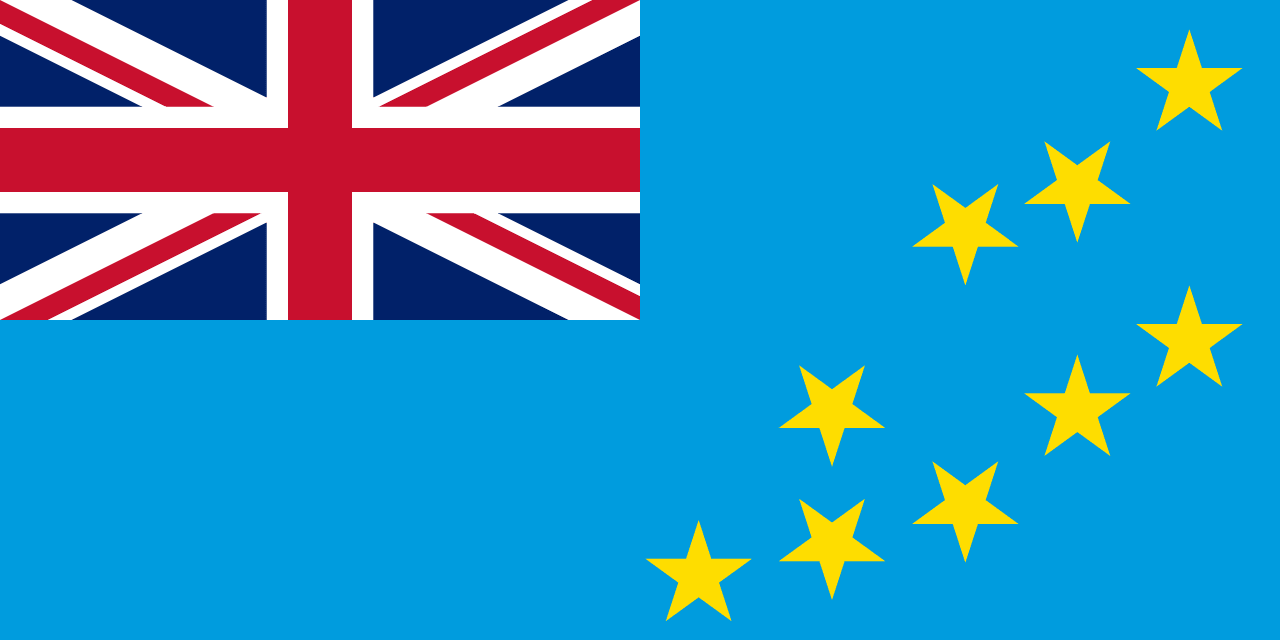
Few national flags wear their geography quite so literally as the flag of Tuvalu. Scattered across a field of light blue are nine yellow stars, and their placement is not decorative whimsy but a working map: each star marks one of the country's nine islands, arranged so that their positions on the cloth mirror their positions in the Pacific Ocean. Adopted in its current form in 1997, this is the banner of one of the smallest and most remote nations on Earth, a string of low-lying coral atolls roughly midway between Hawaii and Australia. It is a flag that tells you, at a glance, exactly what Tuvalu is and where its islands sit.
A Field of Sky and Sea
The dominant color of the Tuvaluan flag is light blue, a paler, brighter shade than the deep navy found on many ensigns. For a nation whose total land area is tiny and whose horizon is dominated by ocean and sky, the choice feels inevitable. The light blue evokes the warm tropical waters of the central Pacific and the open sky above the atolls, the two elements that define daily life in Tuvalu more than any landmass could. Against this gentle backdrop, the design uses three further colors: yellow for the nine stars, and the red, white, and blue of the Union Jack tucked into the upper corner. Together these four colors, light blue, yellow, red, and white, give the flag both its airy openness and its sharp, legible focal points.
Reading the Design
Structurally, the flag follows the familiar pattern of a British-derived ensign. In the upper hoist corner, the part called the canton, sits the Union Jack, a reminder of Tuvalu's long ties to Britain. The remaining and far larger portion of the flag, the fly, carries the nine yellow stars spread across the light blue field. What sets the layout apart from other ensigns is the deliberate scattering of those stars. They are not lined up in neat rows or gathered into a tidy cluster; instead they fan out across the cloth in a pattern that corresponds to the real geographic spread of the islands, with the flag oriented so that east points toward the top. The result is a chart as much as an emblem.
What the Nine Stars Mean
The heart of the flag's symbolism lies in those nine stars. Each one stands for a single island of Tuvalu, and the country's very name reinforces this: Tuvalu is commonly translated as "eight standing together," a phrase rooted in the eight traditionally inhabited islands. The ninth island, long sparsely populated, was eventually counted among the nation's number, and the flag's nine stars reflect that fuller tally. By giving every island its own star and placing each star where the island actually lies, the design makes a quiet but powerful statement: no island is more central than another, and the nation is precisely the sum of its scattered parts. It is one of the rare flags whose imagery doubles as a literal locator map of the territory it represents.
How the Flag Evolved
Tuvalu's flag has a history more eventful than its serene appearance suggests. The country, formerly known as the Ellice Islands, became independent in 1978 and adopted its star-studded light blue ensign at that time. For nearly a decade and a half the design served without controversy. Then, in the mid-1990s, a change of government brought a push to redesign the flag, partly out of a desire to reduce the prominence of the colonial-era Union Jack. A revised banner was introduced, but it proved unpopular with many Tuvaluans, who had grown attached to the original. The debate was resolved when the familiar design was brought back, and the version restored in 1997 is essentially the flag flying today. That episode is a reminder that even in a very small country, a flag is a contested and cherished object, not merely an administrative detail.
Cousins and Look-Alikes
Because it uses a British ensign template, Tuvalu's flag belongs to a broad family of Commonwealth and Pacific flags that share the same basic anatomy. Fiji, for instance, also flies a light blue ensign with the Union Jack in the canton, and a casual glance might confuse the two from a distance. The distinguishing features are clear up close: Fiji places a shield of arms in its fly, whereas Tuvalu uses its constellation of nine yellow stars and nothing else. Other star-bearing Pacific and Oceanian flags, such as those of Australia, New Zealand, and Papua New Guinea, also feature stars on blue grounds, but each uses a different configuration, most commonly the Southern Cross. Tuvalu stands apart because its stars are neither a famous constellation nor an abstract count: they are a cartographic portrait of the country itself. For a fuller picture of the nation behind the banner, see our tuvalu country guide.
Identity, Civic Life, and the Wider World
For a nation of fewer than a dozen square kilometres of dry land, the flag carries outsized weight. It flies over government buildings on the capital atoll of Funafuti, appears on official documents and at national celebrations, and travels the world with Tuvaluan athletes at events like the Pacific Games and the Olympics, where the small delegation marches under the same nine stars. In international forums, where Tuvalu has become a prominent voice on rising sea levels and climate change, the flag has taken on an added resonance: those nine low-lying islands are among the most vulnerable places on the planet to a rising ocean, lending the blue field and its scattered stars a poignant, almost urgent meaning. The banner that maps the islands has become, in a sense, a plea to keep them on the map at all.
Quick Facts at a Glance
- Continent / region: Oceania, in the central Pacific Ocean.
- Colors: Light blue field, nine yellow stars, and the red, white, and blue of the Union Jack.
- Current version adopted: 1997, restoring the earlier independence-era design.
- Stars: Nine, one for each island, arranged to match the islands' real positions.
- Meaning of the name: Tuvalu is often translated as "eight standing together."
- Closest look-alike: Fiji's light blue ensign, distinguished by its shield rather than stars.
Frequently Asked Questions
When was the flag of Tuvalu adopted?
Tuvalu first adopted a light blue ensign with nine yellow stars around the time of its independence in 1978. After a redesign and a period of debate in the 1990s, the original-style flag was restored in 1997, and that 1997 version is the one used today.
What do the colors and stars on the flag mean?
The light blue field represents the Pacific Ocean and sky that surround the islands. The nine yellow stars each stand for one of Tuvalu's nine islands, and they are positioned on the flag to reflect the islands' actual geographic locations. The Union Jack in the corner reflects the country's historical ties to Britain.
Who designed the flag of Tuvalu?
The flag emerged through official processes around Tuvalu's independence rather than being credited to a single celebrated designer. It follows the long-established British ensign template, with the distinctive nine-star arrangement developed to represent the nation's islands. After the controversial 1990s redesign was set aside, the familiar version was reinstated in 1997.
What continent is Tuvalu on, and how does its flag compare to similar ones?
Tuvalu lies in Oceania, in the central Pacific Ocean. Its flag resembles other Commonwealth ensigns, most notably Fiji's light blue flag, but it is set apart by its constellation of nine yellow stars mapping the islands, whereas similar flags use shields or the Southern Cross instead.
