
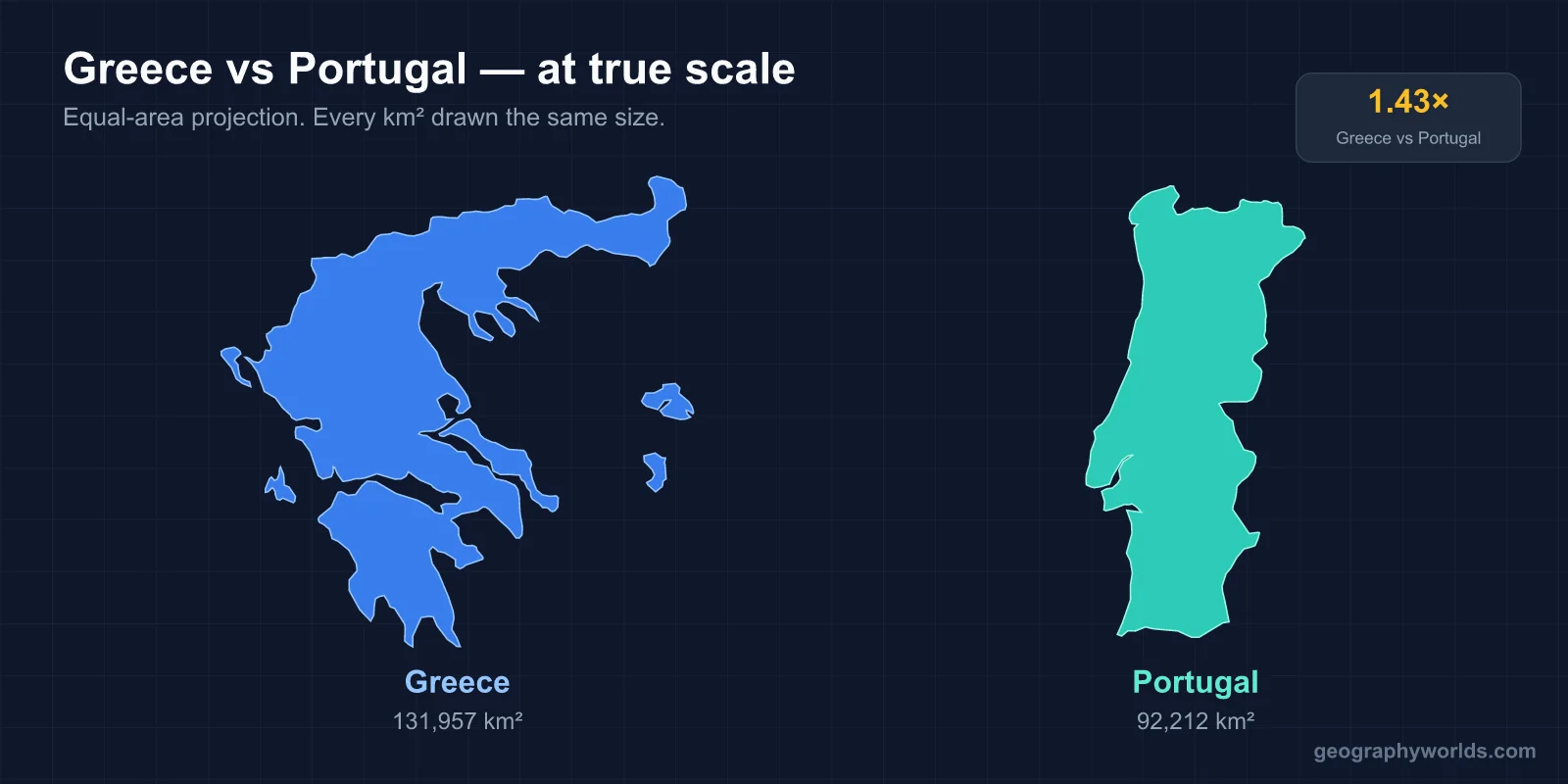
Greece and Portugal sit at opposite ends of southern Europe — Greece in the southeast, Portugal in the southwest. Both have ancient histories, Mediterranean climates (mostly), and are major tourism destinations. So which one is actually bigger by area? Greece — by a significant margin.
The Short Answer
Yes, Greece is bigger than Portugal. Greece covers 131,957 km². Portugal covers 92,212 km². Greece is approximately 43% larger than Portugal.
Side-by-Side Numbers
- Greece area: 131,957 km² (50,949 sq mi)
- Portugal area: 92,212 km² (35,603 sq mi)
- Difference: Greece is ~40,000 km² larger
- Ratio: Greece is ~1.43× the size of Portugal
- Greece population: ~10.4 million
- Portugal population: ~10.3 million
Greece
Greece is in southeastern Europe at the southern tip of the Balkan Peninsula. It borders Albania, North Macedonia, Bulgaria, and Turkey on the mainland, with extensive coastlines along the Aegean Sea (east), the Ionian Sea (west), and the Mediterranean Sea (south). Greece consists of a mainland and over 6,000 islands and islets, of which about 200 are inhabited. The country has one of the longest coastlines in the world relative to its land area — about 13,676 km, including all islands.
Greece is mostly mountainous. The Pindus Mountains run down the spine of mainland Greece; Mount Olympus (2,917 m), the mythological home of the Greek gods, is the highest peak. The country's most famous islands include Crete (the largest), Rhodes, Corfu, Santorini, Mykonos, and many others spread across the Aegean and Ionian seas. Athens, the capital, has about 3.1 million in its metro area; Thessaloniki is the second-largest city.
Portugal
Portugal occupies the western part of the Iberian Peninsula and includes the Atlantic island groups of the Azores and Madeira. The mainland borders only Spain to the east and the Atlantic Ocean to the south and west. Lisbon, the capital, is the largest city with about 2.9 million in its metro area; Porto is the second-largest. Portugal is one of the oldest continuously-existing nation-states in Europe — its borders have been roughly stable since 1297, longer than any other European nation.
Portugal's geography is varied. The north has mountains (Serra da Estrela is the highest mainland peak at 1,993 m), forests, and the Douro Valley's wine country. The center has the Tagus River valley and Lisbon. The south is dominated by the Alentejo plains and the Algarve coast, famous for its beaches and resorts. The country has about 1,800 km of mainland coastline plus extensive island coastlines.
Population
Greece and Portugal have very similar populations — about 10.4 million and 10.3 million respectively. But because Greece is larger by area, its population density is lower (about 79 per km² vs Portugal's 112 per km²). Both countries have aging populations and have experienced significant emigration during economic downturns, though Portugal's population has recently stabilized while Greece's continues to decline. Both have major diasporas — Greek communities in Australia, the US, Canada, the UK, and Germany; Portuguese communities in Brazil, France, the US, Canada, and Switzerland.
Climate
Both countries have Mediterranean climates, but with regional variations. Greece is mostly Mediterranean — hot, dry summers and mild, wet winters across much of the south. The mainland's mountainous interior has continental influences. The Aegean islands are typically warmer and drier; the Ionian islands wetter. Portugal has a Mediterranean climate in the south (the Algarve), gradually shifting to a more oceanic climate in the north. The Azores and Madeira have subtropical maritime climates that stay mild year-round.
Economy
Both economies are mid-sized European economies. Portugal's GDP is about $290 billion; Greece's is about $245 billion. Both have struggled with economic crises (Greek debt crisis 2009–2018; Portugal's austerity period 2011–2014) and have since recovered. Major industries in Greece include tourism (the largest contributor to GDP), shipping (Greek shipowners control about 20% of the world's shipping tonnage), agriculture (olive oil, wine, fruit), and increasingly technology and renewable energy. Portugal's economy includes tourism, manufacturing, agriculture (wine, especially port and Madeira; olive oil; cork — Portugal produces about half the world's cork), and energy.
History
Greece is the birthplace of Western civilization. Ancient Greek city-states — Athens, Sparta, Corinth, Thebes — produced foundational works of philosophy (Socrates, Plato, Aristotle), drama (Aeschylus, Sophocles, Euripides), poetry (Homer), mathematics (Euclid, Archimedes), and political theory (the Athenian democracy). Greece was part of the Roman, Byzantine, and Ottoman Empires for centuries before gaining independence from the Ottomans in 1830.
Portugal has a different but equally consequential history. As one of the first true global empires, Portugal led the European Age of Exploration — Bartolomeu Dias rounded the Cape of Good Hope in 1488, Vasco da Gama reached India in 1498, Pedro Álvares Cabral discovered Brazil in 1500, and Ferdinand Magellan's crew circumnavigated the globe in 1522 (under Spanish flag, but Magellan was Portuguese). The Portuguese Empire spanned Brazil, much of coastal Africa, parts of India, Macau, and East Timor. Portuguese is now spoken by about 280 million people worldwide.
Tourism
Both are major tourism destinations. Greece welcomes about 32 million international visitors per year. Top destinations include the Acropolis in Athens, Delphi, Olympia, Mycenae, the Aegean islands (Santorini, Mykonos, Crete, Rhodes), the Ionian islands (Corfu, Zakynthos), and Mount Athos. Portugal welcomes about 27 million international visitors annually. Top destinations include Lisbon, Porto, the Algarve beaches, the Douro Valley wine country, Sintra, the Azores, Madeira, and Fátima.
Culture and Cuisine
Greek cuisine is one of the foundational Mediterranean diets, emphasizing olive oil, fresh vegetables, fish, lamb, cheese (feta), and herbs. Famous dishes include moussaka, souvlaki, tzatziki, dolmades, baklava, and Greek salad. Greek wine traditions go back thousands of years. Portuguese cuisine is similarly Mediterranean-influenced but with strong Atlantic flavors. Bacalhau (salt cod) is the national dish, prepared in supposedly 365 different ways (one for each day of the year). Other staples include sardines, pastéis de nata (custard tarts), and feijoada. Port wine from the Douro Valley is one of the world's most famous fortified wines.
Diaspora and Global Influence
Both countries have significant diasporas. The Greek diaspora numbers about 5 million worldwide, with major communities in the US (especially New York and Chicago), Australia (Melbourne has more Greeks than any city outside Athens), Canada, and Germany. The Portuguese diaspora is even larger — about 5 million Portuguese-born or descended live abroad, plus about 200 million Brazilians who speak Portuguese as a result of Portugal's colonial history. The Portuguese language is the 6th most spoken in the world.
Languages and Identity
Greek is one of the oldest continuously-spoken languages in Europe, with documented use over more than 3,400 years. Modern Greek descends directly from Ancient Greek, with significant evolution but unmistakable continuity. The language uses a 24-letter alphabet that has remained essentially stable since the 4th century BCE. Portuguese is a Romance language descended from Latin via Vulgar Latin spoken in the Iberian Peninsula. It became distinct from Spanish/Castilian during the medieval period. Today Portuguese is spoken across 9 countries on 4 continents (Portugal, Brazil, Angola, Mozambique, Cape Verde, Guinea-Bissau, East Timor, São Tomé and Príncipe, Equatorial Guinea), making it one of the most geographically spread languages.
Climate Change Pressures
Both countries are climate vulnerable. Greece is on the front line of Mediterranean climate change — record-breaking heat waves, devastating wildfires (the 2023 wildfires burned hundreds of thousands of hectares), increased drought stress, and threats to coastal infrastructure from sea-level rise. The Mediterranean is warming about 20% faster than the global ocean average. Portugal faces similar pressures — increased wildfire risk (the 2017 wildfires killed over 100 people), prolonged droughts that have affected agriculture and water supplies, and threats to coastal regions including parts of Lisbon. Both countries are scaling up renewable energy and climate adaptation, with Portugal in particular emerging as a renewable energy leader.
Key Facts
- Greece is about 43% larger than Portugal by area.
- Both have nearly identical populations (~10.3–10.4 million).
- Greece has over 6,000 islands; Portugal has the Azores and Madeira.
- Both are major tourism destinations.
- Greek is older as a Western civilization; Portuguese has a global colonial legacy.
Fun Facts
- Greece has more archaeological sites than any other country relative to its size.
- Portugal's borders are the oldest stable borders in Europe (since 1297).
- Mount Olympus was the mythological home of the Greek gods.
- Portugal produces about half the world's cork.
- Greek shipowners control about 20% of the world's shipping tonnage.
The Bottom Line
Greece is bigger than Portugal — by about 43%. Both are mid-sized European countries with rich histories, beautiful coasts, and major tourism economies. Greece has more islands and a more storied ancient legacy; Portugal has a more compact mainland and a global colonial legacy.
Quiz Southern Europe!
Test your knowledge of Greece, Portugal, and Mediterranean Europe.
Play Geography Games →