
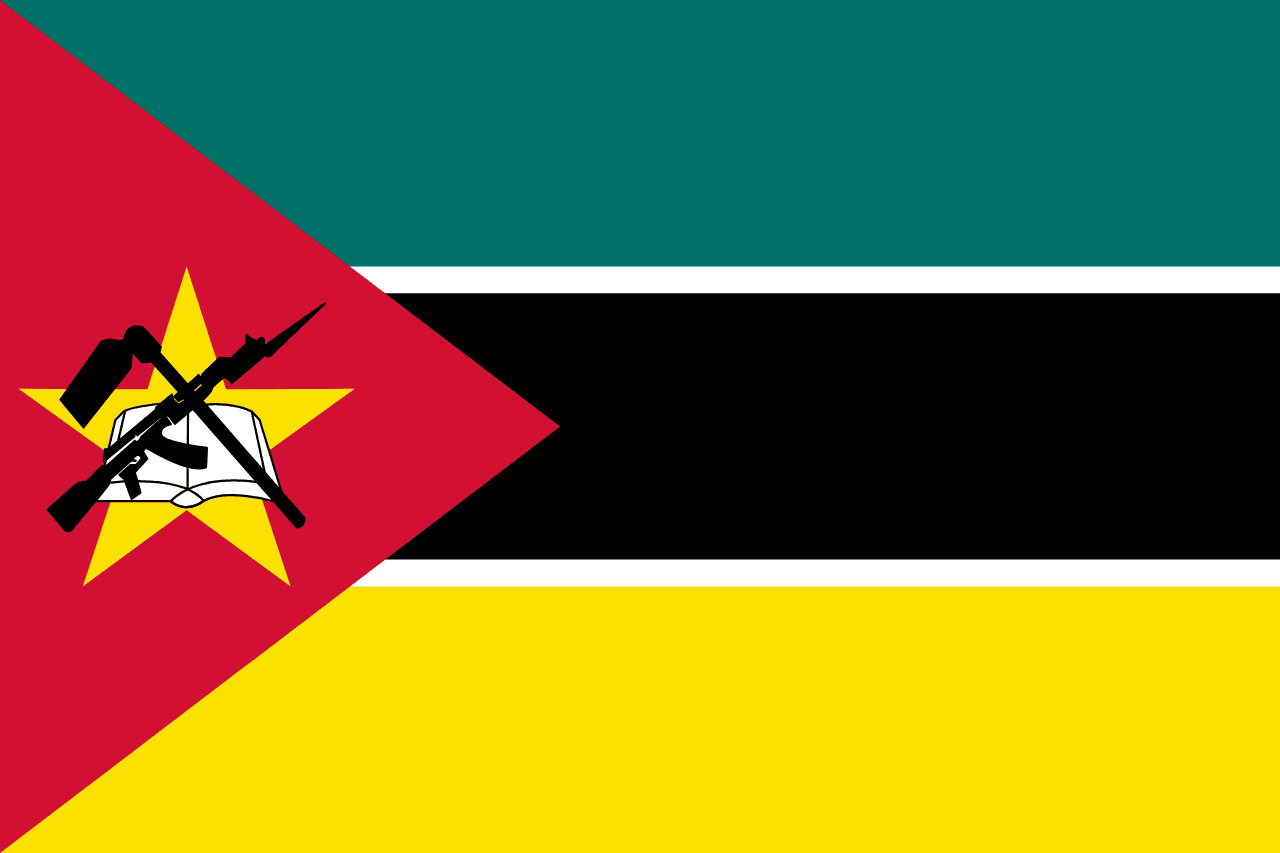
Few national flags spark as much immediate debate as the one that flies over Mozambique. Among the world's banners of stripes, stars, and crests, this is the only one that places a modern assault rifle in plain view — a detail that startles newcomers and fascinates students of vexillology. Yet the flag is far more than that single feature. It is a compact visual essay on a young nation's founding values: knowledge, labour, and hard-won independence. To read this flag is to read the story of a country in southeastern Africa that emerged from a long colonial era determined to define itself on its own terms.
A Banner Built From Five Colours
The Mozambican flag draws on five colours — green, black, yellow, white, and red — a richer palette than most national flags carry. They are arranged as three horizontal bands, separated by thin white fimbriations, with a red triangle anchored at the hoist. Each hue evokes a different facet of the land and its people, forming a deliberate, layered composition rather than a simple tricolour.
Green speaks to the fertility of the soil and the country's agricultural promise. Black represents the African continent and its people. Yellow calls to mind the nation's mineral wealth beneath the earth. White, threaded between the bands, stands for peace and the justice of the struggle for self-rule. Red, filling the triangle, recalls the resistance and sacrifice that accompanied the fight for independence. The colours are not decorative — they were chosen to read like a creed.
The Design and Its Layout
Geometry carries meaning here. From the top, the horizontal stripes run green, black, and yellow, each pair divided by a slim white line. Overlaid at the left edge is the red triangle, and inside that triangle sits the flag's most discussed element: a yellow star bearing an open book, a hoe, and a rifle crossed in front of it. The triangle draws the eye toward the hoist — the side nearest the flagpole — where heraldic tradition places the most important charge.
The open book symbolises education, the hoe stands for the agricultural workforce and rural labour, and the AK-47 represents defence and the armed struggle that secured the nation's freedom. The star itself signals internationalism and the spirit of solidarity. The emblem is dense with intent, packing an entire political philosophy into a single small heraldic device — a reminder that this flag was conceived not merely to identify a state but to declare what that state believes in.
From Liberation Movement to National Symbol
The current flag was officially adopted in 1983, several years after Mozambique gained independence from Portugal in 1975. Its lineage runs directly through FRELIMO, the Front for the Liberation of Mozambique, the movement that led the country to self-rule and then governed it. The national flag was modified from the FRELIMO party flag, which is why the two share such a strong visual family resemblance.
The flag did not arrive fully formed. The banner raised at independence in 1975 already used the green, black, and yellow bands radiating from a red triangle, but it carried a more elaborate central device set on a white cogwheel evoking industry. The 1983 revision settled the emblem into the cleaner yellow star seen today. Rather than reaching for abstract or ancient motifs, the framers chose objects from the lived reality of the independence era — the tools of farming, the means of learning, and the weapon of armed resistance. The flag therefore functions almost as a historical document, freezing in cloth the priorities of the moment a new nation was being built.
How It Compares to Other Flags
Mozambique's flag belongs to a broad family of African banners that lean on the same emblematic palette. Green, black, yellow, and red echo the Pan-African colours popularised across the continent's independence movements. The flags of Angola, Zimbabwe, and Ghana also fold liberation-era symbolism into bold blocks of colour, and Angola — like Mozambique — places tools at its centre, pairing a machete with a cogwheel.
What sets Mozambique apart is unmistakable. No other sovereign state puts a recognisable firearm on its national flag, and certainly not a twentieth-century assault rifle. Where many liberation flags abstract their struggle into a star or a clenched device, Mozambique renders it literally. Place the flag beside any other and the combination of five-colour banding, white fimbriations, and the rifle-bearing star leaves no doubt about which nation it represents — a specificity most flags deliberately avoid.
Identity, Controversy, and Pride
Because the rifle is so visually prominent, the flag has periodically become the subject of national conversation about whether a weapon belongs at the heart of a peaceful country's emblem. Formal proposals to redesign it surfaced in the mid-2000s, when lawmakers debated removing the rifle, yet the flag has endured unchanged. For many Mozambicans, the rifle is not a celebration of violence but an honest acknowledgement of the sacrifices that made independence possible — a refusal to airbrush history.
That tension is part of what makes the flag so distinctive on the world stage. It is unapologetically rooted in a specific historical struggle, and it wears that history openly. Whether one finds it confronting or stirring, it is unmistakably Mozambican. To understand how that identity plays out across the country's regions, cuisine, and landscapes, our mozambique country guide offers a broader portrait of the nation behind the banner.
The Flag in Everyday Life
Across Mozambique, the flag appears in the expected civic settings — government buildings, schools, embassies, and official ceremonies. It is raised on Independence Day, celebrated every 25 June, as well as on observances such as Heroes' Day and Armed Forces Day, when its colours become a backdrop for parades, music, and public celebration. International sporting events bring it into stadiums and onto the shoulders of supporters, where its bold palette stands out vividly against crowds.
Beyond officialdom, the design's strong colours and recognisable emblem make it a natural motif in art, fashion, and everyday displays of patriotism. Schoolchildren learn the meaning of each colour as part of their civic education, so the symbolism is widely understood rather than locked away in protocol manuals. For citizens abroad, the flag serves as an instant marker of home.
Quick Facts Worth Knowing
- It is the only national flag in the world that features a modern assault rifle, the AK-47.
- The flag uses five colours — green, black, yellow, white, and red — more than most national banners.
- Mozambique sits on the southeastern coast of Africa, facing the Indian Ocean.
- The emblem combines a book, a hoe, and a rifle, encoding education, agriculture, and defence in one small star.
- The design was adapted from the flag of the FRELIMO liberation movement.
- It reached its current official form in 1983, refined from the 1975 independence flag.
Frequently Asked Questions
When was the flag of Mozambique adopted?
The flag in its current form was officially adopted in 1983, a few years after the country achieved independence in 1975. It evolved out of the flag used by the FRELIMO liberation movement, which is why the two designs share so much visual DNA.
What do the colours and emblem mean?
Green represents the land and agriculture, black stands for the African continent, yellow signals mineral wealth, white symbolises peace and justice, and red recalls the struggle for independence. Within the red triangle, a yellow star carries an open book (education), a hoe (agriculture and labour), and an AK-47 (defence).
Why does the flag include a gun?
The rifle reflects the armed struggle that secured Mozambique's independence and the principle of national defence. Rather than concealing that history, the designers chose to represent it openly, which is why the flag remains the only national flag to display a modern assault rifle. Periodic redesign proposals have been raised, but the flag has stayed essentially unchanged.
What continent is Mozambique on, and what flags resemble it?
Mozambique is in southeastern Africa, along the Indian Ocean coast. Its layered banding and emblem-bearing star place it among the family of African liberation-era flags, and the colours echo those used widely across the continent's independence movements. Even so, the specific arrangement — and especially the rifle in the emblem — makes it instantly recognisable and unlike any other national flag.
Has the design of the flag ever changed?
Yes. The banner first raised at independence in 1975 used the same colours and triangular hoist but carried a busier central emblem set on a white cogwheel symbolising industry. The 1983 revision streamlined that device into the single yellow star bearing the book, hoe, and rifle that appears today, leaving the broad colour layout intact.