
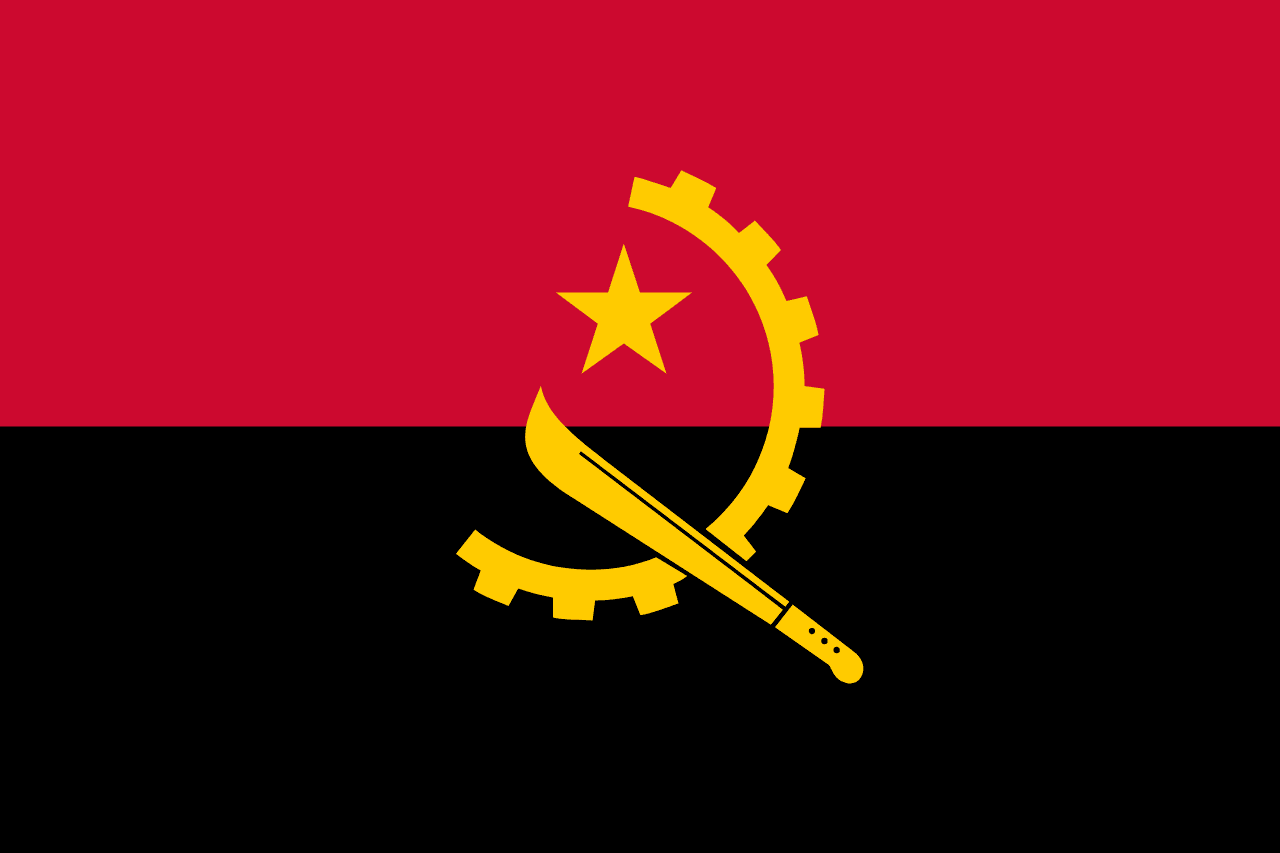
Few national flags wear their origins as openly as Angola's. Adopted in 1975 at the moment the country broke free from centuries of Portuguese rule, the flag pairs two bold horizontal bands with a striking yellow emblem at its heart. It is a banner born of revolution, and every element was chosen to tell the story of a people who fought for self-determination. The flag remains one of the most distinctive in Africa, instantly recognizable for the machete and half cogwheel that sit where many other countries place a star or a coat of arms.
A Flag Forged at Independence
When Angola declared independence on November 11, 1975, it did not have the luxury of a long, deliberative design process. The flag that rose over the new nation was based directly on the banner of the Movimento Popular de Libertação de Angola, or MPLA, the liberation movement that took power as the Portuguese departed. That party's red-and-black colors and emblematic imagery were carried almost wholesale onto the national flag, which is why it reads so unmistakably as a product of its independence struggle rather than a neutral civic symbol stitched together by committee.
This lineage matters. Many flags of the African independence wave drew on pan-African colors, but Angola's leaned into the iconography of a workers' and farmers' revolution, producing a design that feels both continental and ideological at once.
Rival liberation movements, chief among them the MPLA, UNITA, and the FNLA, competed for control even as the colonial administration withdrew. The MPLA's victory in claiming the capital, Luanda, meant its party flag effectively became the flag of the state. For decades before 1975, Angolans had lived under the Portuguese ensign; the new flag was therefore the country's very first national flag, a clean break with the colonial past rather than an evolution from it.
The Colors and What They Carry
Angola's flag uses just three colors, and each was given a deliberate meaning at adoption:
- Red fills the upper band and stands for the bloodshed of the Angolan people, both during the colonial era and through the long armed struggle for independence.
- Black occupies the lower band and represents Africa and the African continent to which Angola belongs.
- Yellow appears in the central emblem, a warm metallic gold meant to evoke the nation's wealth and resources.
The pairing of red over black gives the flag a serious, weighty character; the palette reads as a statement of sacrifice and identity rather than celebration. The two bands are of equal height, and the yellow emblem is centered precisely on the dividing line so that it straddles both colors, letting the symbolism of labor bridge the themes of sacrifice and continent.
Reading the Design and Its Emblem
Structurally, the flag is a horizontal bicolor: a red band on top and a black band beneath. Centered over both is the yellow emblem that does most of the symbolic work.
That emblem combines three pieces. A segment of a cogwheel, or gear, represents Angola's industrial workers. Crossing it is a machete, a tool of the agricultural laborer and a nod to the peasantry. Above them sits a single star. Together, the gear and machete symbolize the union of workers and peasants, the social classes the new state claimed to champion. The composition is intentionally reminiscent of the Soviet hammer and sickle, swapping the hammer for a cogwheel and the sickle for a machete, an echo that reflects the Marxist orientation of the MPLA when the flag was created.
The five-pointed star, a common shorthand for international socialism and progress, completes the emblem. The standard proportions follow a two-to-three ratio of height to width, keeping the emblem balanced at any size.
How It Compares to Other Flags
Set Angola's flag beside its neighbors and the differences are immediate. Many sub-Saharan flags reach for the pan-African green, gold, and red popularized by Ghana and Ethiopia. Angola skips green entirely. Its closest visual relatives are not African at all but the red banners of twentieth-century socialist states; the gear-and-machete belongs to the same family as the hammer and sickle, and like several Soviet-aligned flags it carries a gold emblem and a star on a red field.
Among national flags worldwide, only a handful place a tool-based, explicitly proletarian emblem at their center. Mozambique, another former Portuguese colony in the region, takes the comparison even further by featuring a rifle on its flag, so the two share a willingness to display struggle directly. Yet Angola's clean red-over-black split with a single gold device remains its own, rarely confused with any other banner.
More Than Politics: A Symbol of National Identity
Although the flag's roots are explicitly partisan, over nearly half a century it has grown into something broader than the movement that designed it. For Angolans born long after 1975, the red, black, and yellow are simply the colors of home. The flag flies over schools, government buildings, and border posts, and drapes the shoulders of citizens during moments of national pride. Its imagery of labor and struggle resonates in a country that has spent much of its modern history rebuilding after prolonged conflict.
The flag also serves as a daily reminder of how recently Angola became master of its own affairs. In a region where colonial borders shaped so much, a banner that plainly celebrates self-liberation carries real emotional weight. To see how that history connects to Angola's geography, economy, and culture, the angola country guide offers a fuller picture of the nation behind the flag.
The Flag in Modern Life
Today the flag is woven into Angola's civic calendar. It is raised with particular ceremony on Independence Day each November 11, and appears at official commemorations, military parades, and state functions throughout the year. Angolan athletes carry it into international competitions, and supporters wave it at football matches, where the bold red and black stand out in the stands.
Beyond the big set pieces, Angolans encounter the flag in countless small ways: stitched onto uniforms, printed on official documents, displayed in classrooms during the national anthem, and worn as caps and face paint by fans of the Palancas Negras, the national football team. Vendors sell hand-held versions ahead of national holidays, and the colors appear in murals celebrating the country's hard-won sovereignty.
There have been periodic discussions about whether Angola should move away from its overtly socialist symbolism, and a notably different proposal was floated featuring a sun motif drawn from ancient rock art. None of these efforts has replaced the original, and the 1975 design remains in continuous use, a sign of how firmly it has settled into the national imagination.
Interesting Facts at a Glance
- Adopted on the day Angola gained independence in 1975, the flag has never been formally replaced.
- Its central emblem is widely understood to be inspired by the Soviet hammer and sickle, reworked with a cogwheel and machete.
- The machete references not only agricultural work but also the armed struggle for independence.
- Only three colors appear on the flag, making it one of the more economical palettes among national banners.
- A proposed redesign inspired by prehistoric rock art was discussed but never adopted.
Frequently Asked Questions
When was the flag of Angola adopted?
The flag was adopted in 1975, on November 11, the same day Angola declared its independence from Portugal. It has remained the official national flag ever since.
What do the colors of the Angolan flag mean?
Red symbolizes the bloodshed of the Angolan people during colonial subjugation and the liberation struggle. Black represents Africa. Yellow, used in the central emblem, stands for the country's wealth, while the gear and machete represent industrial workers and peasant farmers.
Who designed the flag and where did the emblem come from?
The flag was based on the banner of the MPLA, the liberation movement that led Angola to independence and formed its first government. The central emblem deliberately echoes the Soviet hammer and sickle, replacing the hammer with a cogwheel and the sickle with a machete to reflect Angola's workers and farmers.
What continent is Angola on, and does its flag resemble any others?
Angola is in southern Africa. Its red-and-black bicolor with a yellow emblem is fairly unique; the machete-and-gear motif draws on Communist-era symbolism rather than resembling a specific neighboring flag, setting it apart from most other African national flags.
What does the star on the Angolan flag represent?
The single yellow star above the gear and machete stands for international solidarity and progress, a symbol associated with the socialist movements of the era. It reinforces the emblem's message of unity among workers and farmers and ties Angola's banner to the broader visual language of mid-twentieth-century revolutionary states.
