
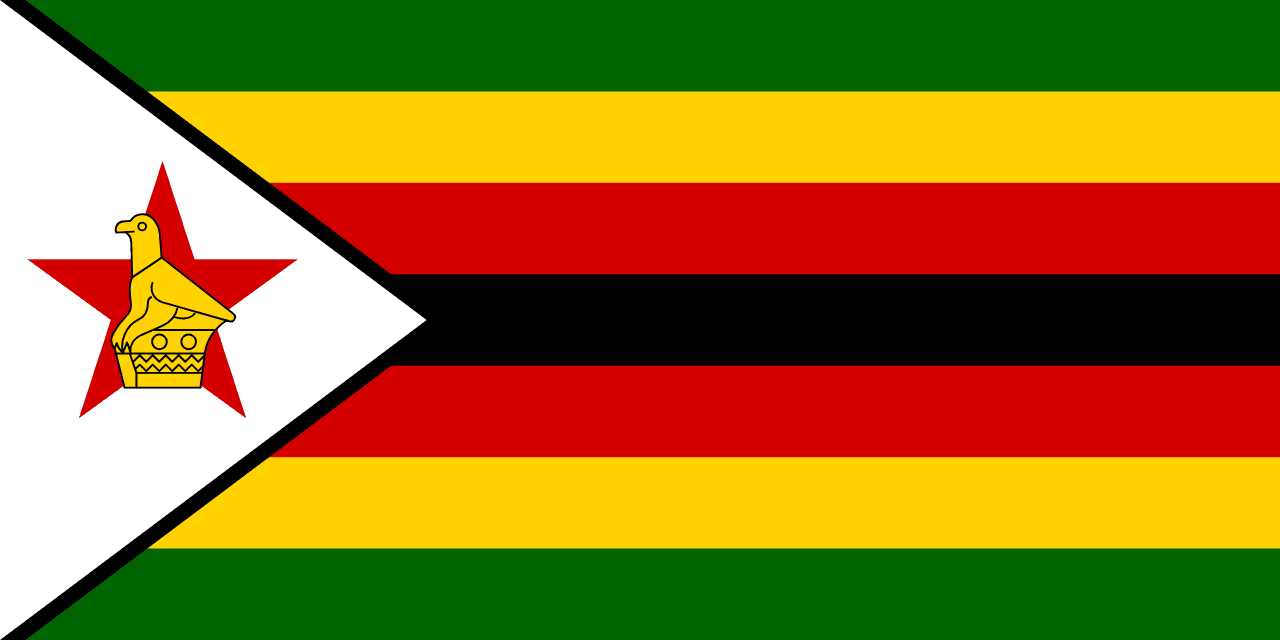
Few national flags pack as much narrative into a single rectangle as the flag of Zimbabwe. Raised for the first time at the stroke of midnight on 18 April 1980, when the country shed the name Rhodesia and stepped into independence, it bundles together liberation politics, mineral wealth, agricultural promise, and an ancient soapstone bird that has watched over the region for centuries. The result is one of the most instantly recognizable banners in Africa, and one that rewards a closer look.
At a glance it is a flag of bold horizontal bands broken by a white triangle on the hoist side, with a striking emblem layered on top. But each element was chosen deliberately, and together they tell the story of a nation reclaiming its identity after British colonial rule.
A Quick Tour of the Design
The Zimbabwean flag is built from seven horizontal stripes. Reading from top to bottom they run green, yellow, red, black, red, yellow, green, so the design mirrors itself around a central black band. This symmetry gives the flag a balanced, almost musical rhythm, and it means the banner reads the same whether you start counting from the top or the bottom.
Pressed against the hoist is a white triangle, edged in black, that points toward the center of the flag and overlaps the stripes. Inside the white field sits the flag's heart: a golden Zimbabwe Bird perched on top of a red five-pointed star. The flag is flown at the proportion of 1:2, twice as wide as it is tall, with the triangle's apex reaching roughly to the midpoint of that length. The combination of horizontal stripes, a contrasting triangle, and a distinctive central emblem makes the layout unusually layered compared with the simpler tricolors of many neighboring countries.
What the Colors Mean
The palette is drawn from the colors associated with the political movement that led the country to independence, and each band carries its own reading rooted in the land and its people.
- Green stands for the agriculture and vegetation that sustain Zimbabwe, from its farmland to its forests.
- Yellow represents the country's mineral wealth, a nod to gold and the other resources buried in its soil.
- Red recalls the blood shed during the struggle for liberation and independence.
- Black honors the heritage and majority of the Black population of Zimbabwe.
- White, in the triangle, points toward peace and the path forward.
The order of the colors is not accidental. By placing green on the outer edges and working inward to a central black band, the design puts the people at its core, framed by the land and resources around them. The red star and golden bird add two more layers of meaning, which deserve their own spotlight.
The Star and the Bird
The red five-pointed star is widely read as a symbol of the nation's revolutionary aspirations and its hopes for the future. The choice of a star, a motif shared by many movements born of anti-colonial struggle, situates Zimbabwe within a wider twentieth-century story of self-determination. Resting upon it is the emblem that gives the flag its singular character: the Zimbabwe Bird.
This stylized golden bird is no ordinary heraldic creature. It is modeled on the carved soapstone birds discovered among the ruins of Great Zimbabwe, the medieval stone city in the country's southeast that lent the modern nation its name. Eight of these sculptures once stood within the city's walls, and archaeologists believe they may have represented royal or spiritual authority. Placing the bird at the center of the flag anchored the new state in a heritage stretching back long before European arrival, declaring that the nation's history did not begin with colonization. The same emblem appears on the national coat of arms and on the country's currency, making it one of the most pervasive symbols in Zimbabwean civic life.
From Rhodesia to Independence
The flag is inseparable from the moment it was born. Before 1980 the territory was known as Rhodesia, named after the British colonialist Cecil Rhodes, and governed under a white-minority administration. Earlier banners told a very different story: the colonial flag was a British-style ensign carrying the Union Jack, and after a unilateral declaration of independence in 1965 the Rhodesian government flew a green-and-white design that pointedly excluded the country's Black majority from its symbolism.
The long and often violent campaign for majority rule, fought through the 1970s, culminated in the Lancaster House Agreement and the elections that followed. When the new flag was first hoisted in 1980, it did more than mark a change of government; it announced a complete reimagining of national identity. The colors of the liberation movement, the ancient bird, and the revolutionary star were woven together into a single emblem that the new country could call entirely its own. To understand how this symbolism fits into the broader story of the nation, its landscapes, and its people, the zimbabwe country guide offers a fuller picture.
The Flag in National Life
Today the flag is a fixture of public and ceremonial life. It flies over government buildings, schools, and embassies, and takes pride of place during Independence Day each April, when the anniversary of 1980 is marked with parades and stadium ceremonies across the country.
It also travels with Zimbabwe's athletes. Supporters drape it across stadiums when the national cricket and football teams compete, and it accompanies the country's representatives at the Olympics and the Commonwealth Games. The golden bird, in particular, has become a shorthand for Zimbabwean pride. You will find it stamped on passports, painted on murals, and stitched onto national sporting kits, a thread of continuity linking the citizen of today to the builders of Great Zimbabwe.
How It Compares
Zimbabwe sits in southern Africa, and its flag shares a family resemblance with several neighbors who also adopted Pan-African and liberation-inspired colors. The combination of green, yellow, red, and black echoes flags across the continent, including those of Mozambique and South Africa, both of which emerged from comparable struggles against colonial or minority rule. The hoist-side triangle is itself a motif Zimbabwe shares with South Africa, the Czech Republic, and a number of other states.
Yet the Zimbabwean flag stands apart thanks to two features: the mirrored seven-stripe arrangement and, above all, the unmistakable Zimbabwe Bird. No other national flag in the world carries that particular emblem. Where Mozambique places a rifle and South Africa a converging Y-shape, Zimbabwe reaches into deep antiquity for its centerpiece, and that single choice gives the flag an identity no other country can replicate.
Interesting Facts at a Glance
- The flag has seven stripes arranged symmetrically, so the top half is a mirror image of the bottom half around the central black band.
- The golden bird is based on soapstone sculptures found at the Great Zimbabwe ruins, the archaeological site that gave the nation its name.
- The same Zimbabwe Bird appears on the national coat of arms and on the country's banknotes and coins.
- The flag was adopted in 1980, replacing the symbols of the former Rhodesia at the moment of independence from British rule.
- Five distinct colors appear on the flag: green, yellow, red, black, and white.
Frequently Asked Questions
When was the flag of Zimbabwe adopted?
The flag was adopted in 1980, when the country gained independence from British rule and took the name Zimbabwe in place of Rhodesia. It has been the national flag ever since.
What do the colors of the Zimbabwean flag mean?
Green represents agriculture and vegetation, yellow stands for the country's mineral wealth, red recalls the blood shed during the liberation struggle, black honors the nation's heritage and majority population, and the white triangle points toward peace. The colors are associated with the movement that led the country to independence.
What is the bird on the Zimbabwe flag?
It is the Zimbabwe Bird, a golden emblem modeled on the carved soapstone birds found at the Great Zimbabwe ruins. It is a national symbol that also appears on the coat of arms and the country's money, and it rests on a red five-pointed star at the center of the flag.
What did the flag look like before 1980?
Before independence the territory was Rhodesia, which flew colonial and minority-rule banners. These included a British-style ensign with the Union Jack and, after 1968, a green-and-white design that left out the symbolism of the Black majority. The 1980 flag broke completely with those earlier designs.
What continent is Zimbabwe on?
Zimbabwe is in southern Africa. Its flag shares the green, yellow, red, and black palette common to many African nations, but the mirrored stripe pattern and the unique Zimbabwe Bird set it apart from its neighbors.
