
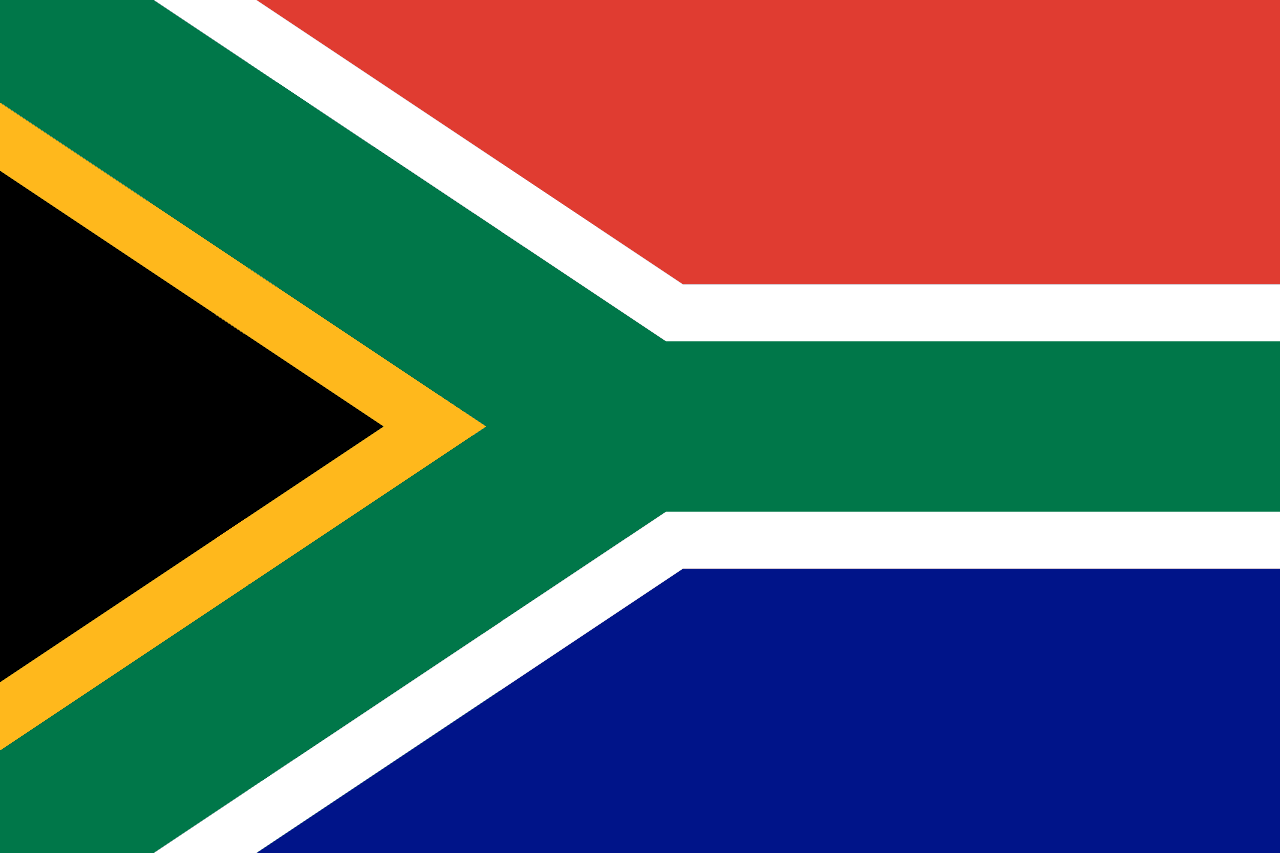
Few national flags announce themselves as boldly as the one South Africa raised on a single autumn morning in 1994. Where most flags settle for two or three colors, this one fans out across six hues arranged around a sideways green Y. It is loud, it is unusual, and it carries a story written in the final, fragile weeks before a country reinvented itself. To understand the flag is to understand a nation choosing what it wanted to become rather than clinging to what it had been.
A Flag Born in One Frantic Week
The most remarkable fact about South Africa's flag is how little time went into making it. As the country prepared for its first democratic, all-race elections in April 1994, there was suddenly an urgent problem: the new South Africa needed a flag fast. After a public competition produced thousands of submissions and no clear winner, the task landed with Frederick Brownell, the State Herald, who sketched the now-famous design in roughly a week.
The flag was first hoisted on 27 April 1994, the day that has since become known as Freedom Day. Officials viewed it as an interim emblem, to be revisited once the dust of transition had settled. But the public embraced it so warmly that any thought of replacing it quietly evaporated. The temporary flag simply became the permanent one, made official by popular affection rather than by lengthy committee.
The Flag That Came Before
To appreciate how radical the 1994 design felt, it helps to know what it displaced. From 1928 to 1994, South Africa flew the so-called Oranje, Blanje, Blou — three orange, white, and blue horizontal bands derived from the historic Dutch Prinsenvlag. In its central white band sat three miniature flags: the British Union Jack and the banners of the two former Boer republics. That earlier flag tried to reconcile only the country's white settler factions while leaving the Black majority unrepresented, and by the late apartheid era it had become, for millions, a symbol of exclusion. The new design made a clean break, folding the competing color traditions into a single abstract form so that no flag-within-a-flag could claim primacy.
The Six Colors and What They Carry
South Africa's flag uses six colors in equal prominence: red, white, blue, green, yellow, and black. Officially these carry no fixed symbolic meaning, a deliberate choice that lets citizens read their own significance into them. Yet the palette is far from random: it gathers threads from the country's tangled political past and weaves them together.
The black, green, and gold echo the flag of the African National Congress, the movement led by Nelson Mandela. The red, white, and blue recall the older flags tied to the Boer republics and the colonial era. By placing these once-opposing color families on the same cloth, the design insists that the new nation belongs to everyone who had ever lived under its competing banners. Many South Africans nonetheless attach informal readings to the colors — green for the land, gold for mineral wealth, blue for sky and ocean — but the state has always been careful to leave such interpretations to the individual.
Reading the Design
The flag's signature feature is a horizontal Y-shape, known in heraldry as a pall. Rendered in green and trimmed with narrow white borders, the Y begins as two arms at the hoist (the side nearest the flagpole) and merges into a single band running toward the fly. This convergence is the design's central idea: diverse elements that once pulled apart now joining and moving forward as one.
Around this green pall, the field divides into distinct zones. At the hoist, the space between the arms of the Y holds black and yellow-gold sections. The upper fly is red, separated from the pall by a slim white stripe, while the lower fly is blue, likewise edged in white. The whole is set in a 2:3 ratio, and crucially, every one of the six colors is given equal visual weight. The official specification even pins down exact widths for the green pall and its white fimbriations, so a correctly made flag is surprisingly precise beneath its free-flowing appearance.
How It Compares to Other Flags
The most natural comparison is with South Sudan, the only other national flag that displays six colors in equal prominence. The two are otherwise quite different, but they share the rare distinction of refusing to limit themselves to a frugal palette.
South Africa's flag also brushes up against the broader Pan-African color tradition of red, green, gold, and black seen in flags such as Kenya's and Ghana's. Yet it is not a straightforward Pan-African flag: the red, white, and blue from the Boer and colonial heritage set it apart, as does the unmistakable green pall, a shape no other national flag uses in quite the same way. That distinctive Y makes the flag instantly identifiable, with no risk of confusion with the horizontal tricolors that crowd much of the world's vexillological landscape.
A Symbol of the Rainbow Nation
When Archbishop Desmond Tutu coined the phrase "Rainbow Nation," he gave South Africans a way to describe their multicolored, multilingual society, and the flag fit that metaphor almost perfectly. Adopted as apartheid ended and Nelson Mandela rose to the presidency, it became shorthand for reconciliation: a visible promise that a country long divided by law could be held together by choice.
That symbolism is why the flag replaced its predecessor so decisively, offering an opposite message without naming winners or losers. The convergence of the Y leaves the past behind not by erasing it but by pulling its fragments into a shared direction. For travelers curious about the land behind the banner, our south africa country guide explores the wider story.
The Flag in Everyday and National Life
Today the flag turns up wherever South Africans gather to celebrate themselves. It flies thickest on Freedom Day (27 April), the anniversary of that first 1994 election, and on Heritage Day (24 September), when communities honor the many cultures. Government buildings, schools, and homes raise it as routine civic pride, and it appears on passports, currency, and the kit of the national teams.
Sport, though, is where the flag truly comes alive. South African supporters are famous for their exuberant flag-waving at international events, and the banner is inseparable from the country's rugby and cricket teams on the world stage. The image of the Springboks lifting the Rugby World Cup beneath a sea of six-colored flags has become part of the national memory. Draped over shoulders and stretched across stadium stands, the colors travel far beyond the nation's borders whenever a major tournament is underway.
Interesting Facts at a Glance
- South Africa is one of only two countries whose flag displays six colors in equal prominence; the other is South Sudan.
- The design was completed in roughly one week before the 1994 elections.
- It was meant to be interim but was kept permanently because the public loved it.
- The Y-shaped pall represents diverse peoples converging and moving forward.
- Brownell also contributed to the flag designs of Namibia and Zimbabwe.
- The flag replaced the 1928 Oranje, Blanje, Blou, which had embedded three smaller flags in its white band.
Frequently Asked Questions
When was the South African flag adopted?
The flag was adopted in 1994 and first flown on 27 April that year, now celebrated as Freedom Day, coinciding with the country's first democratic elections that ended apartheid.
What do the colors of the South African flag mean?
The government assigned no official meaning to the six colors. Unofficially, they blend palettes from earlier South African flags, including the black, green, and gold of the ANC and the red, white, and blue associated with the Boer republics, signaling unity across former divisions.
Who designed the South African flag?
It was designed by Frederick Brownell, the State Herald, who created it in about a week before the 1994 elections. He is also credited with work on the flags of Namibia and Zimbabwe.
What does the Y-shape on the flag represent?
The horizontal Y, called a pall in heraldry, shows two arms at the hoist merging into a single band running toward the fly. It symbolizes the convergence of South Africa's diverse peoples and histories coming together and moving forward as one unified nation.
What continent is South Africa on, and which flag is it most often compared to?
South Africa sits at the southern tip of Africa. Its flag is most often compared to that of South Sudan, since both are among the very few national flags featuring six colors given equal prominence.