
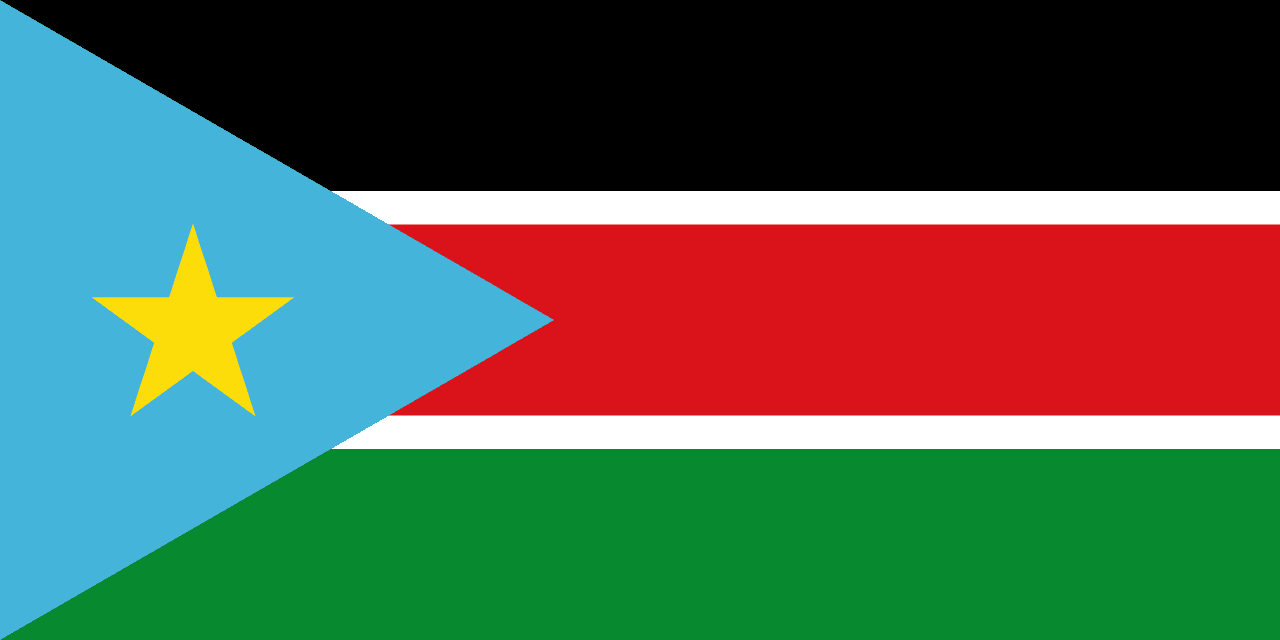

When South Sudan raised its flag for the first time as an independent nation in July 2011, the moment carried the weight of decades of struggle. This was not a banner designed in a quiet committee room of an established state, but the emblem of a country that had just emerged from one of Africa's longest and most painful conflicts. The flag's six colors crowd together in a way that few national designs attempt, and each one tells part of a story about people, land, sacrifice, and a hard-won future.
As one of the youngest flags in the world, the South Sudanese banner is a useful reminder that vexillology is a living craft. New nations are still being born, and with them come fresh symbols that must somehow compress an entire identity into colored cloth. Here is what those colors mean, how the design came together, and why it matters so deeply to the people who fly it.
A Palette of Six Colors
Most national flags settle for two or three colors. South Sudan's uses six: black, red, green, white, blue, and yellow. That richness is deliberate, and each shade was chosen to carry a distinct meaning rather than to simply decorate the cloth.
- Black stands for the people of South Sudan themselves, the majority population whose identity sits at the heart of the nation.
- Red honors the blood shed during the long fight for freedom and independence.
- Green represents the land, its agriculture, and the natural wealth of the country.
- Blue evokes the waters of the Nile, the great river that flows through the nation and sustains it.
- White threads through the design as thin separating stripes, a quiet symbol of peace.
- Yellow forms the star, the emblem of unity for the country's many peoples.
Read together, the colors form a kind of sentence: the people (black), who shed blood (red) for their land (green) and the life-giving Nile (blue), now seek peace (white) and unity (yellow). It is one of the more legible color schemes in the world, where almost nothing is left to guesswork.
How the Design Is Arranged
The flag is built from three horizontal bands of black, red, and green, running from top to bottom. Each band is separated from the next by a thin white stripe, so the eye reads a clear sequence rather than a blur of touching colors. Against the hoist, the left edge nearest the flagpole, sits a blue triangle. Inside that triangle is a single golden-yellow star, sometimes described as a five-pointed star representing the guiding light of unity.
This horizontal-stripes-plus-triangle layout is a recognizable family of African flag design, and it gives the South Sudanese banner an immediate kinship with several of its neighbors. The triangle pointing inward from the hoist draws the eye toward the star, making that symbol of unity the natural focal point of the whole composition.
Born From Older Banners
South Sudan's flag did not appear from nothing in 2011. Its design descends from the flag used by the Sudan People's Liberation Movement, the political and armed movement that led southern Sudan through years of civil war toward self-determination. When independence finally arrived after a referendum, the movement's banner was adapted into the official flag of the new state, with the colors and star carrying their established meanings forward.
That lineage is significant. Rather than inventing an entirely new symbol, the founders chose continuity with the struggle that had defined a generation. The flag that had once been carried in liberation became the flag of a sovereign nation, a transition that gave the new emblem instant emotional resonance for the people who had fought under earlier versions of it.
What the Flag Means to a New Nation
For a country that gained independence only in 2011, the flag is one of the most visible markers that South Sudan exists at all. It appears on government buildings, in classrooms, at border crossings, and at international gatherings where the nation takes its place among the world's states. In a young country still building many of its institutions, shared symbols like the flag do real work in knitting together a sense of common belonging.
The emphasis on unity is no accident. South Sudan is home to many different ethnic communities and languages, and the yellow star was chosen precisely to represent the hope that these groups can stand together as one people. The flag therefore carries not only pride in independence but also an aspiration that the nation continues to grow toward. To understand the geography and communities behind the banner, you can explore our south sudan country guide.
The Flag in Everyday Life
South Sudanese fly the flag with particular intensity around Independence Day in July, the anniversary of the 2011 declaration. On that occasion the streets of the capital and towns across the country fill with black, red, and green, and the star appears on clothing, vehicles, and faces. The flag also travels with national sports teams and with the large South Sudanese diaspora, who use it to stay connected to a homeland many left during the conflict years.
Because the flag is so young, it has not accumulated centuries of ceremonial tradition the way older national banners have. Instead, those traditions are being created in real time, which gives the flag a freshness and immediacy. Every civic use of it is, in a sense, helping to write the customs that future generations will inherit.
Interesting Facts
- It is one of the newest national flags in the world, adopted in 2011 when South Sudan became an independent country.
- With black, red, green, white, blue, and yellow, it uses six colors, more than most national flags.
- The design evolved directly from the banner of the Sudan People's Liberation Movement.
- The blue triangle specifically represents the waters of the Nile, a defining feature of the country's geography.
- South Sudan lies in East-Central Africa, making it one of the continent's most recently established nations.
Frequently Asked Questions
When was the flag of South Sudan adopted?
The flag was adopted in 2011, the year South Sudan gained independence from Sudan. This makes it one of the most recently created national flags in the world, born alongside the nation itself.
What do the colors of the South Sudan flag mean?
Black represents the people, red the blood shed in the struggle for freedom, green the land and its fertility, blue the waters of the Nile, white the hope for peace, and the yellow star stands for unity among the country's many communities.
Which continent is South Sudan on?
South Sudan is in Africa, located in the east-central part of the continent. It is a landlocked nation through which the Nile flows, which is why the river features so prominently in the flag's symbolism.
Why does the South Sudan flag look similar to other African flags?
The combination of horizontal black, red, and green stripes with a triangle and star at the hoist places it within a recognizable tradition of African flag design, and its colors echo Pan-African themes. Its direct ancestor, however, is the flag of the Sudan People's Liberation Movement, which gives it a distinct identity rooted in the country's own liberation history.