

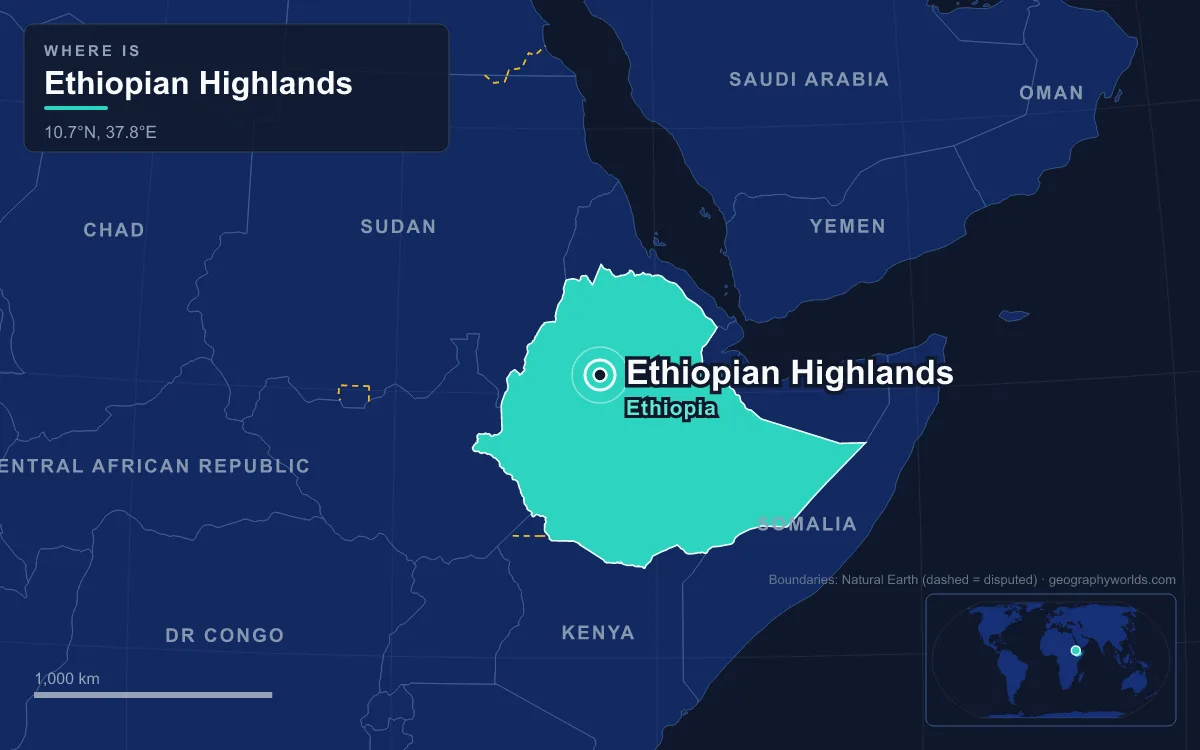
Few landscapes are defined by their animals as clearly as the Ethiopian Highlands, the rugged mass of basalt plateaus and mountains that covers central and northern Ethiopia and extends into Eritrea. They form the largest continuous area of such high ground in Africa: little of the surface falls below 1,500 m, and the summit of Ras Dashen in the Simien Mountains reaches 4,550 m. The Main Ethiopian Rift splits them into the Abyssinian Massif in the northwest and the Harar Massif, with the Bale Mountains, in the southeast. Above 3,000 m lies 25,209 km² of Afroalpine moorland, part of the largest Afroalpine region in Africa, and the highlands as a whole are home to the Ethiopian wolf, walia ibex, gelada and mountain nyala, none of which live anywhere else. Its two flagship reserves are both World Heritage Sites: Simien Mountains National Park (established 1969, inscribed 1978) and Bale Mountains National Park (about 2,150 km², inscribed 2023).
The Ethiopian Wolf on the Sanetti Plateau
The Ethiopian wolf is the animal that best measures the health of the high plateau. It is a slender, red-and-white canid about the size of a coyote, with a long, narrow skull built for snatching rodents from their burrows, and it is one of the world’s rarest canids and Africa’s most endangered carnivore. Its range is now confined to seven isolated mountain ranges between 3,000 and 4,500 m, and the adult population was estimated at 360–440 animals in 2011, more than half of them in the Bale Mountains.
Bale’s Sanetti Plateau, the largest single stretch of moorland in the highlands, is the stronghold. Two subspecies are recognised: Canis simensis simensis north of the Rift, in the Simien Mountains, the Wollo highlands and Guassa Menz in north Shoa, and C. s. citernii in Bale and the neighbouring Arsi Mountains. Surveys in the late 1990s found the wolf had already vanished from Mount Choqa, Gojjam and every northern Afroalpine area where farming was well developed.

The species’ history tracks Ethiopia’s own. Eduard Rüppell described it scientifically in 1835 from the Simien Mountains. It was recognised as needing protection in 1938 and received it in 1974. The American-sponsored Bale Mountains Research Project began the first detailed studies in the 1980s, but in the early 1990s shooting during the civil war and a severe rabies epidemic, carried by domestic dogs, wiped out most of the packs being studied in the Web Valley and on the Sanetti Plateau. The IUCN moved the wolf to critically endangered in 1994, and Oxford University set up the Ethiopian Wolf Conservation Programme in Bale in 1995 with the Ethiopian Wildlife Conservation Authority, vaccinating dogs and working with herders. Within a decade the Bale packs had recovered to their pre-epidemic numbers, and the species was downlisted to endangered in 2004.
Giant Root-Rats and Giant Lobelias: The Bale Afroalpine Food Web
The wolf can only survive where its prey is dense, and on the Sanetti Plateau that prey is extraordinary. The giant root-rat, or Ethiopian African mole-rat, is found only in the Bale Mountains, where it reaches densities of up to 2,600 animals per square kilometre. Weighing up to about 930 g, with eyes set high on its head like periscopes, it feeds by tunnelling up to the surface and pulling in the plants around the hole, keeping the back half of its body underground. Bale National Park’s rodent community runs to 47 species, and ecologists treat these rodents as keystone species of the plateau: they turn over the soil, feed the wolves and raptors, and shape the grassland.
The vegetation is as distinctive as the animals. Above the tree line the moorland is a mix of grassland, herb meadow and low shrubs of tree heath (Erica arborea and Erica trimera), with everlasting flowers, lady’s mantle and fescue grasses between them. Rising above everything is the giant lobelia, Lobelia rhynchopetalum, a palm-like plant endemic to Ethiopia’s Simien and Bale mountains that can reach 6.5 m when its violet flower spike, up to 3.5 m long, shoots up. Frosts are common throughout the year here, especially from November to March, and rainfall runs from about 2,500 mm in the southwest of the moorland zone to about 1,000 mm in the north.
Walia Ibex on the 1,500-Metre Simien Escarpment
North of the Rift, the Simien Mountains are the remnant of a huge shield volcano built from flood basalts about 30 million years ago and cut by erosion into serrated peaks and cliffs as much as 1,500 m high. Those cliffs are the only home of the walia ibex, the southernmost ibex in the world. Chocolate- to chestnut-brown, with males weighing 80–125 kg and carrying backward-curving horns up to 110 cm long, it lives on very steep rock between 2,500 and 4,500 m, browsing giant heath and grazing on ledges.

The ibex is the reason Simien Mountains National Park exists. It was established in 1969, set up by Clive Nicol, and was among the first places inscribed as a World Heritage Site, in 1978. Only 200–250 walia ibex survived in 1994–96, and the park was placed on the List of World Heritage in Danger in 1996. Numbers then climbed to about 500 by 2004, and with populations of its characteristic species stabilised, the park came off the danger list in 2017. Its mountain habitat could support roughly 2,000 ibex at most, and the species is still classed as vulnerable, threatened by settlement, livestock grazing, farming and road building. The park’s single unpaved road runs east from Debark, the headquarters, through villages to the 4,430 m Buahit Pass. Overhead, the park’s birds include the lammergeier, or bearded vulture, with a wingspan of about 3 m.
Geladas: The Grass-Eating Primates of the Simien Plateau
On the grassy tops above the Simien cliffs live the gelada, the only surviving member of the genus Theropithecus and a primate found only in the Ethiopian Highlands, between 1,800 and 4,400 m. Unlike almost every other monkey it is a grazer: grass makes up as much as 90 percent of its diet. Adult males average 18.5 kg and carry a heavy cape of hair and a bright red, hourglass-shaped patch of bare skin on the chest, which gives the species its nickname, the bleeding-heart monkey.
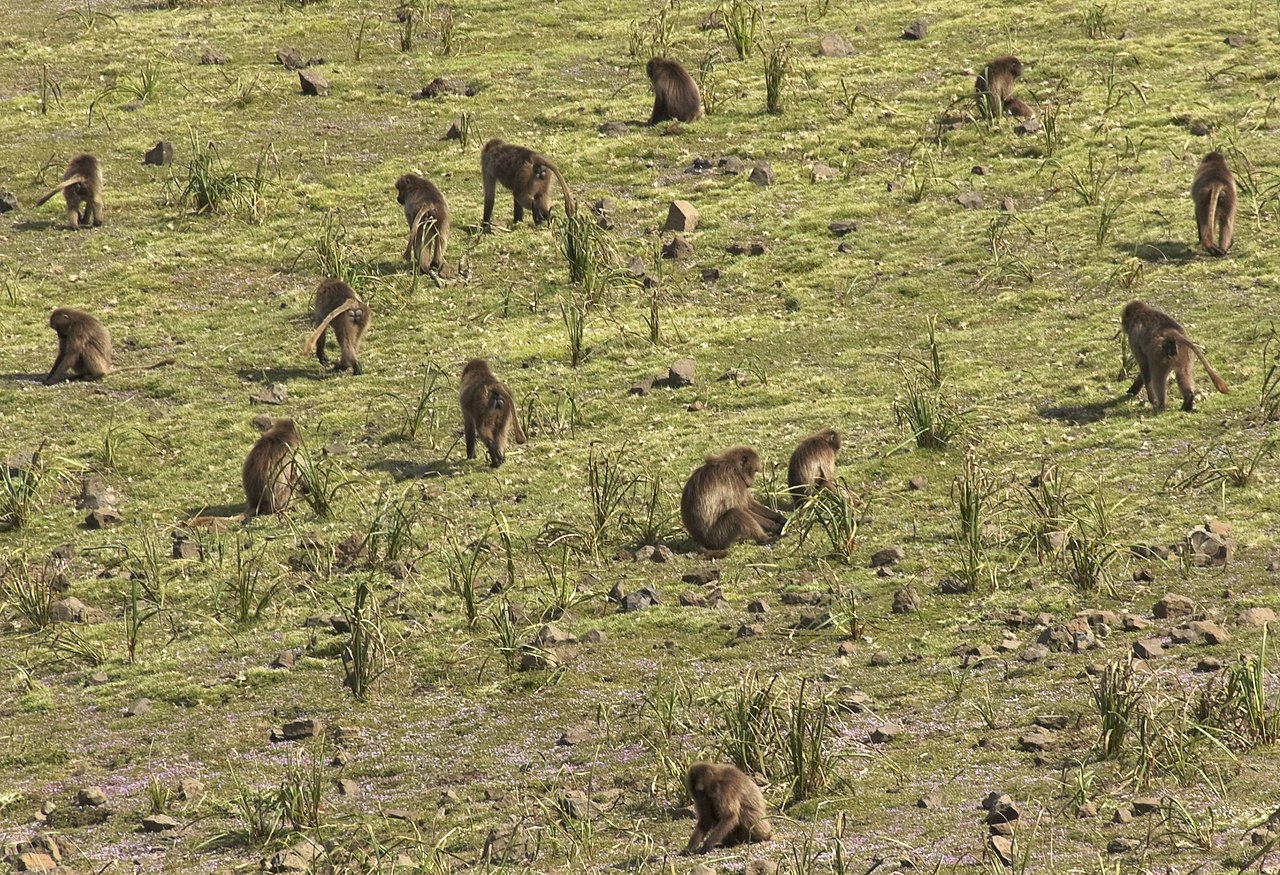
Geladas live in a layered society. Reproductive units of up to 12 females with one to four males combine with all-male units into bands, bands gather into herds of up to 60 units, and one to four bands form a community. The species was estimated at 440,000 animals in the 1970s and about 200,000 in 2008, when the IUCN assessed it as least concern despite the decline. Farmers near Simien treat geladas as crop pests, since the monkeys favour barley, and farm expansion and shooting are the main threats.
Mountain Nyala in Gaysay and the Harenna Forest Below
East of the Rift, the northern edge of Bale Mountains National Park holds the last large antelope to be discovered in Africa. Major Ivor Buxton brought a mountain nyala he had shot back to England in 1908 after a hunting trip, and Richard Lydekker described the species in 1910 as Tragelaphus buxtoni. Males stand 120–135 cm at the shoulder and weigh 180–300 kg, with spiral horns and a row of white spots along grey-brown flanks. The species is endemic to the highlands east of the Rift between 6°N and 10°N, in montane woodland at 3,000–3,400 m, and up to half of the whole population lives in the 200 km² Gaysay area of the park. It is listed as endangered, and its image is struck on Ethiopia’s ten-cent coin.
South of the Sanetti Plateau the land drops into the Harenna Forest, the largest of Ethiopia’s few remaining natural forests, covering 3,500 to 7,000 km² of the southern slope between 1,450 and 3,200 m. At the top, below a heath belt of Erica arborea, grow Hagenia woods and stands of highland bamboo, the food of the Bale Mountains vervet, a monkey limited to the upper Harenna and nearby forests. Lower down the forest opens into woodland of Warburgia, Croton and podocarp with wild Coffea arabica as the main understorey shrub, a reminder that Arabica coffee is native to these highlands. The forest holds Ethiopia’s only population of Harvey’s duiker, along with giant forest hog, mantled guereza, leopard and lion; African wild dog once hunted here, though its presence is now in question. Bale as a whole has recorded more than 282 bird species, among them the blue-winged goose, a grey-brown, Near Threatened bird of high grassland and marsh at 2,500–4,000 m, found only in Ethiopia and gathering in flocks of up to 100 outside the breeding season.
Spurfowl, Turacos and Seedeaters of the Montane Forest Belt
Below the moorland, the wetter southwestern and southeastern highlands carry the Ethiopian montane forests, where Afromontane forest grows mainly between 1,800 and 2,600 m on 600 to 1,500 mm of rain a year. Little of it survives intact: only 11 percent of this ecoregion is protected, and just 1 percent of the land outside protected areas is still relatively intact forest. The surviving fragments hold endemic birds of their own, among them Harwood’s spurfowl, Prince Ruspoli’s turaco and the yellow-throated seedeater.
The rest of the middle highlands, between about 1,000 and 3,000 m, is a mosaic of grassland, open woodland and forest patches that has been densely populated for centuries. Ethiopian highland farming developed on its fertile black soils weathered from basalt, and fire, grazing and cultivation have replaced much of the original woodland. Most of the country’s major cities sit here at around 2,000 to 2,500 m, including Addis Ababa and the historic capitals of Gondar and Axum, which is why the wildlife described above is now concentrated in the moorlands and protected forests above the farmland.
Ethiopia has long used a different animal, the lion, as its emblem, as this post on the national animal of Ethiopia explains, while the wider guide to Ethiopia’s geography sets these mountains in the context of the whole country. The same plateau that shelters the wolf and the ibex also catches the June-to-September monsoon rain that feeds the Blue Nile as it leaves Lake Tana.