

Introduction
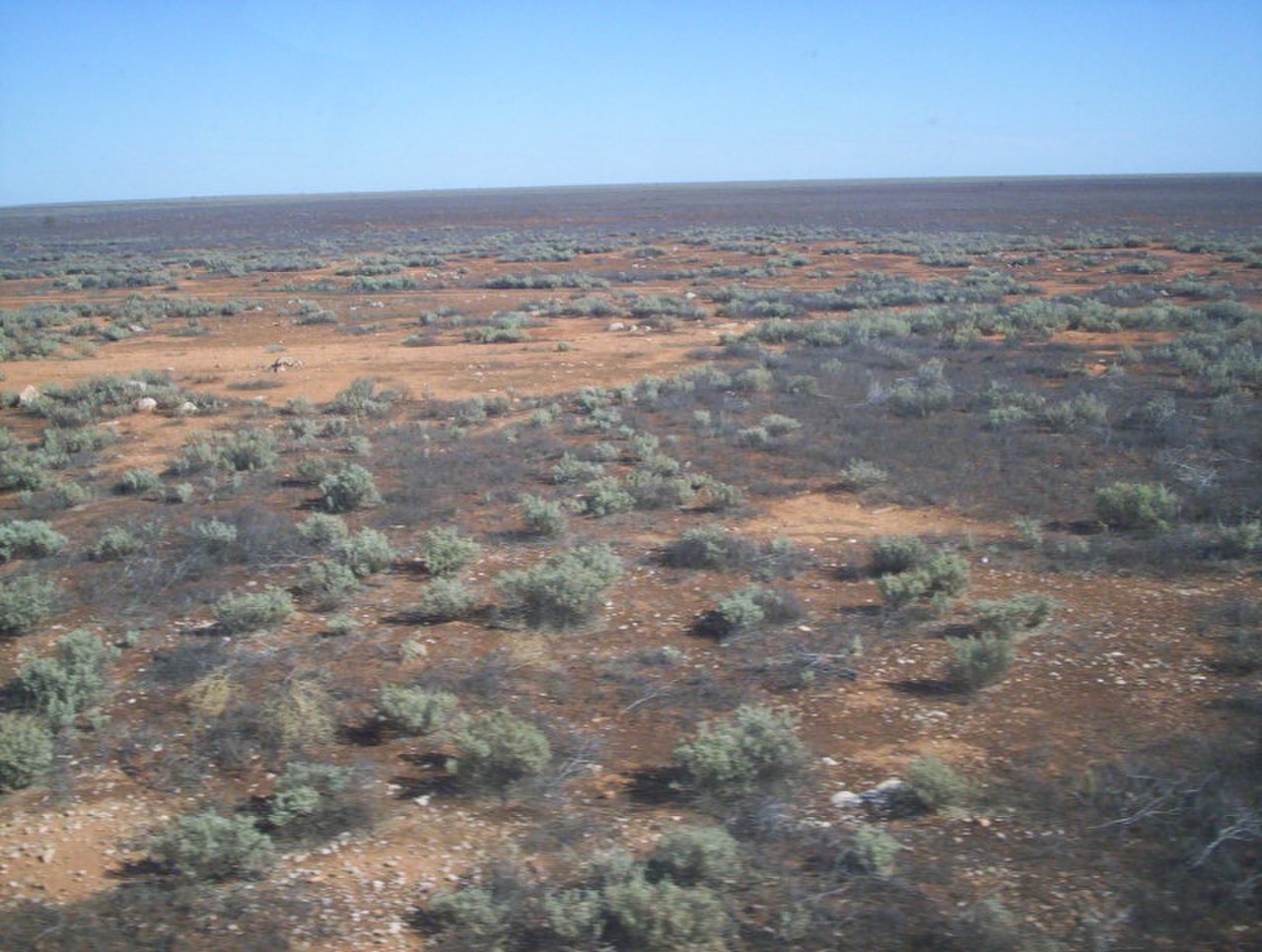
The Nullarbor Plain is one of the flattest and most sparsely inhabited landscapes on Earth, a vast expanse of treeless limestone stretching approximately 200,000 square kilometers across the southern margin of Australia. The name comes from the Latin nullus arbor, meaning no tree, an apt description for this arid, windswept plain where the horizon is unbroken by any vertical feature for hundreds of kilometers.
The Nullarbor is the world's largest single piece of limestone, formed from sediments deposited on an ancient seabed roughly 20 million years ago. When the sea retreated, it left behind a flat limestone platform that has been slowly dissolving over millions of years, creating one of the most extensive cave systems in the Southern Hemisphere beneath a surface of almost eerie flatness.
Geography & Dimensions
- Area: ~200,000 km²
- Elevation: 30–200 m
- Location: Southern Australia (Western Australia and South Australia)
The Nullarbor Plain extends from the Great Australian Bight coast in the south to the Great Victoria Desert in the north, and from Ceduna in South Australia to Norseman in Western Australia. The plain is bisected by the Trans-Australian Railway, which includes the world's longest straight stretch of railway track at 478 kilometers.
The southern edge of the Nullarbor terminates in some of the most dramatic sea cliffs on Earth. The Bunda Cliffs rise 60 to 120 meters above the Southern Ocean, stretching for over 200 kilometers along the Great Australian Bight. These cliffs are one of Australia's most spectacular but least-visited natural features.
Climate & Weather
- Temperature Range: 5°C to 48°C
- Annual Precipitation: 150–300 mm
The Nullarbor has a hot, arid climate with minimal rainfall. What little rain falls tends to soak directly into the porous limestone rather than forming surface streams. There are no permanent rivers or surface water bodies on the entire plain, making it one of the driest inhabited landscapes in Australia.
Summer temperatures regularly exceed 40°C, while winter nights can drop near freezing. Strong winds sweep across the flat surface unimpeded. Despite the harsh conditions, rare rainfall events can temporarily transform patches of the plain with wildflower blooms, a phenomenon that attracts botanists from across Australia.
Ecology & Biodiversity
- Key Ecosystems: Arid scrubland, underground cave systems
- Notable Species: Southern right whale (offshore), wombat, wedge-tailed eagle
The surface of the Nullarbor supports sparse, low scrubland dominated by saltbush, bluebush, and myall (acacia) species. Despite the name, scattered low shrubs survive, though true trees are absent. The plain's ecology is subtly complex, with unique plant communities adapted to the alkaline limestone soils and low rainfall.
The Nullarbor's caves are its most remarkable ecological feature. Underground systems, including Cocklebiddy Cave (one of the world's longest underwater cave dives), harbor unique cave-adapted invertebrates. The Bunda Cliffs and offshore waters are critical habitat for southern right whales, which calve in the sheltered waters of the Great Australian Bight.
Human Geography
- Population: Virtually uninhabited (<0.01 people per km²)
- Key Route: Eyre Highway and Indian Pacific Railway
The Nullarbor is one of the most sparsely populated landscapes on Earth. A handful of roadhouses along the Eyre Highway and railway sidings along the Trans-Australian Railway are the only permanent settlements. Crossing the Nullarbor, either by road or rail, is considered a quintessential Australian journey, often taking two to three days.
Aboriginal peoples, particularly the Mirning people, have inhabited the Nullarbor edges for thousands of years, with cultural sites and rock art in caves along the coast. The Trans-Australian Railway, completed in 1917, was a monumental engineering achievement that linked the eastern and western halves of Australia across this vast empty plain.
Significance & Challenges
- Geological Significance: World's largest single exposure of limestone
- Key Challenge: Climate change impacts on marine ecosystems
The Nullarbor is of significant geological and speleological interest. Its cave systems provide records of past climatic conditions through stalagmite analysis. The plain itself is a window into Australia's geological history, preserving evidence of ancient seas and the retreat of marine environments over millions of years.
The Great Australian Bight Marine Park, adjacent to the Bunda Cliffs, protects important marine ecosystems including whale calving grounds. Proposals for oil and gas exploration in the Bight have been controversial, with environmentalists arguing that spills could devastate the marine environment. Climate change threatens to alter rainfall patterns and ocean conditions along the coast.
Key Facts
- The Nullarbor Plain is the world's largest single piece of limestone at approximately 200,000 km².
- The Trans-Australian Railway crosses the plain with the world's longest straight railway track (478 km).
- The Bunda Cliffs along the southern edge rise 60-120 meters above the Southern Ocean.
- The plain has no permanent surface water; all drainage is underground through the limestone.
- Cocklebiddy Cave contains one of the world's longest underwater cave passages.
Fun Facts
- The Nullarbor is so flat that early surveyors thought their instruments were broken.
- Dingoes on the Nullarbor are separated from sheep country by the world's longest fence, the 5,614 km Dingo Fence.
- Meteorites are easier to find on the Nullarbor because dark stones stand out against the pale limestone surface.
- The Indian Pacific train journey across the Nullarbor takes about 65 hours from Sydney to Perth.
Final Thoughts
The Nullarbor Plain is a landscape of stark extremes: utterly flat above, honeycombed with caves below; scorching hot in summer, bitterly windy in winter; seemingly barren on the surface, yet rich in hidden geological and ecological wonders. Crossing this vast treeless expanse is one of Australia's great adventures, a journey that brings home the sheer scale of the Australian continent and the power of geology to shape extraordinary landscapes.
