
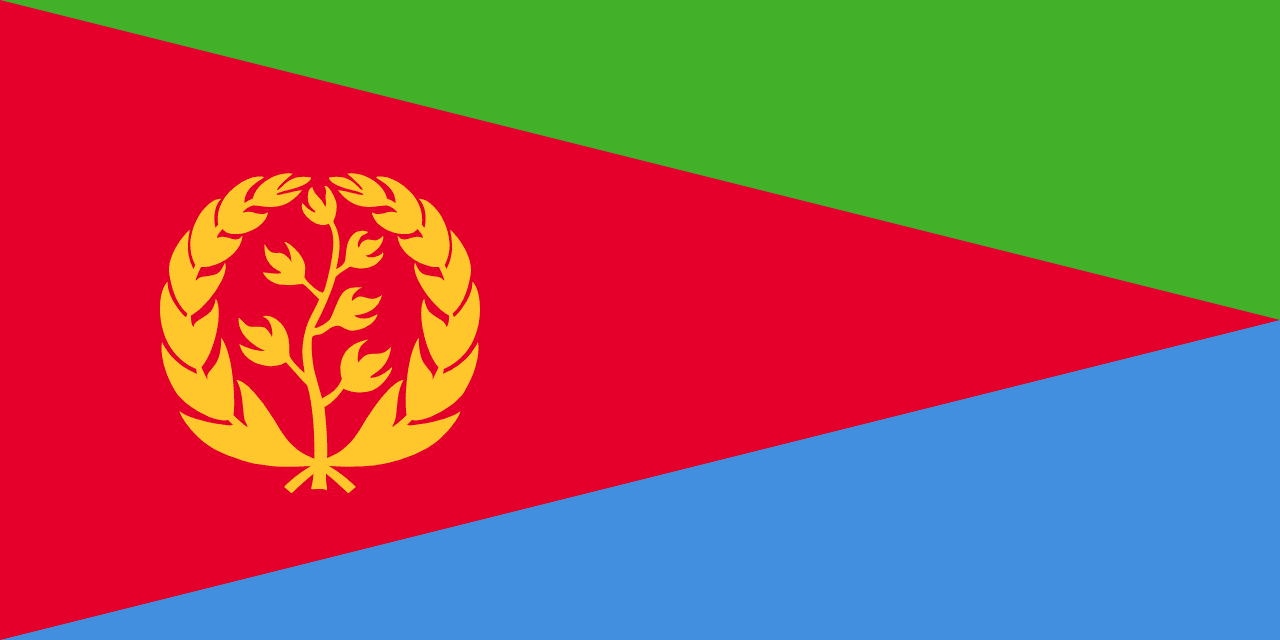
Few flags carry the weight of a thirty-year struggle as openly as the flag of Eritrea. Adopted in 1993, the year the country declared its independence, the design is built around a bold red triangle that drives across the cloth like a wedge, framed by triangles of green and blue. Tucked inside the red is a golden olive wreath encircling an upright branch. It reads almost like a sentence: the land, the sea, the blood that was spilled, and the peace that was finally won.
A Banner Born From a Liberation Movement
To understand the flag, you have to understand the fight behind it. Eritrea's design is based directly on the banner of the Eritrean People's Liberation Front, the movement that waged a long armed campaign against Ethiopian rule. When independence arrived in 1993, the new nation did not reach for an entirely new symbol. Instead it adapted the flag that fighters had already carried and died under, keeping the triangular structure and layered colors that had come to stand for the cause.
That continuity matters. Many countries design a flag in a committee room and then ask citizens to grow attached to it. Eritrea inherited a flag already soaked in meaning, recognized by the people who had spent decades fighting for the right to fly it. The civic olive wreath replaced the movement's star, signaling the shift from struggle to statehood, but the visual DNA stayed intact.
The Flags That Came Before
Eritrea's banner did not appear in a vacuum; the territory flew several different flags across the twentieth century. Under Italian colonial rule, from the late 1880s until the Second World War, it was governed under the Italian tricolor. After Italy's defeat it passed under British military administration, and in 1952 it entered a federation with Ethiopia under a United Nations arrangement.
During that federal period, from 1952 to 1962, Eritrea flew its first distinctly Eritrean civil flag: a pale blue field charged with a green olive wreath and branch. That short-lived banner is the true ancestor of the emblem at the heart of today's flag, which is why the olive imagery feels less like a 1993 invention and more like the recovery of something older. When Ethiopia dissolved the federation and annexed Eritrea in 1962, that flag was banned and the long war began. Reviving the wreath in 1993 was a deliberate act of memory.
Reading the Colors
The Eritrean flag uses four colors, and each one is anchored to something concrete rather than abstract slogans:
- Green stands for the agriculture and fertility of the land, the farms and highlands that sustain the country.
- Blue represents the sea, a fitting tribute for a nation with a long Red Sea coastline and a maritime history.
- Red is the color of the blood shed in the long struggle for freedom, and it occupies the most commanding position on the flag.
- Yellow, or gold, appears in the olive wreath and branch, lending the emblem its warmth and value.
The layout itself reinforces the message. The red triangle is not a quiet stripe; it dominates, pushing the green and blue to the margins, so the sacrifice of the struggle is the largest element shown. There is a logic to the ordering too: green sits above for the highlands, blue below for the coastal waters, and the red drives between them.
The Design and Its Geometry
The flag's construction is unusual. Rather than horizontal or vertical bands, it is divided into three triangles. A red isosceles triangle has its base along the hoist (the side nearest the flagpole) and its point reaching toward the fly edge. Above and below it sit green and blue triangles, with a dynamic, forward-leaning result. The flag flies at a ratio of two units of height to three of width, and the red apex lands near the center of the fly edge, so the green and blue fields read as mirror-image right triangles.
Centered within the red triangle is the national emblem: an olive wreath curving around an upright branch, rendered in gold. After decades of war, the branch represents peace, and the wreath ringing it suggests honor and the hope of a settled future. It is a quietly optimistic note placed at the heart of a flag whose dominant color speaks of bloodshed.
How It Compares to Other Flags
Many flags across the continent draw on the Pan-African palette of red, green, gold, and black. Eritrea shares red and green with that family, and its independence pedigree places it in the same tradition, yet it swaps black for blue, tying the design to the Red Sea rather than to the broader Pan-African idea.
The most obvious visual cousin is the flag of Guyana, an unrelated nation across the Atlantic, which also uses a forward-pointing triangle. Both rely on the energy of the wedge, but Guyana's is gold and points the opposite way, while Eritrea's is red and carries an emblem. The Eritrean banner is sometimes confused with Ethiopia's, yet the two look nothing alike: Ethiopia uses horizontal stripes with a central star-on-disc emblem. The red wedge and golden olive wreath make the Eritrean flag instantly its own.
Cultural Significance and National Identity
For Eritreans, the flag is inseparable from the idea of nationhood, because the nation and the flag were born in the same moment. Independence in 1993 was not handed down; it was claimed after one of the longest armed conflicts in modern African history. The flag functions as a kind of collective memory, and that emotional charge follows the diaspora wherever it has settled, raised at festivals as a link back to a homeland shaped by sacrifice. For broader context on the country's landscapes, people, and place in the Horn of Africa, our eritrea country guide fills in the picture around the symbol.
The Flag in Modern Life
The flag is most visible on national occasions, above all Independence Day on the 24th of May. It flies over government buildings, schools, and embassies, and appears on the jerseys of Eritrean athletes; the country's cyclists in particular have carried the colors into major European races, far from the Horn of Africa. Citizens encounter it in quieter ways too, on currency, painted on public buildings, and worn as scarves and pins during Martyrs' Day. In each setting the flag does the same work: it announces that a small Red Sea nation, against considerable odds, secured the right to define itself.
Interesting Facts About the Flag of Eritrea
- The flag was adopted in 1993, the same year Eritrea gained its independence.
- Its design is based on the banner of the Eritrean People's Liberation Front.
- The olive branch and wreath stand for peace, set within a flag otherwise marked by sacrifice.
- The olive emblem echoes Eritrea's first flag from the federal period of 1952 to 1962, recovering a symbol banned for three decades.
- The dominant red triangle outweighs the green and blue, placing the cost of freedom front and center.
- Eritrea sits in Africa, on the Horn of Africa along the Red Sea coast.
Frequently Asked Questions
When was the flag of Eritrea adopted?
The flag was adopted in 1993, the year Eritrea became an independent nation following a referendum on self-determination. The country and its flag effectively share a birth year.
What do the colors of the Eritrean flag mean?
Green represents agriculture and the fertility of the land, blue stands for the sea, and red symbolizes the blood shed during the struggle for freedom. The gold of the central olive wreath and branch completes the palette and ties into the emblem of peace.
Who designed the Eritrean flag and where did it come from?
Rather than crediting a single named designer, the flag descends from the banner used by the Eritrean People's Liberation Front during the independence struggle. When statehood arrived in 1993, that flag was adapted into the official national flag, with an olive wreath placed at its center.
What continent is Eritrea on, and does its flag resemble any others?
Eritrea is in Africa, on the Horn of Africa along the Red Sea. Its triangular layout and use of red, green, and blue echo the visual language of African liberation flags, yet the combination of the dominant red wedge and the golden olive emblem makes it instantly distinct from its neighbors.
Why does the Eritrean flag use a triangle instead of stripes?
The triangular layout is inherited from the flag of the Eritrean People's Liberation Front, where the forward-pointing red wedge expressed the momentum of the independence movement. Keeping that shape after 1993, rather than switching to conventional horizontal bands, turned the geometry itself into a statement of continuity with the liberation era.