
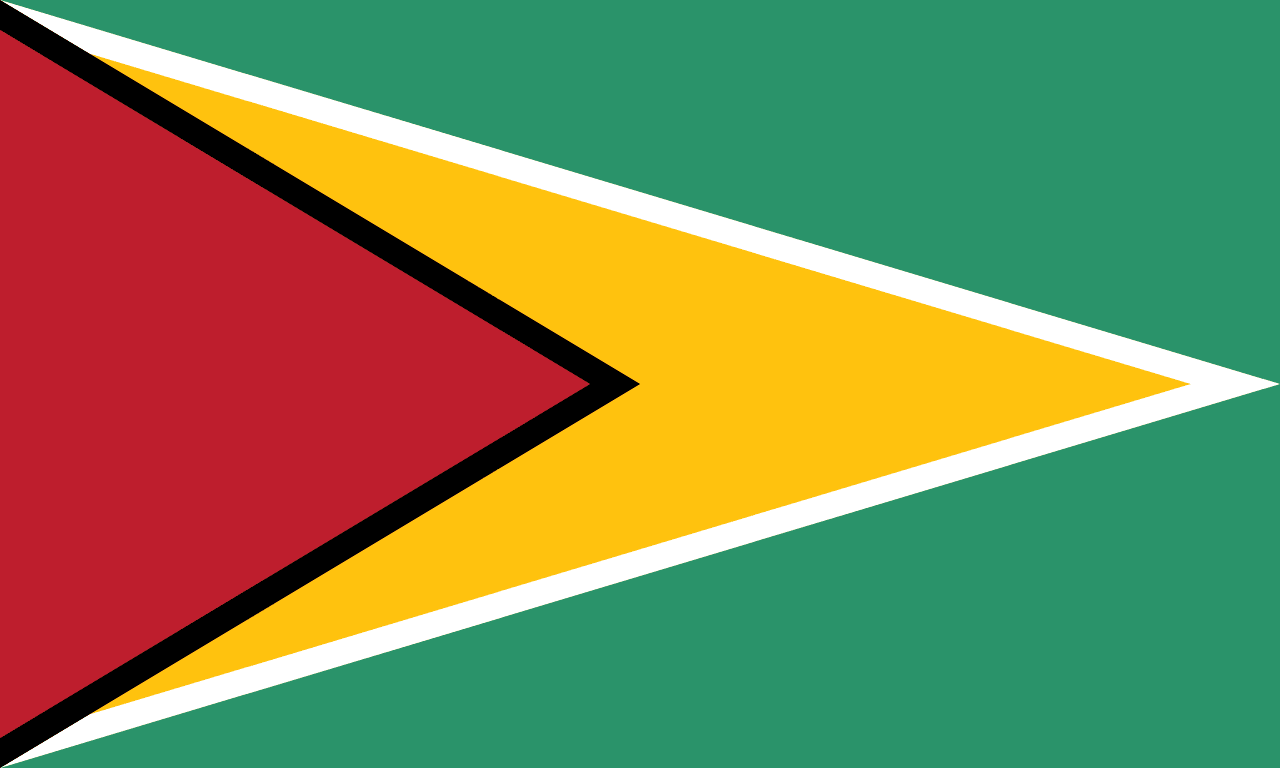

Few national flags announce themselves quite like the Golden Arrowhead. From a distance it looks less like a banner and more like an arrow caught mid-flight, its bright triangles pointing the way forward. Adopted in 1966 when Guyana stepped out from British colonial rule into independence, the flag distills an entire young nation's hopes into five colors and a handful of clean geometric shapes. It is a design that rewards a second look, because the longer you study it, the more its layered triangles seem to gather speed.
A Banner Born With a New Nation
Guyana raised the Golden Arrowhead for the first time in 1966, the year it gained independence. For a country that had spent generations under colonial administration, the new flag was a deliberate break from the past and a statement of self-definition. Rather than borrowing a European template or recycling an old colonial ensign, Guyana commissioned a fresh design built around symbols that spoke to its own land, labor, and ambitions. The result is one of the more distinctive flags in the Western Hemisphere, instantly recognizable and unlike almost anything that came before it.
The nickname "Golden Arrowhead" stuck almost immediately, and it is now used as readily as the country's name itself. That a flag earned such an affectionate, widely repeated nickname says a great deal about how quickly it was embraced as shorthand for the nation.
The Five Colors and What They Carry
The Golden Arrowhead uses five colors, and each one is tied to a specific idea about the country and its people. The meanings are not vague poetry; they map directly onto Guyana's economy and character.
- Green stands for agriculture and the forests that blanket so much of the interior. It is the dominant background color, a nod to a land of fields, rivers, and dense rainforest.
- Yellow (often described as golden) represents the country's mineral wealth, from gold to bauxite buried beneath the soil.
- White appears as a narrow fimbriation, or border, separating the yellow from the green and lending the design its crispness.
- Black symbolizes endurance, the perseverance that will carry the nation through challenges.
- Red signals zeal, the energy and dynamism of a young people building a future.
Read together, the palette tells a compact national story: a green land rich in gold, sustained by endurance and driven by zeal. It is a rare flag where the official symbolism and the visible economy line up so neatly.
Reading the Design From the Hoist Outward
The structure is best understood as a series of nested triangles laid over a green field. Anchored at the hoist (the edge nearest the flagpole), a long yellow triangle sweeps horizontally across the flag toward the fly end, narrowing to a point like an arrowhead in motion. Layered on top of that, a shorter and bolder red triangle points the same direction, sharing the same starting edge.
Two thin borders keep the colors from bleeding into one another. A white fimbriation outlines the yellow triangle against the green, and a black fimbriation outlines the red triangle. These slim lines are not decorative afterthoughts; they are what give the flag its sense of depth and precision, making the central arrowhead seem to leap off the green background. Strip the borders away and the whole effect would collapse into a muddle. With them, the triangles read as distinct, stacked layers, each one driving the eye forward.
The Vexillologist Behind the Arrowhead
The Golden Arrowhead carries an unusual distinction: it was designed by Whitney Smith, one of the twentieth century's most influential figures in the study of flags. Smith was, in fact, the person who coined the very word vexillology, the scholarly study of flags and their meaning. Having an actual flag specialist design a national flag is the exception rather than the rule, and it shows in the clarity of the finished product.
Smith's original concept was refined during the run-up to independence, with the addition of the black and white borders that sharpen the design as we know it today. The collaboration produced something both scholarly and stirring, a flag that satisfies the technical instincts of a vexillologist while still working as an emotional symbol for ordinary citizens. For more on the country itself, its geography, and its place in the region, see our guyana country guide.
How It Stands Apart From Its Neighbors
Many flags lean on horizontal stripes, vertical bands, or a central emblem. The Golden Arrowhead does none of these, which is exactly why it stands out. Its defining feature is the dynamic triangle pointing toward the fly, a layout shared by very few national flags worldwide.
It is worth comparing it to other flags that use overlapping triangles or arrow shapes. The flags of nations like the Czech Republic, the Philippines, or various Caribbean states all employ a triangle at the hoist, but those triangles typically point inward from the hoist edge as a wedge. Guyana's triangles instead radiate outward across the field, creating forward motion rather than a static wedge. Compared to the many green-yellow-red flags found across Africa, the Golden Arrowhead's geometry is unmistakable; the colors may rhyme, but the arrangement does not. That combination of a familiar warm-and-cool palette with a one-of-a-kind shape is what makes the flag impossible to confuse with another.
The Flag in Everyday Guyanese Life
The Golden Arrowhead is woven into national life far beyond government buildings. It flies prominently each year around Independence Day, and its image appears on everything from sporting jerseys to school events and community celebrations. In cricket, a sport deeply loved across the Caribbean, the colors turn up in the hands of fans cheering on regional and national sides.
The flag also travels well within the Guyanese diaspora. Communities abroad raise the Golden Arrowhead at cultural festivals and parades, where its bright triangles make it easy to spot in a crowd. Because the design is so simple and the colors so vivid, it reproduces cleanly at any size, whether painted on a face, printed on a banner, or stitched onto a lapel pin. That versatility has helped it remain a unifying emblem for a population that is ethnically and culturally diverse, giving people of many backgrounds a single shared symbol to rally around.
Quick Facts Worth Remembering
- The flag's official nickname, the Golden Arrowhead, is used almost as commonly as the country's name.
- It was adopted in 1966, the year Guyana became independent.
- It is one of the few national flags designed by a professional vexillologist, Whitney Smith.
- The five colors each carry a distinct meaning: green for agriculture, yellow for mineral wealth, white as a divider, black for endurance, and red for zeal.
- The white and black borders, or fimbriations, are essential to the design, separating the triangles and giving the flag its layered, forward-moving look.
- Guyana sits on the northern coast of South America, even though its culture and history connect it closely to the Caribbean.
Frequently Asked Questions
When was the flag of Guyana adopted?
The Golden Arrowhead was adopted in 1966, the same year Guyana gained its independence. It replaced the colonial flag used during British rule and has represented the country ever since.
What do the colors of the Guyana flag mean?
Green represents agriculture and the nation's forests, yellow (golden) stands for its mineral wealth, black symbolizes endurance, and red signals zeal and energy. A white border separates the yellow triangle from the green field, adding clarity to the design.
Who designed the Guyanese flag?
It was designed by Whitney Smith, an American scholar widely regarded as the founder of modern vexillology, the study of flags. The black and white borders were added during the design process to refine the final version.
What continent is Guyana on, and how does its flag compare to others?
Guyana is located in South America, on the continent's northern Atlantic coast, though it shares strong cultural ties with the Caribbean. Its flag stands apart from many others because of its outward-pointing nested triangles, a shape rarely seen on national flags, even among the many that share its green, yellow, and red palette.