
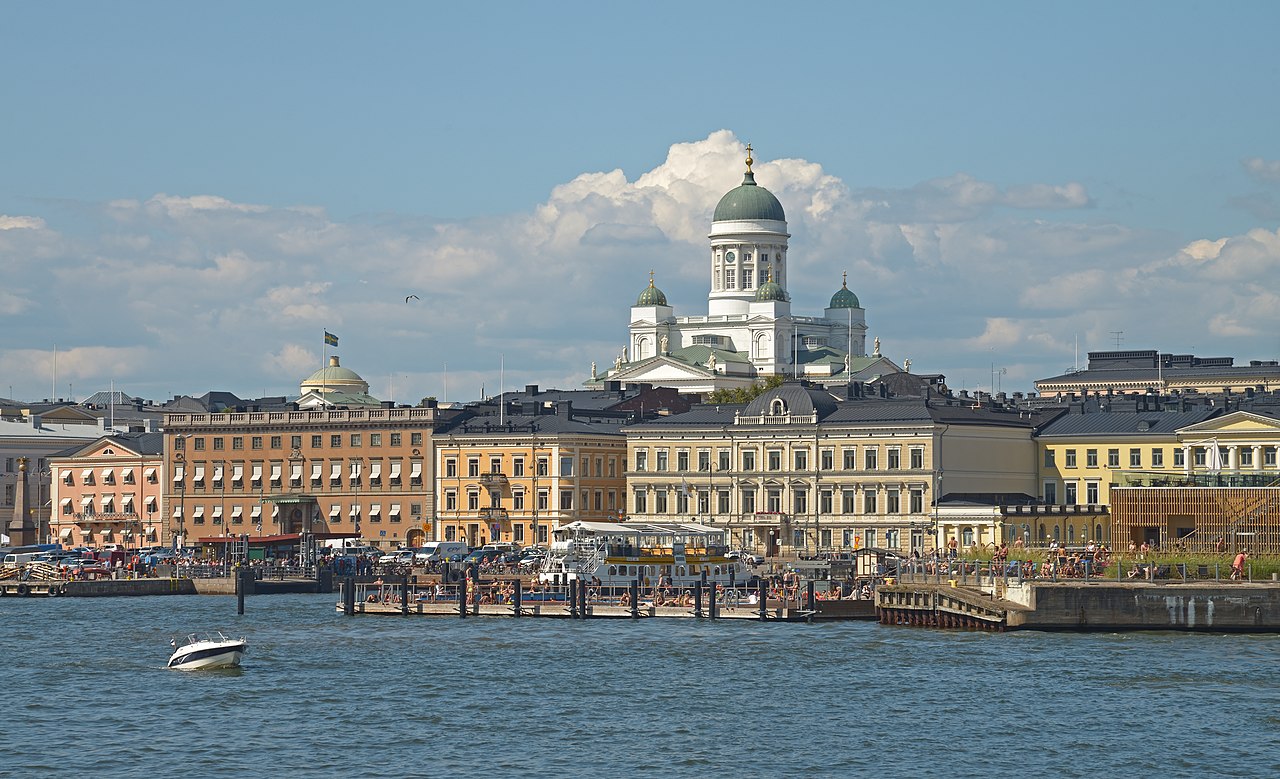
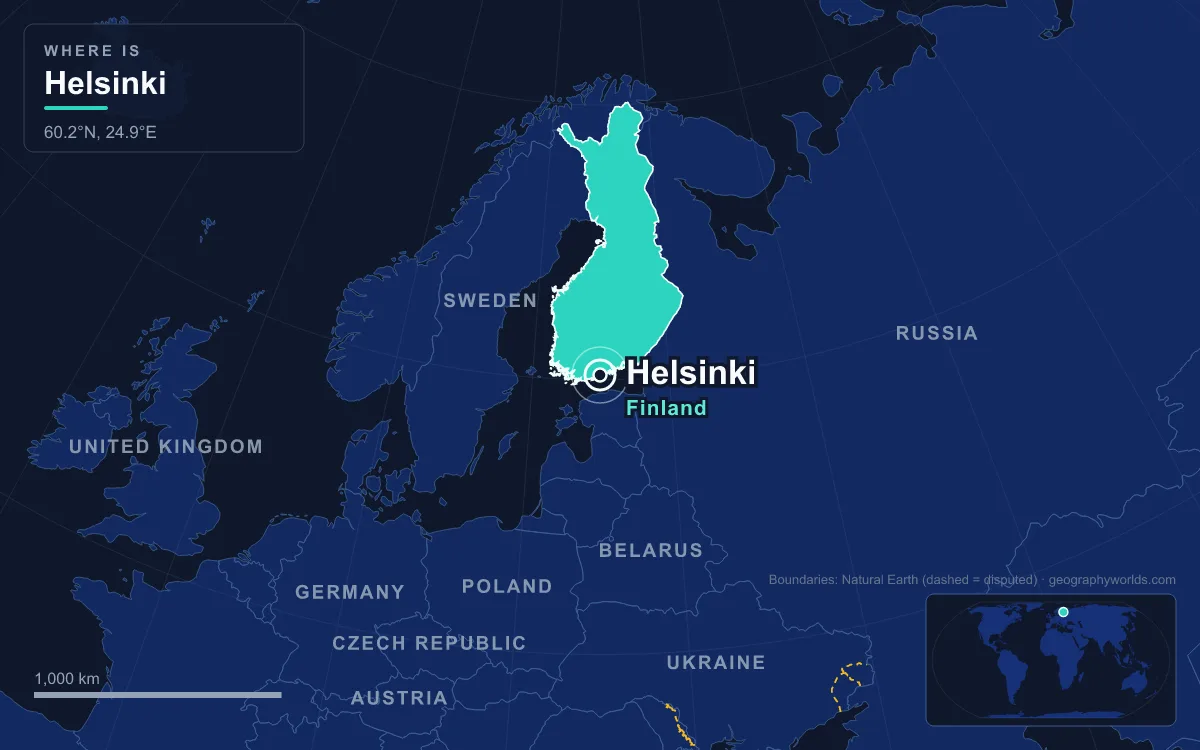
About 694,000 people live in Helsinki, the capital of Finland, according to Statistics Finland's final figures for 2024, and roughly 1.6 million live in its metropolitan area. The city sits on a peninsula and 315 islands on the northern shore of the Gulf of Finland, at 60°10′N, which makes it the northernmost capital of any European Union member state. It became the capital in 1812, when the Russian emperor moved the seat of government away from Turku. Helsinki is easiest to understand in comparisons: against its old rival Turku, against its own suburbs, against the long Finnish winter, and against Tallinn and St Petersburg across the water.
694,000 Residents and 12 Percent of Finland
By Finnish standards Helsinki is huge. It is home to about 12 percent of the population of a country of 5.7 million, and it is the largest municipality in Finland and the third largest in the Nordic countries, after Stockholm and Oslo. Its density of 3,147 people per square kilometre makes it the most densely populated city in Finland, and the inner district of Kallio reaches 16,494 per square kilometre.
Widen the frame and the numbers grow. The capital region of Helsinki, Espoo, Vantaa and Kauniainen has about 1.28 million people on 770 square kilometres, more than 20 percent of the country's population on 0.2 percent of its surface. The metropolitan area, with ten more surrounding municipalities, covers 3,697 square kilometres and holds about 1.62 million people, roughly a quarter of all Finns and some 750,000 jobs. It is the world's northernmost urban area with more than a million inhabitants. The concentration of money is stronger still: 83 of the 100 largest Finnish companies are headquartered in the metropolitan area. The city's international profile is out of proportion to its size as well: it hosted the 1952 Summer Olympics, the first summit of the Conference on Security and Co-operation in Europe in 1975, and the first World Athletics Championships in 1983.
Helsinki Versus Turku: The Capital That Moved in 1812
Helsinki is the younger city by more than three centuries. Turku, on the south-west coast, takes 1229 as its founding year and was the most important city in Finland under Swedish rule. Helsinki was founded by King Gustav I of Sweden on 12 June 1550 as a trading town called Helsingfors, meant to rival Reval, today's Tallinn, across the gulf. The king ordered the burghers of Porvoo, Raseborg, Rauma and Ulvila to move there, but the bay at the mouth of the Vantaa River was too shallow for a harbour. In 1640 Count Per Brahe moved the town to the Vironniemi peninsula by the sea, the site of today's centre.
What changed the balance was war. Russia took Finland from Sweden in 1809 and made it an autonomous grand duchy, with Turku as its capital. On 8 April 1812 Emperor Alexander I moved the capital to Helsinki, to reduce Swedish influence and bring the seat of government closer to St Petersburg. Turku kept its university until the Great Fire of Turku in 1827; after that, the Royal Academy, founded in 1640, moved to Helsinki and became the University of Helsinki. Today Turku has about 210,000 people, less than a third of Helsinki's total.
The new capital was rebuilt to look the part. The German-born architect Carl Ludvig Engel planned a neoclassical centre around Senate Square, framed by the Government Palace to the east and the main university building to the west. Helsinki Cathedral, built from 1830 to 1852 and known as St Nicholas's Church until independence in 1917, closes the square to the north. The white facades earned the city the name "White City of the North", and their resemblance to St Petersburg later made Helsinki a stand-in for Soviet cities in Cold War films such as Reds (1981) and Gorky Park (1983).

Under 1,700 People in 1700, Over 100,000 by the 1910s
For its first 250 years Helsinki barely grew. A wooden town, it burned repeatedly in the late 17th century, and by the start of the 18th its population had fallen below 1,700. The plague of 1710 killed most of the inhabitants, and when Russian troops took the town in May 1713, the retreating Swedish administration set parts of it on fire. By about 1800 it had recovered only to around 3,000 people.
Two things turned it around. From 1748 Sweden built the sea fortress of Sveaborg, now Suomenlinna, on islands off the harbour, and then came the move of the capital. The railway arrived with Finland's first line, to Hämeenlinna, opened on 17 March 1862. By 1890 Helsinki had 61,530 people, and by the 1910s it had passed 100,000. Between 1944 and 1969 the population nearly doubled again, from 275,000 to 525,600, as Finns left the countryside for the city.
Espoo's Ninefold and Vantaa's Thirteenfold Growth Next Door
In the 1960s Helsinki's growth slowed, mainly because it ran short of housing, and people began moving across the city line. The neighbours grew far faster than the capital itself. Espoo went from 22,874 people in 1950 to 244,353 in 2009, a ninefold increase, and Vantaa from 14,976 to 197,663 over the same years, thirteenfold. Espoo now has about 326,000 people and is Finland's second-largest municipality, ahead of Tampere, about 263,000, which is the largest inland city in the Nordic countries and the centre of the second-largest urban area in Finland.
The result is a capital that works as a single labour market spread over several cities. Helsinki Airport is in Vantaa, 17 kilometres north of the centre, and Aalto University is in Espoo. The metro, opened in 1982, was extended into Espoo in 2017 and 2022, and cooperation between the municipalities produced a shared transport authority, HSL. Higher housing costs have pushed commuters still further out, to towns such as Lohja, Hämeenlinna, Lahti and Porvoo. The strongest intercity tie is with Tampere, the most frequent rail service out of Helsinki Central, with more than 40 intercity departures a day as of 2026.
Finnish 73 Percent, Swedish 5 Percent and 160 Other Languages
Helsinki is officially bilingual, and for much of its history Swedish was the language of the town. At the start of the 20th century Finnish and Swedish speakers were roughly equal in number; Finnish speakers had overtaken Swedish speakers only in 1890. Today 509,486 residents, 73.4 percent, speak Finnish as their first language and 37,349, 5.4 percent, speak Swedish, concentrated in the south of the city. In the district of Ullanlinna one resident in five is a Swedish speaker, and Byholmen is the only district with a Swedish-speaking majority.
The fastest-growing group speaks neither. Foreign languages are the mother tongue of 21.2 percent of residents, and at least 160 languages are spoken in the city, led by Russian (3.1 percent), Somali (2.3), Arabic (1.7), English (1.6) and Estonian (1.3). As of 2024, 142,296 people with an immigrant background lived in Helsinki, about 21 percent of the population. The local slang reflects the older mix: stadin slangi grew up from the 1890s as a Finnish-Swedish hybrid with German and Russian borrowings, and its own word for the city, Stadi, comes from the Swedish stad, "town".
5 Hours 48 Minutes of Daylight in December, 18 Hours 57 in June
At 60 degrees north, the seasons are extreme. Around the winter solstice the day lasts 5 hours and 48 minutes and the noon sun rises just over 6 degrees above the horizon; around the summer solstice there are 18 hours and 57 minutes of daylight. The cold is milder than the latitude suggests, because the Baltic Sea and the North Atlantic Current moderate the winter: the average in January and February is about −4 °C, and temperatures below −20 °C occur only a few times a year.
The extremes are wide all the same. The city's record high is 33.2 °C, set at Kaisaniemi on 28 July 2019, and its record low is −34.3 °C, on 10 January 1987. Summer daytime highs from June to August average around 19 to 22 °C.
80 Kilometres From Tallinn, 300 From St Petersburg
Helsinki's position on the gulf is the final contrast. Tallinn in Estonia is 80 kilometres to the south, Stockholm 400 kilometres to the west and St Petersburg 300 kilometres to the east, a geography that explains both the 1550 founding against Reval and the 1812 move towards St Petersburg. The sea traffic is heavy enough that in 2017 Helsinki was rated the world's busiest passenger port.

The sea also defended the city. Suomenlinna, about 4 kilometres south-east of the centre, is spread over eight islands, six of them fortified, and was planned by Admiral Augustin Ehrensvärd on the star-fort principles of the French engineer Vauban. Much of Helsinki's own territory is water too: 60 nature reserves cover 38,640 hectares, just over half of it sea.
Those numbers add up to an unusual capital: young next to Turku, small next to Stockholm, dark in December and bright in June, and closer to Tallinn than to most Finnish cities. For the other contenders in the national ranking, see the largest cities in Finland; for the sea that shapes the city's ferries and fortress, read our guide to the Gulf of Finland; and if the daylight figures above are what you are planning around, check the best time to visit Helsinki.
Quick Facts About Helsinki
- Country: Finland
- Continent: Europe (Northern Europe)
- Country population: approximately 5.6 million
- Capital city status: Helsinki is the capital of Finland, the seat of national government, and the location of foreign embassies, parliament, and the head of state's official residence.
Frequently Asked Questions
What is the capital of Finland?
The capital of Finland is Helsinki. Helsinki is the seat of national government, hosts most foreign embassies and consulates, and is typically where the head of state and parliament are located.
What continent is Helsinki in?
Helsinki, the capital of Finland, is located in Europe, in the Northern Europe region. As Finland's capital, Helsinki serves as the country's primary connection to the broader Europen political, economic, and cultural sphere.
Why is Helsinki the capital of Finland?
Helsinki was chosen as the capital of Finland for reasons that typically combine geography, history, and politics. Capital city selections often reflect a desire for centrality (being accessible from across the country), historical importance (being a longstanding seat of government or culture), or neutrality (being acceptable to multiple regions or ethnic groups within the country). The specific reasons for Helsinki's designation are detailed in the city's history above.
What is Helsinki known for?
As the capital of Finland, Helsinki is best known for housing the country's central government institutions — parliament, presidential or royal residences, supreme court, and key ministries. It is also typically a major cultural and economic center within Finland, hosting national museums, embassies, and signature monuments. The introduction and history sections above provide detailed coverage of the city's specific notable institutions and landmarks.
Related Pages
- Finland Country Guide — full geography, climate, economy, and culture overview
- Flag of Finland — meaning, history, and design of Finland's national flag