

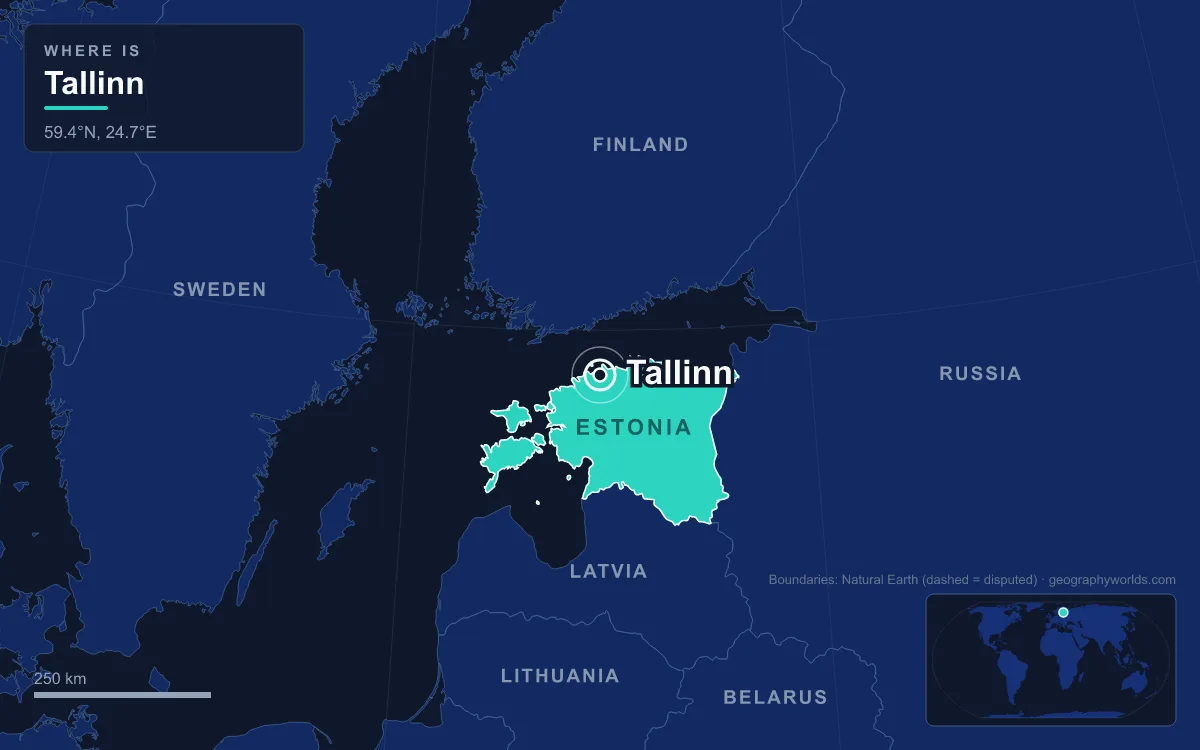
The capital of Estonia is Tallinn, a port city on a bay of the Gulf of Finland on the country's north coast, just 80 kilometres across the water from Helsinki. It had 452,563 residents in 2026, roughly a third of Estonia's population of nearly 1.4 million, and it is the country's governmental, financial and cultural centre. For most of its history the rest of Europe knew it as Reval, the northernmost member of the Hanseatic League, and its walled Old Town, one of the best-preserved medieval cities in Europe, has been a UNESCO World Heritage Site since 1997. The city makes most sense read through four threads that run through it: who ruled from its hill, where its people prayed, what its merchants traded, and how its residents live now.
Toompea Hill: Danish Crusaders, Swedish Governors and the Riigikogu
Power in Tallinn has always sat on Toompea, a limestone hill in the city centre. An Estonian stronghold stood there by around 1050, guarding a harbour on the trade route between Novgorod and western Europe. In 1219 King Valdemar II of Denmark took it during the Northern Crusades, when northern Estonia's people were among the last in Europe to be forcibly Christianised. The Danes built a castle on the site, and the Estonian phrase for it, taani linna or "Danish castle", is the most widely accepted origin of the name Tallinn. A Danish legend holds that the Dannebrog, Denmark's flag, fell from the sky during that battle, which the Danes called Lyndanisse.
The hill changed hands repeatedly. The Order of the Brethren of the Sword took the castle in 1227 and began rebuilding it; Denmark recovered it in 1237 and sold it, with the rest of its north Estonian lands, to the Teutonic Order in 1346. The knights raised the towers still visible today, including Pilsticker, Landskrone and Tall Hermann (Pikk Hermann), which stands 48 metres high. In 1561 northern Estonia passed to Sweden, whose governors turned the fortress into a ceremonial and administrative seat. In 1710, during the Great Northern War, plague-stricken Tallinn surrendered to Peter the Great's Russia, although its local institutions, the Magistracy of Reval and the Estonian Knighthood, kept their cultural and economic autonomy within the Russian Empire; the Magistracy itself was abolished only in 1889.

Independence came twice. The Estonian Declaration of Independence was proclaimed in Tallinn on 24 February 1918, and after the German occupation ended in November that year the city became the capital of a sovereign state; its international names Reval and Revel gave way to the Estonian one. The Soviet Union occupied and annexed Estonia in 1940, Nazi Germany held it from 1941 to 1944, and a Soviet air raid on 9 and 10 March 1944 killed 757 people and left 20,000 homeless. Tallinn became the capital of an independent country again on 20 August 1991. Today Toompea Castle houses the Riigikogu, Estonia's parliament, and every day at sunrise the national flag is raised on Tall Hermann to the sound of the anthem and lowered at sunset.
St Olaf's Spire and the Churches of Reval
Religion came to Tallinn by conquest and changed with each ruler. The oldest church in the city, and in mainland Estonia, is St Mary's Cathedral on Toompea, known as the Toomkirik or Dome Church. It was founded as a Roman Catholic cathedral in the 13th century after the Danish conquest, became Lutheran in 1561, and is now the seat of the Archbishop of the Estonian Evangelical Lutheran Church. It was also the only building on Toompea to survive a 17th-century fire.
Down in the Lower Town, St Olaf's Church is named after the Norwegian king Olav II Haraldsson, patron saint of seafarers, and was probably first built by Scandinavian merchants. It is first mentioned in 1267 and its tower in 1364. One medieval craftsman claimed the spire was 84 fathoms tall; read as Rhineland fathoms that would be 159 metres and would have made it the tallest building in the world, but local fathoms, and a probable height of 115 to 125 metres in 1590, are more likely. Lightning has struck the tower around ten times and the church has burned down three times. After rebuilding, its spire now stands about 124 metres, still the tallest church in Estonia. A legend names its builder Olev, who fell to his death from the top when the townspeople shouted his secret name at him. Its later history is less romantic: from 1944 to 1991 the Soviet KGB, headquartered nearby, used the spire as a radio and surveillance tower, and since 1950 the church has belonged to Baptists.
Tallinn converted to Lutheranism early in the Reformation, and St Olaf's itself kept a large, mostly German-speaking Lutheran congregation until 1939. Russian rule later added a landmark of its own. The Orthodox Alexander Nevsky Cathedral, built on Toompea between 1894 and 1900 to a design by Mikhail Preobrazhensky, went up during the Russification drive of the late 19th century. It is the city's largest domed church, its eleven bells were cast in St Petersburg, and the largest weighs about 16 tonnes. Many Estonians disliked it as a symbol of Russian rule; its demolition was planned for 1 May 1929 and then cancelled, and the debate revived after Russia's full-scale invasion of Ukraine in 2022. The Soviet years left many churches in disrepair, and the cathedral has been restored since 1991.
Hanseatic Reval: Town Hall Square, Guild Halls and Marzipan
If Toompea was where rulers lived, the Lower Town was where Tallinn made its money. Denmark granted Reval Lübeck town rights in 1248, and in 1285 it joined the Hanseatic League, the German-led alliance of merchant cities around the North and Baltic seas. Standing at the junction of trade between western Europe and Novgorod and Muscovy, it was arguably the most important medieval port on the Gulf of Finland. By the late Middle Ages about 8,000 people lived inside a wall with 66 defensive towers, which has been described as an outstanding example of German medieval fortification.
The merchants governed from Town Hall Square. A town hall with a large meeting room is first recorded in 1322, and the square reached its present length in the 1370s. The present building, 36.8 metres long with a 64-metre tower, is the oldest town hall in the Baltic Sea region and Scandinavia, and it housed the city administration until 1970. Since 1530 the weather vane on its spire has been Old Thomas (Vana Toomas), a figure of an old soldier that has become a symbol of the city.

Trade had its own brotherhoods. The Brotherhood of Blackheads, an association of ship owners, merchants and foreign traders dating from the 14th century, bought its house in 1517 and gave it a Renaissance facade in the style of the Low Countries in 1597. Russian emperors including Peter I became honorary members, and the brotherhood stayed active until 1940, when its members fled to Germany during the Soviet occupation. Nearby, the Great Guild Hall now holds the Estonian History Museum.
Some of that commerce survives on the table. Marzipan was made in Reval and Lübeck almost at the same time in the Middle Ages, and in 1695 it appeared as a medicine on the price list of the Town Hall Pharmacy. In 1806 the Swiss confectioner Lorenz Caviezel opened a shop on Pikk Street that Georg Stude bought in 1864 and that still trades as the Maiasmokk cafe. The port's other staple is vürtsikilu, sprats pickled with black pepper, allspice and cloves. The harbour kept its importance through 19th-century industrialisation, and the city still lives off the sea: cruise ferries make up to eight crossings a day to Helsinki, a trip of two to three and a half hours.
Lasnamäe, Telliskivi and the Song Festival Grounds
Daily life in modern Tallinn is shaped by the Soviet decades. Before the Second World War ethnic Estonians made up more than 80 percent of the city. The Soviet authorities then moved in workers from Russia and other republics and built whole districts to house them, among them Mustamäe, Väike-Õismäe and, above all, Lasnamäe, a plateau of 5- to 16-storey panel blocks put up from the 1970s. Lasnamäe has been the most populous district since the 1980s, with about 119,000 residents, most of them Russian-speaking. By 2011 the city was almost evenly split: 50.1 percent of residents spoke Estonian as a first language and 46.7 percent Russian. In 2022 ethnic Estonians made up just over 53 percent, and most Soviet-era arrivals now hold Estonian citizenship.
The city's collective voice is heard at the Song Festival Grounds (Lauluväljak) in Kadriorg. The Estonian Song Festival was founded in 1869, when the country was still a Russian province, and is now held every five years in July alongside a dance festival; its joint choir has numbered more than 30,000 singers before 80,000 listeners. The present arched stage was built in 1959 and first used for the festival of 1960. In 1988 these grounds became the stage of the Singing Revolution, and that September a reported record of 300,000 people, more than a quarter of all Estonians, gathered in Tallinn to sing songs banned under Soviet rule. The same Kadriorg district holds Kadriorg Palace, built from 1718 to 1725 for Peter the Great, who had bought a small manor nearby for his wife Catherine after his army took the city; it is now an art museum, with Kumu, home to the country's largest collection of modern and contemporary art, nearby.
The newer Tallinn shows up in its offices. More than half of Estonia's GDP is produced in the city, and in 2012 it had more start-ups per head than any other European capital. Skype and Bolt were founded here, and the city hosts the European Union's IT agency and the NATO Cooperative Cyber Defence Centre of Excellence. The Telliskivi Creative City area is home to Fotografiska Tallinn, an international photography institution. Tallinn was a European Capital of Culture in 2011 and European Green Capital for 2023, and it runs the Black Nights Film Festival each winter, when December sunshine averages just 20.7 hours for the whole month. For the country around it, see our Estonia country guide; for the sea that made Reval rich, our guide to the Baltic Sea; and for the Hanseatic city 300 kilometres to the south, our profile of Riga.
Quick Facts About Tallinn
- Country: Estonia
- Continent: Europe (Northern Europe)
- Country population: approximately 1.3 million
- Capital city status: Tallinn is the capital of Estonia, the seat of national government, and the location of foreign embassies, parliament, and the head of state's official residence.
Frequently Asked Questions
What is the capital of Estonia?
The capital of Estonia is Tallinn. Tallinn is the seat of national government, hosts most foreign embassies and consulates, and is typically where the head of state and parliament are located.
What continent is Tallinn in?
Tallinn, the capital of Estonia, is located in Europe, in the Northern Europe region. As Estonia's capital, Tallinn serves as the country's primary connection to the broader Europen political, economic, and cultural sphere.
Why is Tallinn the capital of Estonia?
Tallinn was chosen as the capital of Estonia for reasons that typically combine geography, history, and politics. Capital city selections often reflect a desire for centrality (being accessible from across the country), historical importance (being a longstanding seat of government or culture), or neutrality (being acceptable to multiple regions or ethnic groups within the country). The specific reasons for Tallinn's designation are detailed in the city's history above.
What is Tallinn known for?
As the capital of Estonia, Tallinn is best known for housing the country's central government institutions — parliament, presidential or royal residences, supreme court, and key ministries. It is also typically a major cultural and economic center within Estonia, hosting national museums, embassies, and signature monuments. The introduction and history sections above provide detailed coverage of the city's specific notable institutions and landmarks.
Related Pages
- Estonia Country Guide — full geography, climate, economy, and culture overview
- Flag of Estonia — meaning, history, and design of Estonia's national flag