
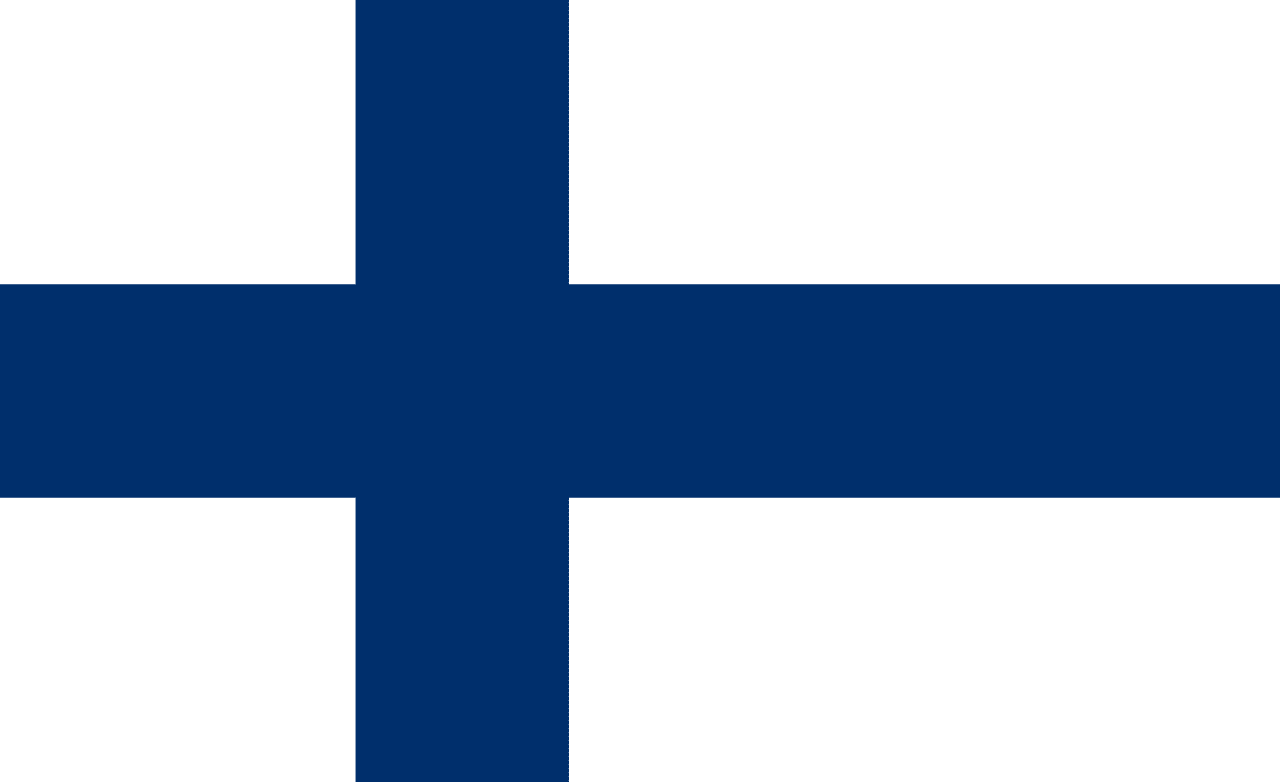

Few national emblems capture the spirit of a landscape as plainly as the flag of Finland. A clean blue cross laid across a field of white, it reads almost like a map of the country itself: thousands of lakes glinting beneath an enormous northern sky, framed by snow that lingers for half the year. There is nothing crowded or fussy about it. The design says everything it needs to say with two colors and a single geometric idea, and that restraint is exactly what has made it one of the most recognizable banners in Europe.
Officially adopted in 1918, the year Finland steadied itself as a newly independent nation, the flag is known in Finnish as the siniristilippu, literally the "blue cross flag." This article looks at where those colors come from, how the cross is arranged, the path the flag took to become official, how it relates to its Nordic neighbors, and the role it plays in Finnish life today.
Blue and White: A Country Painted in Two Colors
The Finnish flag uses just two colors, and each carries a meaning rooted in the physical country. The blue is said to represent Finland's countless lakes and the waterways that thread through the interior. The white stands for the snow that blankets the land through the long winters, as well as the bright Nordic summer nights. Together they form a portrait of place rather than a heraldic abstraction.
One detail Finns are particular about is the precise shade. The blue is not navy and not royal but a clear, luminous sky blue, often described as the color of a Finnish lake reflecting a cloudless day. Choosing this lighter blue was a deliberate aesthetic decision, and it distinguishes the Finnish banner from the deeper blues used by some other nations. The pairing of crisp white with that airy blue gives the flag a cool, calm, almost luminous quality that feels distinctly northern.
The Nordic Cross and the Geometry of the Design
The structure of the flag is a Nordic cross, the off-center cross shared across Scandinavia. A horizontal blue band and a vertical blue band intersect, and crucially the vertical arm sits closer to the hoist, the edge nearest the flagpole, rather than in the middle. This shifts the crossing point toward the left, leaving a larger field on the fly side.
The result is a white rectangle divided into four panels by the blue cross. Because the cross extends fully to all four edges of the flag, it never floats inside the field but anchors the entire design. The visual logic is simple enough that a child can draw it, yet the off-center placement keeps it from feeling static. It is a design that works equally well snapping in the wind atop a summer cottage or printed at thumbnail size on a sports jersey.
From Idea to Independence: How the Flag Took Shape
Finland's flag was born out of a longer search for national symbols. Through the nineteenth century, while Finland was an autonomous Grand Duchy under the Russian Empire, writers, artists, and patriots debated what an independent Finnish banner ought to look like. Blue and white had circulated as patriotic colors for decades, tied in the popular imagination to the nation's lakes and snows, so when the moment came they were the natural choice.
That moment arrived with independence. After Finland broke from Russia, the young state needed an official flag, and in 1918 the blue Nordic cross on white was confirmed as the national banner. Adopting it at the very founding of the republic gave the design an unmistakable association with sovereignty and self-determination. Rather than inheriting a flag from an older regime, Finland chose a fresh emblem that announced a new chapter, and the basic design has remained stable ever since.
A Family of Crosses: Finland Among the Nordic Flags
The Finnish flag belongs to one of the most cohesive flag families in the world. Denmark, Sweden, Norway, Iceland, and Finland all fly the off-center Nordic cross, a shared template that visually binds the region together. To an outside eye these banners can blur into one another, so it helps to know what sets Finland's apart.
The clearest distinction is the palette. Sweden's cross is yellow on blue; Denmark's is white on red; Norway and Iceland use red, white, and blue together. Finland is the only one of the group to pair a blue cross with a plain white field, which makes it both the lightest and the coolest-looking flag in the family. Where its neighbors lean on warm reds and golds, Finland keeps to the quiet blues and whites of water and snow. The cross itself signals kinship with the broader Nordic world, while the specific colors keep the flag unmistakably Finnish. Anyone curious about the country behind the banner can explore more in our finland country guide.
What the Flag Means to Finns
For Finland, the flag is bound up with a national story of perseverance and quiet pride. A nation that secured its independence and then defended it through difficult decades tends to invest its emblems with real emotional weight, and the blue cross is no exception. It appears on public buildings, is raised at homes and summer cottages on flag days, and is treated with genuine respect in everyday ceremony.
Part of the flag's appeal is how naturally it reflects the Finnish relationship with nature. This is a country defined by its lakes, forests, and seasons, and a banner that literally encodes water and snow speaks to that identity in a way few national symbols manage. The flag does not depict a crown, an eagle, or a coat of arms; it depicts the land. That grounded, unpretentious symbolism suits a culture that prizes modesty and a deep connection to the outdoors.
The Flag in Modern Finland
Today the siniristilippu is woven into the rhythm of Finnish life. It flies on official flag days marking events such as Midsummer, Independence Day in December, and other national occasions, when raising and lowering the flag follows established custom. Citizens hoist it at cottages and homes, and on long summer evenings a flag against the pale midnight sky is a familiar northern sight.
Internationally, the flag is most visible in sport. Finnish fans wave it at ice hockey championships, in cross-country skiing and other winter events, and at the Olympic Games, where the blue cross has become shorthand for the country's outsized success in cold-weather competition. Beyond sport, the colors appear in branding, design, and tourism imagery, reinforcing an image of Finland as clean, calm, and close to nature. Continent-wise, Finland sits in northern Europe, and its flag is among the most instantly recognizable on that part of the map.
Quick Facts About the Finnish Flag
- The flag features a blue Nordic cross on a white field, with the cross set off-center toward the hoist.
- It was officially adopted in 1918, the year Finland established itself as an independent republic.
- The blue stands for the country's lakes and the white for its snow.
- The blue is specifically a sky blue, lighter than the deep blues of many other national flags.
- Finland's banner shares the Nordic cross with Sweden, Norway, Denmark, and Iceland but is the only one combining a blue cross with a white field.
- In Finnish the flag is called the siniristilippu, the "blue cross flag."
Frequently Asked Questions
When was the flag of Finland adopted?
The Finnish flag was adopted in 1918, the same period in which Finland secured its independence from Russia. Establishing the blue cross banner at the founding of the new republic tied it directly to the nation's sovereignty, and the core design has stayed consistent ever since.
What do the colors of the Finnish flag mean?
The two colors are read as a portrait of the Finnish landscape. The blue represents the country's many lakes and waterways, while the white represents the snow that covers the land in winter. The blue is a clear sky blue rather than a dark navy, chosen to evoke water and the northern sky.
What continent is Finland on?
Finland is located in northern Europe. It sits in the region known as the Nordic countries, alongside Sweden, Norway, Denmark, and Iceland, which is why its flag follows the shared Nordic cross pattern common across that part of Europe.
How is the Finnish flag different from other Nordic flags?
All the Nordic flags use an off-center cross, but each has its own color scheme. Finland is the only one to combine a blue cross with a plain white field, giving it the lightest, coolest appearance of the group. Sweden uses yellow on blue, Denmark white on red, and Norway and Iceland blend red, white, and blue, so the blue-on-white palette is what immediately marks a flag as Finnish.